Showing posts with label Women. Show all posts

Tuesday, March 01, 2016

Checking Your Religion Before Boarding the Plane

A few years ago I boarded an El Al airplane at Ben Gurion Airport in Israel headed back to the United States. I had a lot running through my mind. Earlier that morning I watched as two female colleagues of mine were arrested at the Western Wall for the odd crime of praying while wearing tefillin (phylacteries). While those two women rabbis were being detained at the police station in the Old City of Jerusalem I sat in a conference room with a dozen other colleagues listening to the former Soviet dissident Natan Sharansky explain how he hoped to solve the issue of religious and gender discrimination at the Western Wall plaza.

As I settled into my seat on the plane and readied myself for the long flight home, I was tapped on my shoulder by a Haredi Orthodox man and asked if I'd give up my seat so he could sit there and not be forced to sit next to a woman. On any other day I likely would have explained to this man that I had already spent time and energy procuring my bulkhead seat with extra leg room (I'm tall) and was already situated in my assigned seat so I would not be able to acquiesce to his request. On this particular day, however, my denial was based on principle. His religious views would not trump my right to my assigned seat. The man then asked the woman next to me to give up her seat so he could sit next to me and avoid violating his religious convictions of sitting next to a woman for a prolonged period of time. My seatmate simply looked at him and said, "Absolutely not!"

The practice of seat switching on airplanes to accommodate the Haredi men who won't sit next to the opposite sex has gotten out of hand. After my mother's flight landed in Israel a couple of weeks ago, I called her to check in. When I inquired about her flight she lamented that it was very late taking off from Newark because of a frustrating game of "musical chairs" in which the flight attendants had to orchestrate the seat switching fiasco so families who wanted to sit together were still able to do so after the Haredi men refused to sit in their assigned seats.


Unfortunately, it's not just about the Haredi men causing turmoil on airplanes over sitting next to women. There has also been unrest in the friendly skies when it comes to what some ultra-Orthodox Jews consider immodest movies. Last week a passenger from Beit Shemesh reportedly damaged two viewing screens and attacked the cabin crew during his rampage on an El Al flight. He was angered that the airline was showing a movie that he felt was indecent based on his religious views.


Wednesday, December 30, 2015

The Dividing Wall of Netanyahu's Legacy

In the 1970s and 1980s, if someone referenced "The Wall" they were likely referring to the Berlin Wall (or the Pink Floyd album). Today, mention of "The Wall" likely refers to the Western Wall (the Kotel) in Jerusalem. While walls of the security variety have been much discussed lately -- from Israel's security fence to the billion dollar one Donald Trump wants to erect in America to keep out Mexicans -- the Kotel's gender divisions have been a divisive issue for the Jewish people for a very long time.

An article on the Jerusalem Post website recently ran the headline:  "Netanyahu agrees with haredim not to allow Women of the Wall to read Torah at Western Wall." That decision by the Prime Minister of Israel might be chalked up to the status quo and considered not very newsworthy as 2015 comes to a close, however, it is contradictory to his previous promise. As Women of the Wall officially noted, “Apparently when Netanyahu spoke of ‘all’ Jews in November 2015, he forgot that women make up half of all Jews."  The group was referencing Netanyahu's statement at the Jewish Federations of North America General Assembly last month.

Kotel - Women Praying - Jerusalem Israel

In response to this negated promise, I don't think any Jews will offer up the rallying cry of "Mr. Netanyahu: Tear down that wall," but the ongoing unfairness at the Kotel is sure to leave many non-Orthodox Jews feeling that the Kotel no longer represents a religious or spiritual place for us. On my first visit to the Kotel I felt enormously spiritual while touching the ancient walls and offering a personal prayer for my dying grandfather. That was over 21 years ago, and I've returned to Israel many times since then. With each successive visit to the Kotel, I feel less and less connected to this ancient destination. This decline of spirituality and connection at the Kotel has been triggered specifically by the treatment of women at this holy site, but more generally by the way the Israeli government has allowed the Kotel to be controlled by the haredi Orthodox Jews. Non-haredi Jews feel marginalized at the Kotel and have been made to feel like strangers there -- or at the very least like guests in an ultra-Orthodox synagogue. The Kotel should be a holy site to all the Jewish people.


Thursday, February 05, 2015

Michelle Obama's Dress in Saudi Arabia

When leading teen trips in Israel, there was always that first day in the Old City of Jerusalem. On the night before that day, I would often make an announcement on the bus as we headed back to our hotel or youth hostel. Prepping the teens for our exciting day in the Old City, I would remind the young women on the bus that they should dress appropriately making sure to cover their arms and wearing a skirt so as not to offend any of the Ultra-Orthodox near the Kotel (Western Wall) or on our walk around the neighborhoods of the Old City.

There would always be a couple teens who would challenge what I said, asking why we would have to adjust our normal attire for the sake of someone else's beliefs. Some of the teen girls would voice their opposition to the unfairness that the boys could still wear shorts and tank tops in the hot Jerusalem sun the next day, but the girls had to wear long skirts. The compromise was usually that the girls could wear shorts and just keep their skirts in their backpack so they could pull them out and cover up when we entered the Old City. It was a difficult rule for me to defend, but I explained that it was our way of showing respect... not to mention I didn't want to have to deal with the Israeli police who would let me know if any of the teens in my group weren't dressed appropriately for the Kotel plaza.

Some Saudis criticized Michelle Obama's decision not to cover her head on her Saudi visit


I thought of those days in Israel when I saw the news footage of First Lady Michelle Obama’s decision not to cover her head in a scarf in Saudi Arabia, when visiting there for the funeral of King Abdullah. She certainly wasn't the only First Lady to eschew this policy -- Hillary Clinton and Laura Bush also didn't wear head scarves during trips to Saudi Arabia. Mrs. Obama's face was blurred out by Saudi state TV and the new king didn't acknowledge her when he greeted President Obama.


Monday, February 02, 2015

The NFL and Its Ethics Problem

The commissioners of the major professional sports leagues have been in the news quite a bit lately. Adam Silver, the NBA commissioner who replaced David Stern a year ago, has received high marks for his first year in office. The biggest items he's currently dealing with are the idea to add four new basketball franchises in Europe and whether to expand the NBA All-Star rosters. NHL commissioner Gary Bettman, who is routinely booed at the NHL All-Star Game and when presenting the Stanley Cup, has actually done a great job of diminishing the role of fighting in the league and has significantly grown the NHL's annual revenue from increased ticket sales, TV contracts and apparel sales. Rob Manfred, the new commissioner of Major League Baseball who replaced Bud Selig, just started his new post and his biggest controversy to date is whether to ban infield defensive shifts.

That brings us to Roger Goodell, the NFL commissioner. It seems that when Goodell isn't dealing with the off-season arrests of his pro football players for everything from drugs and rape to weapons and drunk driving, he's embattled in cheating scandals and lawsuits of former players who barely remember their playing days due to their many concussions.

Roger Goodell, NFL Commissioner and Ethics Problem

The NFL's ethics problem isn't new. Eleven years ago, back in February 2004 after Janet Jackson revealed too much during the Super Bowl halftime show, I wrote on this blog that, "So many people are citing this year's Super Bowl as proof of a complete absence of dignity and moral behavior in our society." I then quoted New Jersey Jewish News Editor Andrew Silow-Carroll's argument about the Super Bowl. He wrote, "I hate to sound like a prude, but this year’s Super Bowl was an assault of tasteless, inappropriate, and uncomfortable images — and we missed the half-time show! Like most viewers, I used to look forward to the Super Bowl commercials. But that was before advertisers seemed to decide that the country’s most powerful economic cohort lives in frat houses."

Wednesday, January 14, 2015

Haredi Newspapers Again Scrub Women From Iconic Photos

The Haredi newspapers are at it again.  Back in 2011 I wrote several blog posts (here on this blog, in the Huffington Post, and in The Jewish Week) about how a couple of Haredi Jewish newspapers had used Photoshop to remove women from iconic photos. Back then it was the Ultra-Orthodox Hasidic Jewish newspaper Der Tzitung removing Hillary Clinton from the famous photo of when Osama Bin Laden had been captured. My article in The Jewish Week was even shown on The Colbert Report when Stephen Colbert discussed the topic.

Now, the Haredi Israeli newspaper HaMevaser has digitally altered the now iconic photo of the 44 world leaders who marched in Paris on Sunday to express solidarity with France. The paper removed German Chancellor Angela Merkel, Paris Mayor Anne Hidalgo and EU foreign affairs and security chief Frederica Mogherini. Another female leader, Danish Prime Minister Helle Thorning-Schmidt, was cropped out of the photo (one of her hands remains visible in the photo). The Israeli news site Walla.com first noticed the Photoshop job.

The iconic photo of world leaders at the march in Paris after being altered to remove the women
The iconic photo of world leaders at the march in Paris after being altered to remove the women.

The iconic photo of world leaders at the march in Paris before being altered
The iconic photo of world leaders at the march in Paris before being altered.


Monday, February 11, 2013

The Crime of Wearing a Tallit

Empathy is never easy. As a man, I confess that I have struggled to be empathetic to the cause of the Women of the Wall (Nashot HaKotel). This group of women has been coming to the Kotel Hama'arivi (Western Wall) in the Old City of Jerusalem for close to a quarter century to pray in protest of the religious freedom they lack.

From thousands of miles away I have followed their plight after each Rosh Chodesh (new month) prayer service they conduct in the relatively small women's section of the Kotel. In the past year or so I've read about the women who are detained or arrested for having the nerve to wear a tallit (prayer shawl) at the Kotel, which according to Israel law is to be treated as an Orthodox synagogue. While I took interest in their civil disobedience and was supportive of their efforts, I felt they were too focused on the Western Wall when in fact they were being allowed to hold their prayer services (women only or mixed) at the Southern Wall (Robinson's Arch) which was historically more significant anyway.

Our group of male rabbis before heading down to the Kotel plaza

And then all that changed this morning. Together with about a dozen of my male rabbinic colleagues we woke up well before dawn and walked from our Jerusalem hotel to the Old City. I wrapped myself in my tallit, wound my tefillin (phylacteries) around my left arm and on my head, and joined my colleagues at the mechitza (dividing wall) next to the women's section. Rather than holding our own separate service we joined the women in their prayers. Several of the women proudly wore tallitot and I even saw one woman wearing tefillin. It was exhilarating to watch the women begin to spontaneously dance during Hallel, the joyous, musical psalms for Rosh Chodesh.

Conservative Rabbis Robyn Fryer Bodzin and Debra Cantor at the Kotel 

Friday, June 29, 2012

Domestic Violence is Real (Chukat)

In this week’s parsha, Chukat, Moses is once again feeling the stress of leadership. Tired and quickly losing hope following the death of his sister Miriam, the Israelites complain to Moses that they would have rather died in Egypt. They go so far as to wish they had died a horrible death along with those punished for joining Korach’s rebellion. They grumble that they were happier during their slave years in Egypt, where at least they had certain assurances compared to their current nomadic experience. They protest that they have been brought to a wretched place with no good food to eat or water to drink.

Thursday, June 14, 2012

Michigan Rep. Lisa Brown Talks About Her Kosher Kitchen and Her Vagina on House Floor

The title of this blog post would seem odd unless you are familiar with Lisa Brown's speech on the floor of the Michigan House of Representatives yesterday. Somehow Brown, a State Representative from West Bloomfield, Michigan, managed to segue from a personal account of her kosher observance at home to mention that her vagina was not to be a topic discussed by her congressional colleagues.

For mentioning the word "vagina," Brown was blocked from speaking on the state House floor today as punishment. Her speech yesterday was addressing a controversial bill that would have further regulated abortions in Michigan. At the end of her speech, Brown said, "Finally Mr. Speaker, I'm flattered that you’re all so interested in my vagina, but 'no' means 'no.'"

Monday, April 23, 2012

Hamas Chief Cool With Women Rabbis

One of the most common questions I get from Orthodox Jews is how I can defend the Conservative movement's decision (from 1983) to ordain women as rabbis. I was too young to be a part of the debate concerning women's ordination in the late 70s and early 80s, but from what I've read it was a very tense time at the Jewish Theological Seminary where students and faculty were split on the issue.

It has now been close to thirty years since women began studying for ordination in Conservative Judaism. Within the Conservative movement, women rabbis have become commonplace and it is no longer an issue for the majority of Conservative congregations. The conversation has shifted from a halachic nature (Can a woman serve as a rabbi according to Jewish law?) to a more social nature (Are women rabbis treated fairly in the rabbinate?).

Truthfully, I never understood how women rabbis are problematic from a Jewish legal standpoint since there's no problem with women serving as teachers, which is the main function of a rabbi. However, in the Orthodox world, the issue of women rabbis is still in its infancy with a minority of liberal Orthodox leaders like Rabbi Avi Weiss advocating for female rabbinic ordination. The first woman to be ordained by Rabbi Weiss, Rabba Sara Hurwitz, has been successful in her rabbinate but is far from being accepted by most Orthodox Jews.


Over the weekend, I read of support for women rabbis from a most unlikely source. In fact, I did a double take when I read the Jewish Daily Forward's title for this article: "Hamas Chief on 'Noble' Women Rabbis". Did the leader of Hamas, a known terrorist organization, really come out in favor of the ordination of women as rabbis and call women rabbis "noble"?

It turns out that the Jewish Daily Forward sent the husband ("Rebbetzman"?) of Rabbi Diane Cohler-Esses to Egypt to interview Hamas chief Mousa Abu Marzook over the course of two days before Passover earlier this month. This could have been a great story (Dayenu!) if it were only about a Jewish journalist in Egypt meeting face-to-face with the ruler of a foreign oppressor and trying to get out of Egypt before the holiday commemorating freedom from Egyptian bondage.


But the story gets much better. Journalist Larry Cohler-Esses is married to Rabbi Diane Cohler-Esses, a Conservative rabbi who was ordained from the Jewish Theological Seminary in 1995 and is the first woman from the Syrian Jewish community to become a rabbi (and the first and only person (male or female) from her community to become a non-Orthodox rabbi. She had to give her husband permission to fly to Egypt in the days before Passover to interview the Hamas leader. He was concerned about leaving home during the week of Passover preparation. She flippantly told her husband that he wasn't much help anyway so he should go to Egypt.

In Egypt, during the two-day interview the two men discussed Passover in the 21st century:

Abu Marzook could not believe I was leaving Cairo so fast, or understand why I'd end up divorced if I didn’t. I explained about the Seder, and about Passover, when the Jews had to…well, leave Egypt really fast. He said, "But that was 4,000 years ago when the Pharaoh was trying to kill the Jews. No one’s trying to kill you now."

"Actually," I said, “kind of, you guys are." And we were off on what ended up being a five-and-a-half hour discussion over those two days.

Surprisingly, what Mousa Abu Marzook was most fascinated with was his interviewer's rabbi wife. When Cohler-Esses told the Hamas leader that his wife is a rabbi, Abu Marzook was astounded and asked, "There are women rabbis?" he asked.

Cohler-Esses explained to Abu Marzook that about one-half of all rabbinic students in the liberal American seminaries are actually women. He then explained his wife's personal struggle in becoming a rabbi because of her roots in the Syrian Jewish community. The Hamas leader, whose Muslim religious beliefs treat women as second-class citizens, seemed dumbfounded that she hasn't been accepted by her community. "She's done nothing wrong," he said. "What she’s done is noble."

Obviously, the issue of women rabbis was only a side conversation in a long and serious interview by Cohler-Esses, who took a small dose of criticism by some for even meeting with a member of Hamas. But this story is amazing. Who would have ever thought that the most vocal proponent of women's rabbinical ordination in the Orthodox movement might just be the leader of Hamas?

Sunday, December 18, 2011

Jewish Dolls for Jewish Girls

For generations Jewish girls collected and played with their Barbie Dolls. Yes, both Barbie and Ken looked quite Aryan but I don't believe many little Jewish girls were complaining about their dolls' non-Semitic looks. Now, all of a sudden, there is a plethora of very Jewish looking dolls on the market. I know this because I was escorted through the American Girl Place in Chicago this past August by my own little Jewish doll. She grabbed me by the hand and dragged (yes, dragged) me past dozens of dolls to show me the elaborate display of American Girl's answer to religious pluralism. And that's when I met Rebecca Rubin for the first time.


Rebecca Rubin is not a stereotypical Jewish girl. At least not from this century! She's a cute little brunette growing up in New York City in 1914 (think Fievel from "American Tale" but a little girl instead of a mouse). Rebecca Rubin now lives with our family. We've adopted her, but she's maintained her Rubin sir name and Lower East Side Depression-era attire.

As if Rebecca Rubin doesn't look quintessentially Jewish enough, my daughter can beJEWel her even more until this doll has been tricked out with the Jewy-ist accoutrements imaginable. For $68 (that's not a typo), Rebecca can enjoy a beautiful Shabbat with "The Rebecca Rubin Sabbath Set." (For much less than $68 I can feed my family a delicious Shabbat dinner, complete with brisket and wine.) The Sabbath set is advertised as featuring "everything Rebecca's family needs to celebrate the Sabbath: A Russian samovar and tray for heating water and serving tea, a tea canister and a ceramic teapot, two glasses, pretend hallah bread and a scalloped cloth, a pair of Sabbath candles that the women in Rebecca’s family 'light' before sundown, and two blue candlesticks that were a gift to Rebecca from Mr. Rossi." Based on the price of the set, I just assumed those candlesticks from Mr. Rossi were real silver and that I wasn't getting ripped off too badly.

The Rebecca Rubin doll sells for $100. With all of her hyper-Jewish accessories, figure the total investment will be around $18,000 (and that's before Rebecca Rubin even starts day school).

If the Rebecca Rubin doll is too Old World Jewish for your daughter's taste then there's a whole crop of more modern Jewish dolls on the market. I learned this from an email I received this morning from the Jewish version of Groupon called JDeal, which is offering Gali Girls at a 37% discount today. Not only are these Jewish dolls less expensive than Rebecca Rubin, their less expensive than her candlesticks!


Advertised as "Learn and play the Jewish way! Gali Girls gives young Jewish girls an opportunity to bring positive Jewish values into their doll play, and create a connection between the contemporary Jewish girl and her heritage. While the majority of dolls in today's market focus on fashion and makeup, Gali Girls reinforces the positive Jewish values that have kept the Jewish people alive and growing for 5000+ years."

Based on the description, it looks like each of the Gali Girl dolls even comes with a Shabbat kit (in addition to a Jewish star bracelet for herself and her new owner, and a Hebrew/English name birth certificate). Not only that, but the Gali Girl dolls' clothing is compatible with American Girl dolls. And if your daughter still wants her doll to have the nostalgic immigrant look of Rebecca Rubin, there are Gali Girls options like Shoshana who lives in colonial New York.


If you're looking for something more feminist and egalitarian for your daughter than either the Rebecca Rubin American Girl doll or the collection of Gali Girl dolls, might I suggest this post-modern religious Barbie doll created by Jen Taylor Friedman, a Torah scribe (yes, a female Torah scribe!) in New York. The Tefillin Barbie Doll can be purchased on her website and comes in various options including a computer engineer Barbie Doll wearing a tallit and tefillin. A Mattel Barbie with tallit, tefillin and book from the Talmud sells for $130 and Torah scrolls are an additional $40. If your daughter doesn't want the standard looking blonde Barbie, you can send Taylor Friedman any Barbie Doll and she will wrap her in the traditional Jewish garb.

All I can say is, "Barbie... You've come a long way baby!"


Monday, November 21, 2011

Sarah Silverman on Being Jewish

This year I've given a handful of presentations on the topic of Jewish Humor. I talk about the Jewish comedians who have been making people laugh over the past sixty plus years. I show video clips of the legends of Jewish comedy from Sid Caesar, Jack Benny and Milton Berle to Lenny Bruce, Woody Allen and Andy Kaufman. I also talk about more modern Jewish comics like Jerry Seinfeld, Adam Sandler, Richard Lewis and Seth Rogen.

There aren't many female Jewish comedians in my presentation. I mention Sophie Tucker as the first major Jewish comic for her vaudeville performances. Of course I talk about the legendary Gilda Radner, who grew up in Detroit and attended the University of Michigan in Ann Arbor before becoming famous on Saturday Night Live. I also mention that over the years there have been several female Jewish comedians like Joan Rivers, Elaine Boosler, Rita Rudner, Roseanne Barr, Fran Drescher, Judy Gold, Susie Essman, and Sandra Bernhard. None of these female comedians however elicit the response I get when I talk about Sarah Silverman. People love Sarah Silverman (even if they're uncomfortable when they laugh at her jokes).

With Rita Rudner after a performance in Las Vegas
Last week's NY Times article by Jason Zinoman hit the nail on the head when it highlighted Sarah Silverman's comedy as following in the tradition of Lenny Bruce and George Carlin. Silverman's willingness to break the taste-taboo ceiling, as Zinoman put it, has led to her finding stand-up success in ways her female comedian forebears never did. Zinoman writes,

Comics like Joan Rivers, Roseanne Barr and Sandra Bernhard were trailblazers, but if you had to pinpoint one joke as a breakthrough for this new generation of female comedians, it might be this one: “I was raped by a doctor, which is so bittersweet for a Jewish girl.” When I saw Sarah Silverman deliver that signature one-liner in a downtown theater almost a decade ago, the audience exploded with laughter followed by groans. Then came the anxious chuckles whose subtext seemed to be: I can’t believe I laughed at that joke. 

Sarah Silverman's comedy is very Jewish and she pushes the boundaries like no other female comedian today (Whitney Cummings comes close, but she's been heavily influenced by Silverman). Not since Lenny Bruce's shtick about the difference between the Jewish God (in a mezuzah on the doorpost) and the Christian God (on a cross and in movies) has a stand-up comic been able to make theology so funny in such a provocative way. Her movie "Sarah Silverman: Jesus is Magic" riffed on religion in a way that oddly seemed to be both offensive and hilarious at the same time.


Sarah Silverman with ex-boyfriend Jimmy Kimmel and
her sister Rabbi Susan Silverman and brother-in-law Yossi Abramowitz

Sarah Silverman's influence in the 2008 presidential election with "The Great Schlep" video was nothing short of brilliant when she encouraged young Jewish liberals to travel to Florida to convince their grandparents that it was okay to vote for Barack Obama even though he's black. She has also promoted social justice work and eradicating worldwide hunger with her contribution to the American Jewish World Service video and her own "Sell the Vatican, Feed the World" video. And of course her famous video with Matt Damon was well... you have to watch that one for yourself.

Sarah Silverman and her sister Rabbi Susan Silverman discuss their Jewish identity

I've always wanted to hear Sarah Silverman talk about her Jewish identity, or as she calls it her "Jewy-ness." A couple weeks ago Sarah and her sister, Reform Rabbi Susan Silverman, were interviewed together at an event at the Elie Wiesel Center for Judaic Studies at Boston University. Here's the video of the interview (the first 7 minutes are introduction):

Watch this video on YouTube

Thursday, November 17, 2011

Branding Israel Through Technology

This is my recent "Jews in the Digital Age" column for the Detroit Jewish News:

Sally Whittle is a blogger in Lancashire, England. Her blog “Who’s the Mummy?” is one of approximately 4 million “mommy blogs” on the Web. Like many other young mothers she journals about her life as a mother and provides advice for other mothers around the world. With over 30,000 visitors a month, Whittle is used to receiving comments on her blog but she was surprised when she was offered a free trip to Israel with a handful of other popular mommy bloggers.

The group of mommy bloggers visited Israel this past July as part of VibeIsrael, a program of the apolitical non-profit Kinetis. The social startup seeks to generate domestic and global awareness of Israel as the capital of creative energy. Its founder and executive director Joanna Landau was recently in Metro Detroit to share her vision of how to brand Israel for the 21st century and how to market that brand as widely as possible.


Landau, a lawyer and start-up entrepreneur made aliyah with her family when she was five-years-old. Raised in a well-to-do philanthropic and Zionist home, she actively sought out a way to transition from her for-profit work into a non-profit passion. Her interest was piqued in 2004 when Israel’s Foreign Ministry launched the Brand Israel Project, which aimed to improve the country’s image abroad by downplaying religion and avoiding any discussion of the conflict with the Palestinians. Landau incorporated Kinetis in November 2009 seeding it with some of her own money and got to work on her re-branding Israel project.

While in Metro Detroit, Landau was eager to learn how the state’s “Pure Michigan” campaign was working to improve its image. She quickly noticed the similarities between Metro Detroit’s desire to retain talent by keeping its young people local after college and Israel’s desire to have its children choose to remain in Israel following army service. “Brazil is known for ‘fun’ and Paris is about ‘romance’ and America is connected to ‘freedom.’ When people around the world hear ‘Israel,’ they automatically think about politics and the conflict with the Palestinians,” Landau explains. Israel is all about ‘Creative Energy.’ This is what differentiates Israel as a country and Israelis as a nation. It represents the essence of Israel’s offering and encompasses the nation’s relative advantages in the fields of art and culture, technology and science, lifestyle, heritage and the environment.

Landau argues there is a misguided belief among Israelis that if they can only convince the rest of the world of the legitimacy of its political policies, then the tide will turn and there will be increased travel, investment and love of the Jewish State. “People are not interested in Israel beyond the conflict because we haven’t given them a reason to be interested. Whenever Israel gets a chance to say something, all we ever talk about is this conflict.”

When asked if Landau’s Kinetis is a new type of Israeli hasbara (public relations) organization, she laughs. “Hasbara is what you do when you feel you need to explain yourself? Only when you have done something wrong or if you’re unclear," Landau clarifies. "In Israel we have been so consumed by crisis-management and self-defense that we have been unable to think of a long-term strategy."

Landau wants a paradigm shift that will change the conversation. She believes that Creative Energy is in the DNA of Israelis. She wants to highlight her country’s high global appeal through a hi-tech, arts and culture, lifestyle, and extreme sports. “The Jewish religion is a very creative religion. Curiosity is encouraged and conventions are challenged,” she says. . "What we want to do is celebrate the things that Israel has to offer that are interesting on a global level," she says. "Branding is about giving people something to relate to and connect to on an emotional level."

It is Israel’s imperative to tell her own story and under Landau’s direction Kinetis has taken full advantage of modern technology to control the message. Its Facebook page features a video of Warren Buffet praising Israel as a place in the Middle East that might not have much oil, but it has an abundance in brains, energy, integrity and imagination. At the top of the Facebook page, there is a message that anyone can submit “an inspiring image or video that encapsulates "Creative Energy" about Israel and it will be posted on the page.

In addition to the cutting edge and attractive Facebook page, Kinetis boasts an impressive website available in both Hebrew and English that outlines its many programs all with the goal of place branding Israel in the most positive ways. Drawing upon the success of the book “Start-Up Nation” by Dan Senor and Saul Singer, Kinetis offers an academic program for Israeli students and international students from around the globe. These students in the Start-Up Nation Awareness Program (SNAP) will investigate the sources of Israel's creative and entrepreneurial spirit across numerous spheres. Ultimately, their connection to Israel will help develop Israel as a model to be taught in leading universities worldwide.

The VibeIsrael program provides an all-expenses-paid personalized experience of Israel like the one set up for the mommy bloggers. These groups of opinion leaders include bird watchers, digital photographers, women entrepreneurs, extreme sports enthusiasts, archeologists, members of the fashion industry, technologists, and gourmet chefs. Participants are offered a glimpse into real Israeli life by connecting them with their Israeli counterparts. Rather than spend a week touring all of the typical tourist locations, VibeIsrael participants travel the country with locals who show them places relevant to their interests. These thought leaders then return home where they publish a critical mass of posts, blogs and articles in the printed media and on the Internet which convey an authentic, unadulterated “buzz” about what Israel truly offers.

Israel is a thriving nation made up of citizens who are proud of its accomplishments and offerings. Landau is working to highlight Israel’s best assets to the rest of the world. Through place branding and exploiting new media, every day she is raising the awareness of Israel as the creative energy capital of the world. With the help of technology and drawing on the clout of those with loud voices in the digital age, Kinetis is quickly positioning Israel as a center of excellence in the fields of innovation, creativity, and entrepreneurship.

After returning from her visit to Israel with VibeIsrael, Whittle blogged “What I saw in Israel was an irrepressible sense of possibility. And going forward that means I will always approach any political story about Israel with that memory in mind – the memory of the people we met, the experiences we had, and the fun we shared.”

Wednesday, November 02, 2011

Midrash, Manicures and Middle School Girls

I love reading about the creative ways in which my colleagues are bringing people closer to Torah. Over the weekend I read about one young colleague (a Conservative rabbi) who is using manicures to teach midrash in a Jewish day school. Yes, manicures!

Nicole Bengiveno/The New York Times
The NY Times reports that Rabbi Yael Buechler of the Solomon Schechter Day School of Westchester, New York teaches her middle school students how to do their nails with designs inspired by the weekly Torah portions. 

It’s the Midrash Manicures club at Schechter, a Jewish day school here, where the weekly club offerings include math club, glee club, sports writing club and this one, in which Rabbi Yael Buechler teaches girls in the sixth, seventh and eighth grades how to do their nails with designs inspired by the weekly Torah portion. (The term “midrash” refers to the deep textual interpretation of the Bible, with every word examined for meaning.)

If the mix of acetone fumes and Torah study strikes you as unusual, you’re not alone. When Yarden Wiesenfeld, 13, first heard about the club, she wondered whether there was another meaning for “manicure,” one that did not involve the coloring of fingernails.

But Rabbi Buechler has been at it since college, when she seized upon the manicures “as a way for me to personally explore my own Jewish learning.”

“Re-envisioning education is what this is all about,” said Rabbi Buechler, 25, who was ordained in May by the Conservative movement’s Jewish Theological Seminary and is the middle school student life coordinator at Schechter. “If I said come to a Midrash course, I’d have five or six students. But Midrash Manicures? Twenty plus.”

It seems to me that this is a wonderful example of how a rabbi who is a woman is embracing her femininity and using it to achieve the goal that all rabbis are striving for -- teaching Torah. Rabbi Buechler, who's father Rabbi Howard was ordained from JTS in 1985, is not trying to be like her male rabbinic predecessors. Rather, she is doing something that those male rabbinic predecessors could never have done. She brilliantly connects with these middle school girls in a Jewish Day School environment and makes Torah learning fun.

Prof. Jonathan Sarna, who taught Rabbi Buechler as an undergrad at Brandeis University, told the NY Times that "her Torah-inspired manicures were both innovative and in keeping with the Jewish precept 'that we worship God with all of our bones and our muscles and, by extension, with our fingernails.'" I especially liked the quote from Rabbi Buechler's boss, the school's principal Nellie Harris (wife of my beloved Torah teacher Rabbi Robbie Harris), who described the manicures as "a modern tzitzit."

Incidentally, this is now the second time this year that I've blogged about Rabbi Buechler, although the last time (March 2011) she was still a couple months shy of gaining the title. On this blog I referenced a very funny video Yael Buechler made for Purim at the Jewish Theological Seminary in New York starring the Seminary's Chancellor Arnie Eisen as Sesame Street's "Ernie" and Professor Burt Visotzsky as "Bert".

I certainly hope that her manicure curriculum takes off and that other Jewish Day Schools (including the one my own children attend) begin offering this club to their female students. Perhaps some day my own daughter will get a Torah-inspired manicure from Rabbi Buechler. I'm already very proud of my beautiful daughter who turns 6-years-old later this month and can already (pretend) to read from the Torah. Here's the video:

Sunday, October 30, 2011

Did Oprah Go to the Mikveh for Her New Show?

What has Oprah Winfrey been doing since ending her long-running afternoon talk show last May? If your only news source was JTA.org (the Jewish world's version of the AP), you might think that she has embraced Judaism on the level of Madonna or Demi Moore.


A misleading title grabbed many people's attention this week when the JTA published a news brief with the bold header stating "Oprah visits mikvah for new show." My colleague in Israel, Rabbi Andy Sacks, re-posted the news brief on Facebook and wondered allowed: "Now I have heard of going to Mikveh for Taharaat Mishpacha (family purity), before Haggim or Shabbat, for dishes, conversion, etc. But this is a new one on me."

Well, apparently Oprah did not embrace the Jewish ritual of immersion in a mikveh before launching her new show (that would have made more headlines I'm sure), but she did visit with two Chasidic Jewish families for an upcoming episode and toured a mikveh. The new series called "Oprah's Next Chapter" will premiere in January on her OWN network.

Writing on the Forward's Shmooze blog, Renee Ghert-Zand explained that Oprah stopped by Congregation B'nai Avraham's new state-of-the art ritual bath while scouting locations to film segments for her new show. "The Shmooze is guessing that the visit to the synagogue’s new, has something to do with Winfrey’s plans to touch upon the halachic concept of 'family purity' and the related spiritual nature of immersion in 'living waters.' While a crowd of neighborhood people gathered around to get a glimpse of the highly influential mega-celebrity, mikveh lady Bronya Shaffer admitted to knowing virtually nothing about her or her work."

If the mikveh ends up being showcased on Oprah's new television show, the Jewish ritual of becoming purified after mikveh immersion at the end of a woman's menstrual cycle could take off on a large scale. Just look at what effect Oprah had on book clubs!

Monday, July 04, 2011

Rabbi Approves of Girl Inflicting Wounds for Modesty Reasons

A letter is sent from a college campus midrasha to an Ultra-Orthodox rabbi. The letter writer explains that a young Jewish woman on campus who is a counselor at a midrasha (מרכזת מדרשה) is becoming more devout, but her non-observant parents disapprove. She wants to wear long skirts for modesty reasons, but her parents have forbidden her from doing so. Ynetnews.com reports that the letter continued, "The young woman thought that if she inflicted wounds on her legs she could tell her parents that she is wearing a long skirt to cover the wounds."

According to ynet news, the letter was sent to Rabbi Yitzchok Zilberstein, the son-in-law of prominent Rabbi Yosef Elyashiv, for his opinion. Shockingly, Rabbi Zilberstein approved of the young woman inflicting wounds on her own legs so she could dress modestly, wearing the long skirts her parents have forbidden.

If this story is authentic, it is quite troubling on many levels. The young woman is in college and should be able to determine what she wears on her own, without her parents' consent. [The ynet News translation was erroneous. It said that she was a college student, but the Hebrew explains that she was a counselor in a midrasha (מרכזת מדרשה), meaning that she is likely a teenager.] It should never have gotten to the point where she feels compelled to do self-harm in order to wear modest clothes.


While the commandment to honor ones parents is competing with the young woman's belief in modest dress, there is precedent in Judaism for disobeying ones parents if it leads to adherence of the law in other cases. But above all else, it is in violation of Jewish law to inflict harm on oneself. Inflicting wounds on oneself is a transgression of Jewish law. It would be religious malpractice if Rabbi Zilberstein actually condoned this practice.

According to the article in ynet news, the rabbi responded to the questioner writing, "She is allowed to inflict wounds on her legs in order to dress modestly and evade sin."

There is already documented evidence that young women are self inflicting wounds at a high rate. Reports of intentional cutting and self mutilation among teens, especially young women, is shocking. In a November 2008 article in the Huffington Post, Leslie Goldman wrote about the growing epidemic of troubled Jewish teenage girls who are suffering from eating disorders and body image problems that lead to cutting themselves. I would presume Rabbi Zilberstein was not familiar with this crisis when he penned his response.

Ynet reports, "In his reply, the rabbi commended the student's initiative, saying 'the blood from the self-inflicted wound will atone for the people of Israel,' adding that the coordinator should allow the student to commit the act." The rabbi's opinion is odd. In fact, it even calls to mind the sacrificial system of a bygone era in Judaism. When I first read Rabbi Zilberstein's response I couldn't help but notice that he seems to draw on Christian symbolism.

If there's truth to this story and Rabbi Zilberstein in fact opined that this young woman in college should continue to inflict wounds on her body so that she'll have an excuse to dress modestly in the face of her parents' disapproval, then he owes an explanation for his warped logic. I understand and respect those who feel strongly about modest dress, but there are boundaries. No person in their right mind would grant approval for such a horrible act.

Tuesday, May 17, 2011

Rabbi Joyce Newmark Returns to Jeopardy to Defend her Title

Rabbi Joyce Newmark of Teaneck, NJ won $29,200 in her first appearance on the television game show "Jeopardy!" last night. She returned to defend her title tonight, but came up empty.

She was welcomed back onto the show by host Alex Trebek who mentioned that she won the night before on the twentieth anniversary of her ordination as a rabbi from the Jewish Theological Seminary. He also asked her how long there have been female rabbis and if it's difficult to be one. Newmark answered the question very well, basically explaining to Trebek that she's never been any other kind of rabbi other than a female one.

Here are two video clips from Rabbi Joyce Newmark's second appearance on "Jeopardy!".


JTA Article

Sunday, May 08, 2011

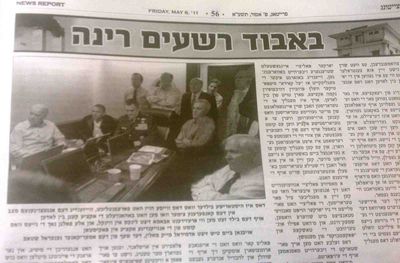
Hillary Clinton Removed from Iconic Photo by Hasidic Newspaper


A big hat-tip to Failed Messiah (who gave a hat-tip to Critical Minyan) for breaking the news that an Ultra-Orthodox Hasidic Jewish newspaper, Der Tzitung, has determined that the photo of top U.S. leaders receiving an update on the mission against Osama bin Laden was too scandalous.


What was so offensive about the image? U.S. Secretary of State Hillary Clinton was in the photo and, based on good intel, the editor of Der Tzitung discovered that she is a woman. The Hasidic newspaper will not intentionally include any images of women in the paper because it could be considered sexually suggestive. The iconic photo shows President Obama, Vice President Biden, and members of the U.S. National Security Team in the Situation Room of the White House. Secretary of State Clinton, wearing a long-sleeved suit jacket, sits with her hand over her mouth. I'm not sure how Der Tzitung determined this was a racy photo. Perhaps they just don't like the idea of a woman with that much political power.


Der Tzitung Photophopped Hillary Clinton out of the photo, thereby changing history. To my mind, this act of censorship is actually a violation of the Jewish legal principle of g'neivat da'at (deceit). I wrote about this subject a year ago following the Flotilla debacle in Israeli waters outside Gaza when the Reuters news agency doctored photos that it published by removing weapons from individuals aboard the Mavi Marmara. The doctoring of photographs like this is referred to as "Fauxtograpphing." I'm curious to hear how Der Tzitung responds to its attempt to remove Hillary Clinton from this iconic photo and thereby from this historic event.

This official photograph was released from the White House and includes the following disclaimer after the caption: "This official White House photograph is being made available only for publication by news organizations and/or for personal use printing by the subject(s) of the photograph. The photograph may not be manipulated in any way and may not be used in commercial or political materials, advertisements, emails, products, promotions that in any way suggests approval or endorsement of the President, the First Family, or the White House."

Friday, May 06, 2011

Saturday the Rabbi Wore a Pantsuit

I wrote this in praise of my female rabbinic colleagues. I have always been impressed by how women rabbis are able to juggle motherhood with the daily grind of the rabbinate. I wish a happy Mother's Day to all the "Rabbi Mommies" out there - many of whom have made a profound impact on my own rabbinate.

Originally posted at JTAThe Jewish Journal and The Daily Rabbi

On a recent trip to Berlin with a dozen other Conservative rabbis, we made certain to stop at the apartment building that Regina Jonas once called home (photo below). I had never heard of Jonas before, but to the four female rabbis in our group she was a hero. In 1935, she became the first woman in the world to be ordained as a rabbi. My colleague, Rabbi Gesa Ederberg, hosted our group at her beautiful Berlin synagogue during our visit and doubled as a knowledgeable tour guide. We also had the opportunity to meet with rabbinical students at the Abraham Geiger College, where in 2010 Rabbi Alina Treiger became the first woman to be ordained in Germany since Jonas. Today there are hundreds of inspiring, smart and passionate women rabbis who have followed in the steps of Regina Jonas.


As another “rabba” will soon be ordained, American Jews are just getting used to the idea of female rabbis in the modern Orthodox world. However, in the more progressive streams of Judaism women rabbis have been on the scene for decades and are now part of the fabric of everyday Jewish life. In fact, one funny anecdote demonstrates that for some of the youngest members of the Jewish community, women rabbis are the only form of rabbi that exists. A female colleague tells the story of when she introduced her 5-year-old son to a male rabbi, he reacted in shock: “But Mommy, I thought only ladies can be rabbis.” Out of the mouths of babes!

In Newsweek magazine’s recent ranking of the top U.S. rabbis for this year, there were many more women listed in the top. Among these superstar rabbis were women who are leading institutions and large congregations, as well as highly sought after authors and entrepreneurs who have launched their own communities.

Like other professions in which women were once not welcome to join, the rabbinate has been forced to learn how to accept female rabbis into the ranks. Certainly, this acceptance is most challenging for the oldest generation of rabbis who came of age in the “Old Boys Network,” a rabbinate sans women. Middle-age rabbis were the first to welcome women into the profession, but also have memories of the controversy that took shape around the seminary doors opening. But for the younger rabbis (and I include myself in this cohort despite the fact my doctor tells me I’m aging a bit each day), there have always been women rabbis and we wouldn’t want it any other way.

I recall the first time I jumped into a New York City cab and noticed that my driver was a woman. I did a double-take, but then things progressed as usual. She got me to my destination, I paid the fare and her tip, said thanks, and was on my way. Not so with female rabbis, however. There are noticeable differences between the sexes and we shouldn’t pretend they don’t exist. Having women as rabbis has added immensely to all aspects of Judaism and these female rabbis have helped shape the conversation.

Women rabbis have added beautiful new rituals to our tradition. They have introduced spiritual rituals that most men wouldn’t have dreamed up like prayers for fertility, teachings at the mikvah, and meaningful customs following a miscarriage. Women rabbis have brought naming ceremonies for our daughters to the meaningful level of the bris. They can relate to the teenage bat mitzvah girl in ways that male rabbis never could or would never even try. Their commentary on the Torah and Talmud is fresh, and they can provide voices to the hidden personas of the many female characters of our rich text that have been missing for generations.

When I was in rabbinical school, I gained new perspectives from my female peers who at the time numbered just one-third of the student body. I cherish the wonderful professional and personal relationships I have with our female rabbis in town. They offer so much to our community and I feel sorry for the previous generations who missed out on the female rabbinic voices.

Many women might yearn for the day when we no longer use the term “woman rabbi” or when the Forward doesn’t publish a list of the top fifty women rabbis. But we should embrace the changing face of the American rabbinate. Men and women are different creatures and so too it is in the rabbinate. It will only be to Orthodoxy’s benefit to welcome more women into rabbinic leadership roles. Regina Jonas would be proud.

Tuesday, January 04, 2011

Rep. Dave Camp Should Force Staffer to Grant Ex-Wife a Jewish Divorce

On the final day of the AIPAC Policy Conference in Washington, thousands of conference attendees descend on Capitol Hill to lobby members of Congress on issues important to the State of Israel. A few years ago I joined other pro-Israel Michiganders and lobbied Representative Dave Camp. The congressman wasn't available to meet with us and left an ill-prepared staffer to answer our questions and try to assure us of his boss's support of the Jewish State. Since Dave Camp represents the 4th Congressional District of Michigan (an area pretty far north of where I live), I didn't think I'd find myself lobbying him on any other issues in the future. And I surely never thought I'd lobby him on the issue of an agunah -- the case of a Jewish woman whose ex-husband refuses to grant her a get (a Jewish bill of divorce).

Rep. Dave Camp becomes the chairman of House Ways and Means Committee tomorrow taking over from Rep. Sandy Levin, and The New York Times reports that there is already controversy surrounding his office. Aharon Friedman, a 34-year-old tax counsel for the Republicans on the House Ways and Means Committee is an Orthodox Jew who is refusing to give his wife, Tamar Epstein, 27, a get.

The NY Times says that Friedman "finds himself scrutinized in the Jewish press, condemned by important rabbis, and attacked in a YouTube video showing about 200 people protesting outside his Silver Spring, Md., apartment on Dec. 19...The Friedman case has become emblematic of a torturous issue in which only a husband can 'give' a get. While Jewish communities have historically pressured obstinate husbands to give gets, this was a very rare case of seeking to shame the husband in the secular world."

One rabbi wrote to the House Ways and Means Committee asking that he lean on Aharon Friedman to grant the Jewish divorce. The couple has been civilly divorced since April and share custody of their daughter, but they are still married according to Jewish law. Without the get neither one of them is permitted to remarry within the faith. Tamar Friedman is considered an agunah, or chained woman until Aharon presents her with a get.

I implore Representative Dave Camp to compel Aharon Friedman, his staff member, to do the ethical thing and grant his wife a Jewish bill of divorce. I'm sure that Rep. Camp wants everyone who works with him to be of moral character. On his first day as the chairman of this important committee tomorrow, I hope Dave Camp will take Aharon Goldstein aside and tell him what he needs to do to "right this wrong." This matter has nothing to do with the Committee on Ways and Means or the 4th District of Michigan, but it has a lot to do with character and hopefully the leadership of the 112th Congress will make that a top priority.

As Rabbi Shmuel Herzfeld told The New York Times, “I don’t think the Messiah can come, as long as there is one agunah in the world.”

Friday, August 06, 2010

Yes, Orthodox Judaism Changes Too

With all the talk of the changing narrative in the intermarriage conversation, the increased acceptance of gays and lesbians in synagogues, and the virtually across-the-board practice of egalitarian prayer in Conservative and Reform congregations, many Orthodox Jews claim that they are the only ones practicing "Torah true" Judaism and refusing to change course on any of these social issues. Of course, even saying Orthodox Judaism is misleading because it encompasses so many different practices and beliefs -- from modern, liberal Orthodoxy to the Haredi (ultra-religious sect).

Judaism, like most religions is fluid. It evolves throughout time; the question is how quickly the changes materialize and when. In response to changes in society, the most progressive denominations evolve the quickest because, well, they are the most progressive. Take the issue of women rabbis for instance. The Reform Movement, Judaism's most liberal branch, minted the first female rabbi in 1972 with the Reconstructionist movement following suit in 1974. The more traditional Conservative movement spent many years debating the change before finally ruling to allow women rabbis in the mid-1980s with my colleague Rabbi Amy Eilberg becoming the first Conservative rabbi to be ordained in 1985.

A quarter century after the Conservatives opened its seminary to women, the more progressive Orthodox Jews in Centrist Orthodoxy are now debating the leadership roles of women in the synagogue. It was only a matter of time.

A few Orthodox women have already been ordained in some seminaries with the most well-known case being Rabba Sara Hurwitz, ordained by Rabbi Avi Weiss (pictured) of the Hebrew Institute of Riverdale (New York). While her title was debated, there's no question that she functions like a rabbi in Weiss's congregation. And I have no doubt that Weiss will ordain more women in the future.

And Orthodoxy has begun to evolve on the case of gay and lesbian acceptance. Again, the Reform and Reconstructionist movements acted quickly with the Conservative movement taking years to study and debate the issue before opening its seminaries and allowing the movement's rabbis to officiate at same-sex commitment ceremonies in December 2006.

Recently, 150 Orthodox rabbis issued a statement calling for the acceptance of gays and lesbians in the Orthodox community. The statement said in part that "Embarrassing, harassing or demeaning someone with a homosexual orientation or same-sex attraction is a violation of Torah prohibitions that embody the deepest values of Judaism... Jews with homosexual orientations or same sex-attractions should be welcomed as full members of the synagogue and school community." At the Orthodox movement's Yeshiva University in New York, there have been several conferences on GLBT issues. Rabbi Steve Greenberg, an out-of-the-closet gay Orthodox rabbi has helped move Orthodoxy to a place of increased acceptance for gays and lesbians following the success of 2001's film "Trembling Before G-d," which explored the struggle of Orthodox Jewish homosexuals.

Many Orthodox Jews will say that the one place there cannot be any leeway is when it comes to davening (prayer). The dignity of the service is compromised when a woman leads, they'll say. And yet, this seems to be the next big change in Orthodoxy -- women prayer leaders. Shira Chadasha in Jerusalem and Darchei Noam prayer group in New York have allowed women to lead certain parts of the service and be called to the Torah for an aliyah honor for years now, but the major news was last Friday evening. Rabbi Avi Weiss allowed a woman at his Orthodox shul in Riverdale to lead the congregation in the Kabbalat Shabbat service. The New York Jewish week reported, "In Rabbi Weiss’ latest effort to push the boundaries of women’s roles in an Orthodox shul, he had a woman, Lamelle Ryman, lead a Friday-night service with both men and women in the pews. Rabba Hurwitz, who heads a seminary for Orthodox women created by Rabbi Weiss, made a few brief remarks, not even touching on the fact that no other Orthodox synagogue in the U.S. had apparently ever before had a woman lead a Kabbalat Shabbat service. But it was Ryman’s show, and according to those in attendance, the davening was beautiful."

Some in the Orthodox movement are in favor of Weiss pushing the envelope and moving Orthodoxy into the future. Others feel that he's making changes without any process or input from others. It's possible that a censure from the Rabbinical Council of America is forthcoming, but Weiss is doing precisely what rabbis have done for generations -- moving Judaism forward.

The Judaism of 2010, in any of the denominations, looks different than the Judaism of past centuries. That's because the times change and the Jewish religion changes too, whether people like it or not.

Orthodox Judaism does not have a monopoly on "Torah true Judaism." If Judaism is truly going to be true to the Torah, then we must all embrace the Torah's dictum that says the Torah does not reside in the heavens. It belongs to humanity and it is up to us to see that it remains vibrant and evolves.