Wednesday, June 28, 2006

Ohio has a new Subway!

Yes, Ohio has a new subway and I'm not talking about public transportation! Apparently some Jews in Cleveland have accomplished one of my own personal dreams by establishing a Kosher Subway restaurant in the U.S.

I'll be moving to Columbus on Friday to begin my new position as rabbi of Congregation Agudas Achim, and I'm sure I'll visit Cleveland a few times during the year, if for no other reason than to have a little Kosher subway.

Kosher Subway RestaurantHere is an excerpt from the article that appeared in the Cleveland Jewish News:

'Subway guy' helps open kosher Subway@theJ

Thanks to a strict diet of health-conscious Subway sandwiches, Jared Fogle may be less than 50% his former size, but he is still 100% Jewish and delighted to be associated with the first North American kosher Subway, recently opened at the JCC.

"I think it's great," says the 28-year-old Fogle, in talking about the Subway's new location and its foray into kosher. "I'm very proud of it, and hopefully, it will be the first of many to come."

Although he doesn't heavily promote his Jewish background, Fogle still feels a connection to Judaism. "I grew up in Indianapolis, and the JCC was a big part of my life," he boasts. "I spent many summers at the JCC, so to have a Subway at the JCC means a lot to me."

Known to millions today as "the Subway guy," Fogle became an overnight celebrity after filming his first TV commercial for Subway in January 2000. In it, he admitted to shedding 245 pounds in one year by adhering to a low-fat diet of no breakfast, two Subway sandwiches a day and diet soda or water. Fogle also added exercise - mostly walking - to round out his regimen.

"It just clicked," Fogle said as he described his dieting experience. "I lived next door to a Subway on campus, and I basically asked 'What if ...?'" [more]

Tuesday, June 27, 2006

Jewish Summer Camping

A lot of summer camps begin today so I thought it would be nice to blog about Jewish summer camps. There is a great radio program available for download here from the University of Michigan Frankel Center's website. My friend Jonah Geller, executive director of Tamarack Camps and the Fresh Air Society, is featured on this program. Deborah Dash Moore, the director of the Frankel Center, is also interviewed on the program along with Riv-Ellen Prell and Albert Vorspan. I attended a lecture given by Prof. Prell this past winter at University of Michigan with Michael Wolf, director of Camp Ramah in Canada. Prof. Prell explained how Jewish summer camping is such an important way to get Jewish children to think more seriously about their Jewish identity. Well, no surprise there, but it is critical that more people hear that.

The Foundation for Jewish Camping, headed by Jerry Silverman and founded by Elise and Rob Bildner of New Jersey, is really advancing Jewish summer camping and is to be commended for their work. Should the Jewish community put more emphasis on Jewish camping for the sake of our future as a people? I know the answer is Yes!

Here is a sermon I delivered at Congregation Agudath Israel in Caldwell, New Jersey in 2003. I updated the sermon and delivered it at Beth Israel Congregation in Ann Arbor last summer after returning from Camp Ramah in Canada where I served as Rabbi-in-Residence for a session.

Thursday, June 22, 2006

John Paintsil and his Israeli Pride

Rabbi Jason Miller BlogI was thrilled to hear about Ghana's soccer star John Paintsil, who also plays for the Hapoel Tel Aviv team, and how he waved the Israeli flag after scoring a goal during a recent World Cup soccer match. The Forward covered the story in this week's edition, however, according to a Yahoo! News report earlier in the week Paintsil's Israeli pride seemed to irk the Egyptians just a bit. Hapoel Tel Aviv issued a statement expressing pride in its player, and a Jerusalem Post writer declared, "At last we have an ambassador for Israel who doesn't care about politics."

Rabbi Jason Miller BlogUnfortunately, two days after the flag waving, Ghana's team spokesman apologized, calling Paintsil's act "naive." He insisted that Paintsil didn't "act out of malice for the Arab people or in support of Israel."

Tuesday, May 16, 2006

Warren Buffett's Rabbi Myer Kripke

Giving tours of the Jewish Theological Seminary campus in New York City to visiting groups was certainly one of the highlights of my six years of rabbinical school. The Wednesday before Thanksgiving during my first year at JTS I attended a training session led by the director of donor relations Rebecca Jacobs. Rebecca shared the story of how the Seminary's library tower caught fire on April 18, 1966 damaging thousands of books and how thirty years later a JTS-ordained pulpit rabbi named Myer Kripke from Omaha donated the funds to renovate that same tower.

Rabbi Myer Kripke - Warren Buffett's Rabbi
Rabbi Myer Kripke


I gave over 200 tours of the Seminary, but I never grew tired of telling the story of how a humble rabbi from the south amassed a fortune big enough to make a $7 million cash donation to name the new Seminary tower. The story is that this rabbi's wife, Dorothy Kripke, wrote a series of children's books entitled "Let's Talk About..." and another Omaha woman loved to read these books to her children. When she found out that the author lived close by she decided she had to meet her. Well, as fate would have it, this woman and her husband became dear friends of Rabbi Myer and Dorothy Kripke. This woman's husband even offered to invest the small inheritance left to Mrs. Kripke. That investment paid off big because it was invested by Warren Buffett, the second wealthiest American according to Forbes magazine.

I'll never forget the time I asked a group of school children if they knew how Rabbi Kripke became a millionaire. One of the little girls offered, "Maybe he gave really good sermons?"

Here's a JTA article about Warren Buffett who recently invested $4 billion in an Israeli company:

Long before Israeli deal, Buffett made his mark on Jewish community
By Chanan Tigay

Warren Buffett is not a Jew, and in fact describes himself as an agnostic. Still, the billionaire investment guru, who earlier this month made big news when his Berkshire Hathaway corporation bought an 80 percent share in Israeli metalworks conglomerate Iscar for $4 billion, for years has been making his mark on the U.S. Jewish community back home — though sometimes in a roundabout way.
“Proportionally, if you look at the number of Jews in this country and in the world, I’m associated with a hugely disproportionate number,” Buffett, the second richest man in the world, told JTA in a telephone interview Monday.
Among the first companies Buffett acquired after launching Berkshire Hathaway, the Omaha-based investment and insurance giant, was The Sun Newspapers of Omaha, then owned by Stan Lipsey, one-time chairman of The Jewish Press, Omaha’s Jewish newspaper.
“At the time, the Omaha Club did not take Jewish members, and the Highland Country Club, a golf club, didn’t have any gentile members,” Lipsey recalls. “Warren volunteered to join the Highland” — rather than the gentile club — “to set an example of non-discrimination.”
Buffett happily recalls the fallout from his application.
“It created this big rhubarb,” he says. “All of the rabbis appeared on my behalf, the ADL guy appeared on my behalf. Finally they voted to let me in.”
But that wasn’t the end of the story, Buffett tells JTA. The Highland had a rule requiring members to donate a certain amount of money to their synagogues. Buffett, of course, wasn’t a synagogue member, so the club changed its policy: Members now would be expected to give to their synagogues, temples or churches.
But that still didn’t quite work, Buffett recalls with a laugh, because of his agnosticism.
In the end, the rule was amended to ask simply that members make some sort of charitable donation, and the path to Buffet’s membership was clear.
“He’s an incredible guy,” says Lipsey, today the publisher of the Buffalo News. In 1973, The Sun won a Pulitzer prize in Local Investigative Specialized Reporting for an expose on financial impropriety at Boys Town, Nebraska.
“Warren came up with the key source for us knowing what was going on out there,” Lipsey says.
Buffett himself researched Boys Town’s stocks to bolster the story, Lipsey adds.
In the 1960s, Omaha Rabbi Myer Kripke decided to invest in his friend Buffett’s new business venture. Their wives had become friendly, he says, and the foursome enjoyed playing the occasional game of bridge together.
“My wife had no card sense and I was certainly no competition to Warren, who is a very good bridge player and a lover of the game,” Kripke, rabbi emeritus of Omaha’s Conservative Beth El Synagogue, told JTA. “He’s very bright and very personable and very decent. He is a rich man who is as clean as can be.”
Kripke, father of the noted philosopher Saul Kripke, bought a few shares in Berkshire Hathaway and quickly sold them, doubling his money, he says.
Recognizing a good thing when he saw it, he bought a bunch more shares in his friend’s company, shares that by the 1990s had made Kripke — who says he never earned more than $30,000 a year as a rabbi — a millionaire.
Kripke met his late wife, the children’s book author Dorothy Kripke, at the Jewish Theological Seminary in New York, the flagship institution of the Conservative movement, where Kripke was ordained as a rabbi in 1937.
In 1996, flush from their prescient investment with Buffet’s company, the couple decided to make a major gift to JTS — $7 million in cash to restore the building’s damaged tower, and a deferred gift of some $8 million, which the seminary will receive after Kripke passes away.
“Rabbi Kripke had the heart to make a donation to JTS, he had the will to make a donation, he had the desire to make a donation — but if he had not had the means to make a donation, the recreation of our tower would never have happened,” says Rabbi Carol Davidson, the seminary’s vice chancellor for institutional advancement. “It was really only possible because of their prior investment many years ago with Warren Buffett.”
Kripke — who says he’s still got a picture of Buffett’s late wife, Susan, on his bulletin board — concurs. Asked if he credits Buffett with his financial success, he doesn’t hesitate.
“Entirely, yes,” he says. “I never had much of an income.”
The Israeli government stands to reap about $1 billion in taxes on Buffett’s purchase of Iscar. Shortly after announcing the deal, Buffett says he was surprised to learn that a Berkshire subsidiary, CTB International, was purchasing a controlling interest in another Israeli company, AgroLogic.
In Israel — which Buffett plans to visit in the fall — the hope is that the deals will have longer legs: Buffett himself has not ruled out future purchases there and, considering his status as a leading investor, observers say others also may take a look at Israeli companies now that Buffett has done so.
“You won’t find in the world a better-run operation than Iscar,” Buffett says. “I don’t think it’s an accident that it’s run by Israelis.”
The Sun newspaper group was not Buffett’s only early purchase of a Jewish-owned company. In 1983, sealing the deal with a handshake, Buffett bought 90 percent of the Nebraska Furniture Mart from Rose Blumkin, a Russian-born Jew who moved to the United States in 1917.
In 1989, he purchased a majority of the stock in Borsheim’s Fine Jewelry and Gifts, a phenomenally successful jewelry store, from the Friedman family.
“He has many friends in the Jewish community,” says Forrest Krutter, secretary of Berkshire Hathaway and a former president of the Jewish Federation of Omaha.
Buffett’s former son-in-law, Allen Greenberg, is a Jew, and now runs the Buffett Foundation, much of whose work has dealt with reproductive rights and family-planning issues. Buffett’s personal assistant is Ian Jacobs, who goes by his Hebrew name, Shami.
Buffett himself counts the late Nebraska businessman Nick Newman and philanthropist Jack Skirball as among his “very closest friends.”
“He is very much honored in the Jewish community,” Kripke says.

Tuesday, January 03, 2006

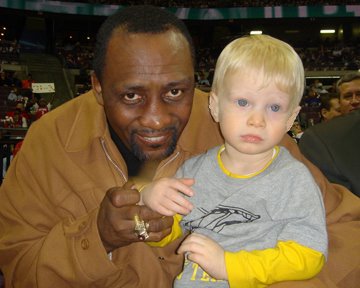
Tommy Hearns beats his son in TKO

I certainly didn't think that my (almost) 2-year-old son was in any danger when I let him sit on the lap of seven-time world champion boxer Tommy "The Hitman" Hearns last week at the Detroit Pistons basketball game at the Palace of Auburn Hills. But I was certainly shocked and upset to read today that Tommy Hearns was arraigned on assualt and battery charges after allegedly assaulting his own 13-year-old son.

Had "The Hitman" so much as looked at my kid wrong, no doubt I would have KO'd him -- I have a deceivingly strong right hook for a rabbi... don't be fooled!

From the Detroit Free Press

Boxer Hearns charged with assault

Former boxing champ told to stay away from son
By FRANK WITSIL

Thomas Hearns, a a seven-time world boxing champion, is expected to go before a judge Friday in a preliminary exam on charges he assaulted his 13-year old son Monday.

Hearns, 47, was arraigned Monday before 46th District Magistrate Eugene Friedman in Southfield and charged with misdemeanor assault and battery. He was released on $10,000 personal bond Monday and ordered to have no contact with his son.

Police arrived at Hearns’ house in the 20500-block of Norwood in Southfield at about 6:45 p.m. Sunday, after receiving a call from Hearns’ wife, who said there had been a domestic dispute. The teenage boy had a swollen eye and a small cut on his chin, Southfield Police Detective John Harris said.

Harris said Hearns apparently told the boy to go to another room; the teen refused and there was a scuffle. But, Harris said, Hearns and his wife gave slightly different accounts of how the boy was injured. Police arrested Hearns and took him into custody until he was released on bond.

Hearns could not be reached Tuesday for comment. He is to face district Judge Sheila Johnson on Friday.

A court clerk said Tuesday that Hearns attorney had not been identified yet in the file.

Hearns made a boxing comeback in July, after five-years without a fight, beating younger boxer John Long with an eighth-round TKO in the cruiserweight bout at Cobo Arena. At the time, Hearns, who boxed out of Detroit’s Kronk Gym, said he planned “to keep fighting for a long time.”

Friday, December 23, 2005

Bat "Mitzvahpalooza"

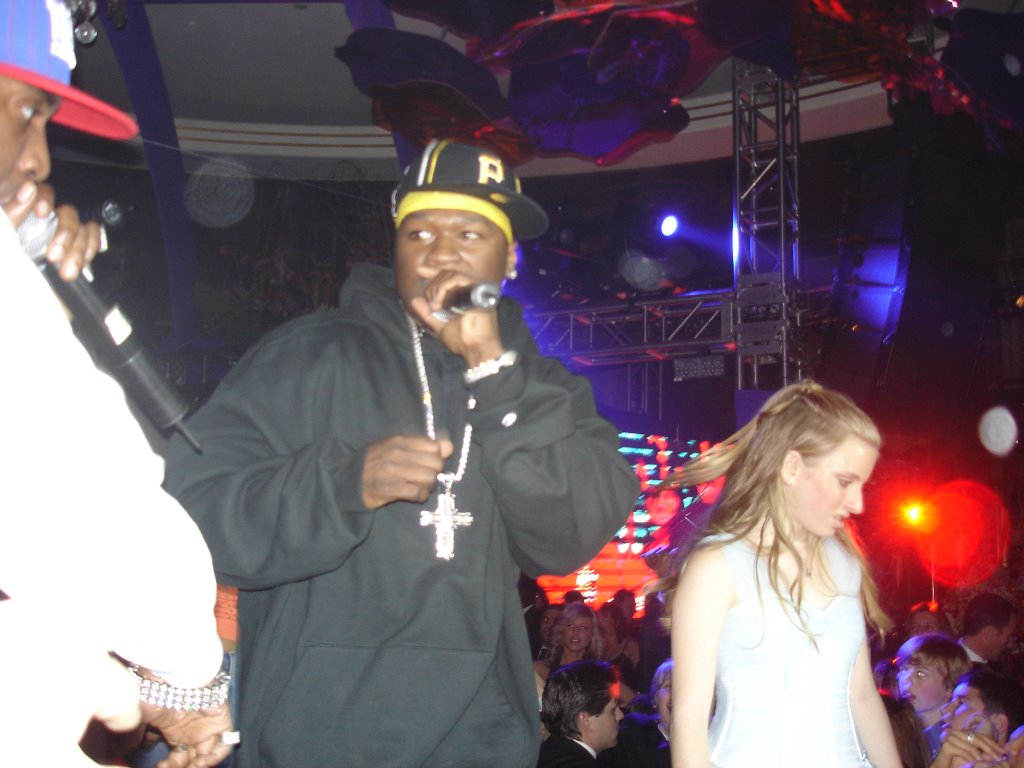
Exclusive photos of Mitzvahpalooza are online here. This is the bat mitzvah spectacular put on by Long Island defense contractor David H. Brooks for his daughter's entry into Jewish responsibility. Here's a link to the original NY Daily News article. At the simcha, performances were by everyone from 50 Cent to Don Henley to Stevie Nicks to Aerosmith. As Blogger Tabloid Baby pointed out, "Brooks got better talent than the NBC Katrina relief benefit."

While 50 Cent didn't play at my Bar Mitzvah (October 1989 for those wondering), The People's Choice band did and they were, well exactly what you'd expect from a Bar Mitzvah band in the late 80s. The truth is that Sam Thomas was an amazing DJ who traveled with The People's Choice to play Run DMC and Beastie Boys music while the adults ate and the kids danced.

And if you want to learn more about the Bar and Bat Mitzvah culture of the 70s and 80s, I recommend the new book Bar Mitzvah Disco. You can check out their very funny promotional video here.

Tuesday, December 06, 2005

No More Pork in Washington!

White House goes kosher
From the JTA

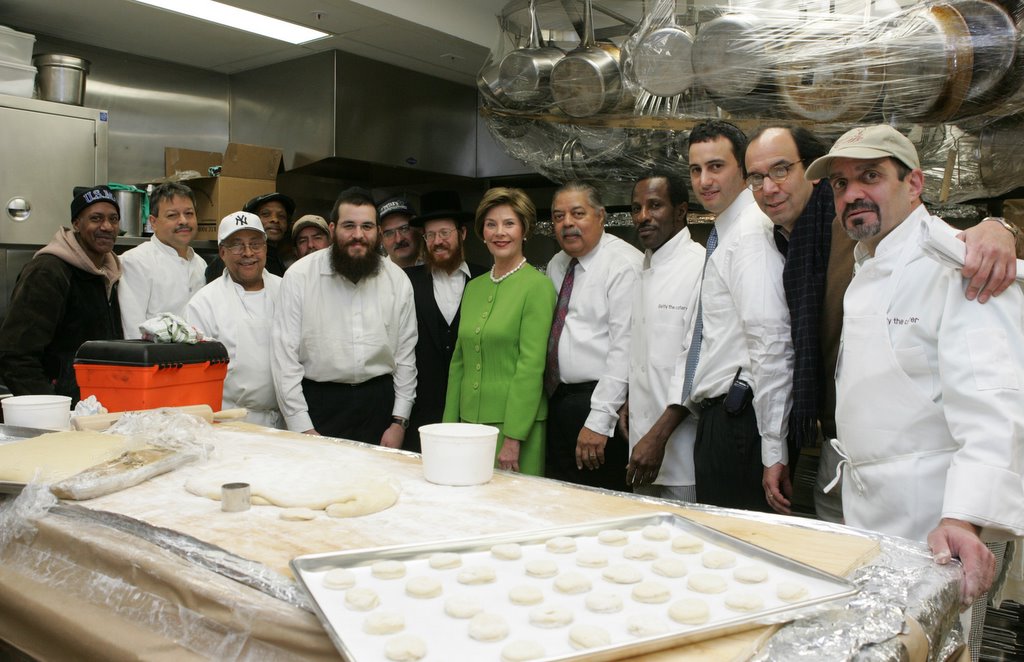
The White House koshered its kitchen ahead of its annual Chanukah reception.

Petak Caterers, under the joint supervision of the Bergen County, N.J., rabbinical council and Washington representatives of Chabad, will serve Glatt kosher meat at the dinner Tuesday night. The meeting is taking place early because President Bush and much of the Washington establishment leaves the city around Dec. 25, when Chanukah starts this year.

The White House said it was the first time that First Lady Laura Bush had handed over the kitchen to kosher caterers for a Chanukah celebration; previous kosher caterers brought food in from outside.

“The First Lady said if the function is kosher, it makes it more comfortable for her guests, and it makes it more comfortable for her,” said Rabbi Levi Shemtov, Chabad’s representative in Washington. Bush will meet with Jewish educators before the party, which hosts a cross-section of the Jewish leadership.The Kosher White House - Rabbi Jason Miller rabbijason.com
Whitehouse gets Kosher!

Friday, December 02, 2005

Alan Dershowitz in Ann Arbor

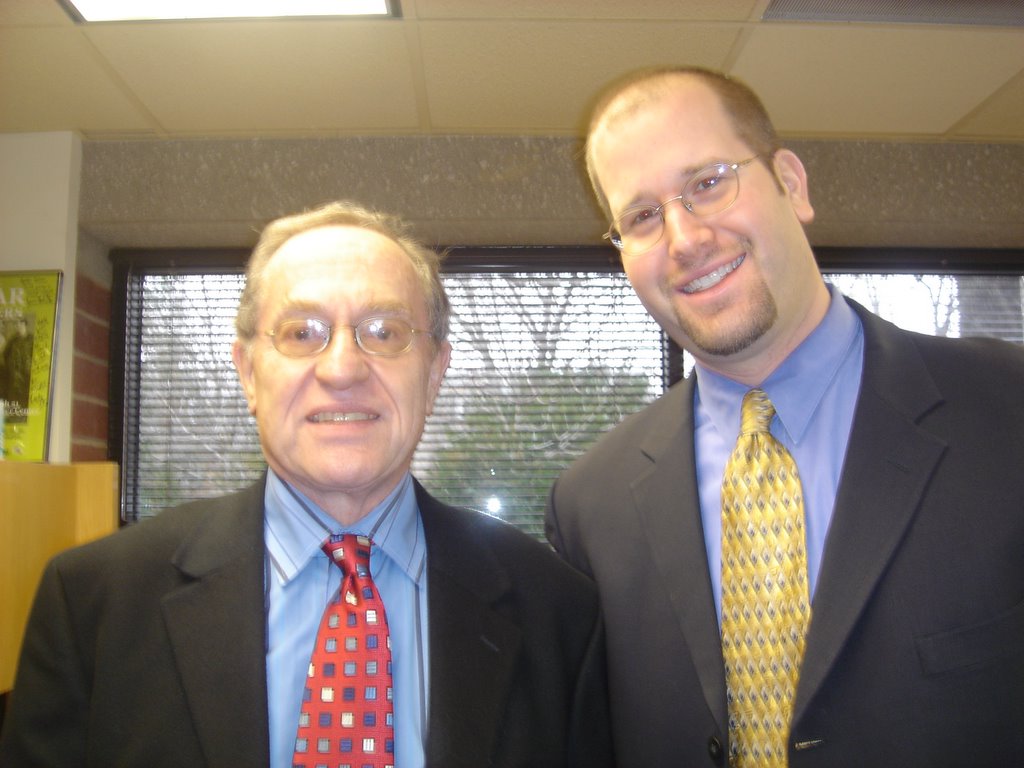
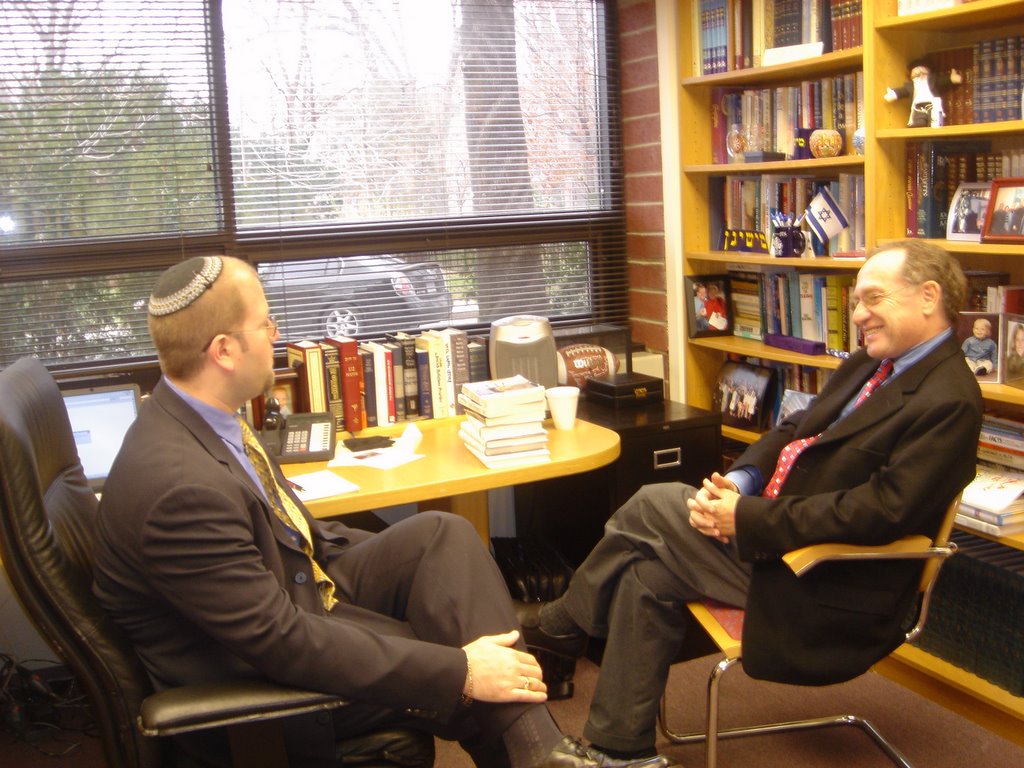
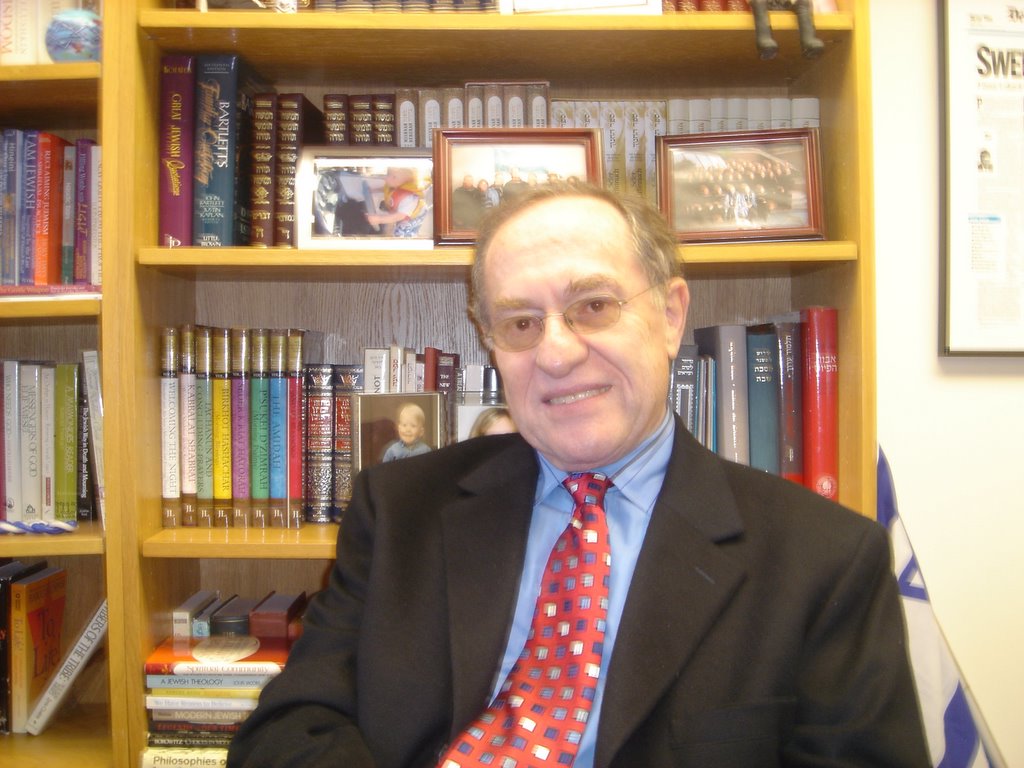
Professor Alan Dershowitz, Harvard's Felix Frankfurter Professor of Law, visited University of Michigan Hillel Foundation on Thursday before addressing the Jewish Law Students Association at the Michigan Union on the topic of Israel advocacy on campus. Here are some photos of Mr. Dershowitz in my office and at the Michigan Union (with Law School dean Evan Caminker and members of the Law School faculty).Alan Dershowitz & Rabbi Jason MillerAlan Dershowitz & Rabbi Jason MillerAlan Dershowitz & Rabbi Jason Miller

Wednesday, November 30, 2005

Bat Mitzvahpalooza: The Most Lavish Bat Mitzvah Party

From the NY Daily News

History will forever record Elizabeth Brooks' bat mitzvah as "Mitzvahpalooza."

For his daughter's coming-of-age celebration last weekend, multimillionaire Long Island defense contractor David H. Brooks booked two floors of the Rainbow Room, hauled in concert-ready equipment, built a stage, installed special carpeting, outfitted the space with Jumbotrons and arranged command performances by everyone from 50 Cent to Tom Petty to Aerosmith.

I hear it was garish display of rock 'n' roll idol worship for which the famously irascible CEO of DHB Industries, a Westbury-based manufacturer of bulletproof vests, sent his company jet to retrieve Aerosmith's Steven Tyler and Joe Perry from their Saturday gig in Pittsburgh.

I'm also told that in honor of Aerosmith (and the $2 million fee I hear he paid for their appearance), the 50-year-old Brooks changed from a black-leather, metal-studded suit - accessorized with biker-chic necklace chains and diamonds from Chrome Hearts jewelers - into a hot-pink suede version of the same lovely outfit.

The party cost an estimated $10 million, including the price of corporate jets to ferry the performers to and from. Also on the bill were The Eagles' Don Henley and Joe Walsh performing with Fleetwood Mac's Stevie Nicks; DJ AM (Nicole Richie's fiance); rap diva Ciara and, sadly perhaps (except that he received an estimated $250,000 for the job), Kenny G blowing on his soprano sax as more than 300 guests strolled and chatted into their pre-dinner cocktails.

"Hey, that guy looks like Kenny G," a disbelieving grownup was overheard remarking - though the 150 kids in attendance seemed more impressed by their $1,000 gift bags, complete with digital cameras and the latest video iPod.

For his estimated $500,000, I hear that 50 Cent performed only four or five songs - and badly - though he did manage to work in the lyric, "Go shorty, it's your bat miztvah, we gonna party like it's your bat mitzvah."

At one point, I'm told, one of Fitty's beefy bodyguards blocked shots of his boss performing and batted down the kids' cameras, shouting "No pictures! No pictures!" - even preventing Brooks' personal videographers and photographers from capturing 50 Cent's bat-miztvah moment.

"Fitty and his posse smelled like an open bottle of Hennessy," a witness told me, adding that when the departing rapper prepared to enter his limo in the loading dock, a naked woman was spotted inside.

I'm told that Petty's performance - on acoustic guitar - was fabulous, as was the 45-minute set by Perry and Tyler, who was virtuosic on drums when they took the stage at 2:45 a.m. Sunday.

Henley, I hear, was grumpy at the realization that he'd agreed to play a kids' party.

I'm told that at one point Brooks leapt on the stage with Tyler and Perry, who responded with good grace when their paymaster demanded that his teenage nephew be permitted to sit in on drums. At another point, I'm told, Tyler theatrically wiped sweat off Brooks' forehead - and then dried his hand with a flourish.

Yesterday, Brooks disputed many details provided to me by Lowdown spies at the affair and by other informed sources, scrawling on a fax to me: "All dollar figures vastly exaggerated."

He added: "This was a private event and we do not wish to comment on details of the party."

Tuesday, November 29, 2005

Rabbi David Wolpe

A Manifesto for the Future
Drop ‘Conservative’ Label to Tap True Meaning and Reach the Faithful
by Rabbi David Wolpe

In early November, I spoke at the Jewish Theological Seminary in New York. The topic was “The Future of Conservative Judaism.” I prepared for the talk by asking colleagues, friends and congregants to define Conservative Judaism in one sentence. It was a dispiriting experience.

Some had no answer at all. Others found themselves entangled in paragraphs, subclauses and a forest of semicolons. Sensible people began to sound like textbooks.

Many of us have learned that Conservative Judaism is either a complex ideology (at least we never get a straightforward explanation) or simply a movement that stands in the center between Reform and Orthodoxy. An early classic of Conservative Judaism was titled, “Tradition and Change,” but tradition and change is a paradox, not a banner of belief.

Conservative Judaism is crying out for renewal and revitalization. Some of the most spiritually charged, socially sensitive prayer groups and institutions in the country choose to not affiliate themselves with the Conservative movement. Yet they are led by rabbis ordained by the Conservative movement and attended by congregants who grew up in that movement.

In synagogues that do define themselves as Conservative, the congregants often expect halachic observance from their rabbis, yet they are not moved to emulate them. Conservative Jews are increasingly confused and uncertain about their spiritual direction.

As I posed these problems and questions, some turned the question back to me.

“Who are you, and what do you believe?”

When I reflect upon the beliefs with which I was raised and how I have grown in my faith, I realize that the word “Conservative” does not best fit who I am and what I believe.

I am a Covenantal Jew.

Covenantal Judaism is the Judaism of relationship. Three covenants guide my way — our way: The covenant at Sinai brings us to our relationship to God, the covenant with Abraham to our relationship with other Jews and the covenant with Noah to our relationship with all humanity.

First Covenant: Relationship to God

The Jewish relationship to God may be seen as a friendship, a partnership, though of obviously unequal partners. In the Midrash, God swears friendship to Abraham, is called the “friend of the world” (Hag. 16a) and even creates friendships between people (Pirke D’Rabbi Eliezer). Friendship is one aspect of the Divine-human connection.

The Torah speaks of God as a parent, a lover, a teacher and an intimate sharer of our hearts. When we speak of friendship or partnership, all of these relationships and more must be understood.

The terms of all friendships are fixed by history — we define our partnerships by our memories. One friend can speak a single word, “Colorado,” and the other knows that the word refers to a trip taken together 15 years before. However, vital friendships do not dwell solely in the past. They are always creating new memories, entering new phases and enriching what has gone before.

Some Jews believe that everything important in the friendship between God and Israel has already been said. The Torah, the Talmud, the classical commentators and codes have said all the vital, foundational words. Our task now is simply to fill in a few blanks, but otherwise the work is done. We are the accountants of a treasure already laid up in the past.

This is not a covenantal understanding. It is a Judaism frozen in time, as though all the clocks stopped in the 18th century.

Conversely, there are those who think the past weightless, because times have so radically changed. This is a friendship that tries to recreate itself each day, dictated by the demands of the moment. While the past is acknowledged, it is seen largely as something to be overcome, not to be cherished and integrated into the present. This creates a relationship with predictably thin and wan results.

Covenantal Judaism believes in the continuous partnership between God and Israel. When we light Shabbat candles, God “knows” what we mean — we have been doing it for thousands of years. It is part of the grammar of relationship. Our past is the platform from which we ascend. The covenant at Sinai is the first, reverberating word.

Yet there is so much more to say. There is no reason why someone as wise and important as the Rambam (who lived in the 12th century) could not be born tomorrow. This person could both incorporate Rambam’s teachings and move beyond them. There is no reason why something as epochal as the Exodus could not happen next year — witness the creation of the modern State of Israel.

Each day, we tremble with the anticipation of something new and powerful on the horizon. Each night, we pray with the awareness that the yearning of the generations sanctifies our words. We create new rituals because today must not only stand upon yesterday but must reach toward tomorrow.

The classical Jewish view teaches “the decline of the generations” — since Sinai we have grown further from revelation and stand, as a result, on a lower level of holiness. This is not a true covenantal understanding. The covenant does not fade or weaken with time. Our future is as promising as our past is powerful.

For the Covenantal Jew, dialogue between the Jewish people and God began in the Bible and continues today. The Bible is, as Rabbi A.J. Heschel put it, the record of the search of human beings for God and of God for human beings.

Second Covenant: Relationship Between Jews

All Jews are involved in the Abrahamic covenant — not only those Jews whom we like or those of whom we approve but all Jews.

Jews have always fought within our own community, and undoubtedly, we always will. Devotion to Torah does not free us from the constraints of human nature.

Still, a Covenantal Jew seeks active dialogue with Orthodox, Reform and Reconstructionist, as well as secular Jews. The covenant does not depend upon movements or ideologies; it is a covenant of shared history and shared destiny.

The emphasis on the responsibility of Jews to other Jews is uncomfortable for some. It seems parochial and ungenerous.

However, we are built to care in concentric circles: first one’s own family, then one’s community and then larger groups — rippling out to the world, always modified by the degree of need. Aniyei ircha kodmim teaches the Talmud: Care first for the poor of one’s own city.

Pallid universalism is not an ideal but a disaster. Too many Jews remind me of Charles Dickens’ Mrs. Jellyby in “Bleak House,” who is always charging off to do good works, while neglecting her own wretched children at home.

I remember when I was teaching at Hunter College in New York, a student approached me and asked: “Today there is an anti-apartheid rally and a rally for Soviet Jewry. I’m planning to attend the anti-apartheid rally. Can you give me a good reason to go to the Soviet Jewry rally?”

“Yes,” I answered. “If you attend the anti-apartheid rally, who will go to the Soviet Jewry rally?”

There are Jews who simply shun large parts of the Jewish world that do not meet their expectations. On both the right and the left, many simply ignore or discount the other side of the religious or political spectrum. But Republican or Democrat, Satmar or secular, affiliations invalidate neither God’s covenant nor our ties to one another.

This sense of Jewish responsibility explains why Solomon Schechter, the first major figure of American Conservative Judaism, was an outspoken Zionist. Ahavat Yisrael, love of Israel, is not an emotional impulse but a covenantal responsibility. That is why Covenantal Judaism is passionate about the land of Israel and the people Israel.

Covenantal Jews give priority in caring to our own, but we do not care exclusively for our own.

Third Covenant: Relationship With the Non-Jewish World

The first covenant was not made with the Jewish people. God sent a rainbow in the time of Noah as a sign to the world, to all of humanity. Noah lived 10 generations before the first Jew.

The meaning is clear: We have a responsibility toward others of whatever faith; we have a covenantal relationship to the non-Jewish world.

The very first question in the Bible is a question God asks of Adam — “Ayecha” — Where are you? This is not a literal question but a spiritual one, a question God asks us at each moment in our lives.

The second question in the Bible is in a way an answer to the first. The second question is one that human beings ask of God. Cain turns to God and asks, “Am I my brother’s keeper?”

If you answer that question, you will know where you are. Do you care for those who are in need, those who are anguished and alone?

Jewish World Watch has organized our response to the calamity of Darfur. Jewish leaders have shouted to the world, bringing attention to genocide in Cambodia and Rwanda, and championed the recognition of the Armenian genocide. These and countless similar causes and efforts are not strategic or to reflect credit on ourselves. They are sacred Jewish obligations. Jews who care for the Jewish community alone are neglecting the first, most comprehensive covenant.

Sadly, many traditional Jewish communities seem to have little concern for the non-Jewish world.

The rabbis of the Talmud insist that compassion is a characteristic of the people of Israel. The first statement about human beings is that each is made in God’s image. Invidious comparisons between the worth of Jews and others are not only malignant but fundamentally at odds with the Covenantal tradition.

Jews receive as well as give to those outside the Jewish community. Covenantal Judaism is eager to learn wisdom — not only practical but spiritual — from the non-Jewish world.

Judaism has many precedents for religious learning from non-Jews, beginning in the Bible. The world begins with Adam, not with Abraham. Noah, the first man called righteous, is not a Jew.

The chapter of Torah containing the Ten Commandments is named “Yitro” (Jethro) — this central chapter containing the revelation from Sinai is named after a non-Jew. The traditional response when someone asks after our welfare, “baruch Hashem” (praise God) is mentioned three times in the Bible. All three times it is said by a non-Jew: Noah (Genesis 9:26), Eliezer (Genesis 24:27) and Jethro (Exodus 18:10). Thus, even when we praise God, we do it in words that were first spoken by those in our community who were not raised as Jews.

The list could be easily multiplied throughout Jewish history: Maimonides learned from the Islamic scholar Averroes, Kabbalah learned from Sufi mysticism, Heschel learned from Reinhold Neibuhr. Covenantal Jews glory in this interchange, which is not threatened by the insights of others but enriched by them.

The Covenant and Jewish Law

The overriding commandment of Covenantal Judaism is to be in relationship with each other and with God. The more halacha (Jewish law) we “speak,” the more full and rich the relationship. Our faith is neither a checklist nor a simple formula. It is a proclamation and a path.

Changes in Jewish law to include women, from bat mitzvah celebrations to rituals for miscarriage, as well as changes that enable people to drive to synagogue or use instruments in the service as our ancestors did, are elements in a covenantal understanding of the tradition. This is a tradition not rigid but responsive and alive, not repetitious but committed to dialogue with the past, each other and God.

Dialogue with God is not an act of chutzpa, not a conviction of equality. Rather God ennobles us by choosing us as partners for dialogue.

Abraham argues with God; Moses opposes God’s decree, and throughout Jewish history, in medieval poetry and modern literature, Jews insist that God wants not puppets nor robots but human beings who bring their passion, confusion and love to the task of Israel, which in Hebrew means wrestling with God.

Jewish authenticity is not measured by the number of specific actions one performs but the quality of the relationships expressed through those actions. Recall what the Torah says of Moses: In praising our greatest leader, The Torah does not recount that he performed the most mitzvot of anyone who ever lived, or even that his ethics exceeded all others. We are told that Moses saw God “panim el panim” face to face. The merit of Moses is in the unparalleled relationship he had with Israel and with God.

The Covenant and the Future

When the covenant is first presented to Noah, God promises not to destroy the world. In that promise is a chilling omission: God does not promise that we will not destroy the world.

As Rabbi Joshua of Kutna points out, the rainbow is a half circle. That is God’s promise to us. God’s half must be completed by our own intertwining colors.

The relationships we build through sanctity, compassion and love are our reciprocal rainbow. Involving all colors, embracing our community and beyond, it teaches us that in covenant is the secret of salvation.

Covenant is the spine of Judaism. No idea is more important to the development of the tradition. Conservative Judaism, as it has grown, has taken the covenantal idea seriously, sometimes without even realizing it. The time has come to claim it, to develop it in powerful and new ways and to fashion a movement of Judaism that can change Jewish life in America and beyond.

Conservative Judaism remains a large and important international Jewish organization of synagogues, schools, camps, youth groups, adult organizations and centers of training for scholars and clergy. By placing covenant at the center of this worldwide Jewish initiative, we will be reframing the enterprise of creating a Judaism that closes the door neither to the past nor to the future. Such openness and conviction are vital for the future of the Jewish people, a covenanted nation born of passion for improving this world under the sovereignty of God.

This is the time for Covenantal Judaism.