Showing posts with label Kosher Certification. Show all posts

Thursday, August 12, 2021

I Knew Jack - Remembering Jack Aronson

 I found it very telling when I received a phone call from a contributing writer at the Detroit Jewish News the day after Jack Aronson passed away. She said she was working on an obituary for Jack but was confused. I asked what she was confused about and she told me that she was having trouble verifying if Jack was Jewish. I started to laugh.

Jack Aronson was not Jewish. But I immediately understood why she was confused. The man was so beloved throughout the Jewish community and he received loving tributes from notable Jewish leaders in the immediate hours after his death that it was not surprising this Jewish News writer had begun working on his obituary before realizing that he wasn’t a member of the Jewish community — at least not officially.

Jack Aronson of Garden Fresh Gourmet with Rabbi Jason Miller in Taylor, Michigan


I looked up to Jack Aronson. Both literally and figuratively. Jack was a big man. He was tall, but he loomed even larger when it came to business. And to the community. And to philanthropy. In the food industry, he was legendary.

The first time I met Jack, I told him about my kosher certification agency. He said he wasn't happy with the agency that Garden Fresh was using and so I jokingly told him to have his people give me a call. Not long after that, I received a call from his manager to set up a meeting. Before that meeting ever took place, Jack had sold Garden Fresh to Campbell's for almost a quarter billion dollars. What stuck with me is not that Jack actually followed through and had someone contact me, but that several people told me that he had contacted them to learn more about me and Kosher Michigan. Jack did his research.

Tuesday, July 23, 2013

Conan O'Brien Teaches Halacha (Jewish Law)

As the founder and director of a kosher certification agency, people often send me anything and everything having anything to do with kosher certification. So last week when the Rabbinical Council of California first certified a sexual lubricant product as kosher and then rescinded the certification, you can imagine I received several articles about the story.

While I wasn't surprised to see coverage of this story making the rounds on late night TV talk shows, I was taken aback when I saw Conan O'Brien's uber-esoteric halachic schtick on last night's episode of "Conan".

Jewish jokes aren't anything new for Conan O'Brien, who is Irish Catholic. One of Conan's long-time writers is Rob Kutner (@ApocalypseHow), who once wrote for "The Daily Show with Jon Stewart". Kutner has become something of a maven when it comes to writing funny Purim shpiels and created The Shushan Channel, a mail-order Purim shpiel business.

Tuesday, June 19, 2012

Are Hebrew National Hot Dogs Kosher?

When I awoke this morning to find a few news articles in my "Kosher" Google News Alerts regarding a lawsuit against ConAgra claiming Hebrew National hot dogs aren't kosher, I didn't give it much thought. That's because a large segment of the kosher observant population hasn't considered Hebrew National hot dogs to be kosher for many years.

Thursday, May 17, 2012

The Deal With Trader Joe's Kosher Chocolate Chips

At some point yesterday Chocolate Chip-Gate began on Facebook. Word got out that Trader Joe's popular kosher chocolate chips were being re-designated as "kosher dairy" rather than "kosher pareve". Immediately, words like "tragic" and "devastating" were being used to describe the change. Facebook users were recounting their urgent visits to local Trader Joe's locations to grab up the pareve (non-dairy) chocolate chips from the shelf in a way that brought back memories of Coca-Cola fans in the 1980s stockpiling cans of Coke when New Coke came out.


Kosher consumers appreciate the pareve designation on chocolate chips because it allows for the substitution of non-dairy chocolate chips in baking for desserts following a meat meal, which is customary among most kosher-observant carnivores for Shabbat dinner.

As soon as the news that Trader Joe's would substitute the OK pareve hekhsher (kosher certification symbol) for a dairy one, discussion threads were launched on Facebook describing how favorite recipes for trail mix and chocolate chip challah would be an impossibility without the pareve chocolate chips from Trader Joe's. An online petition was started to urge Trader Joe's to reverse the decision.

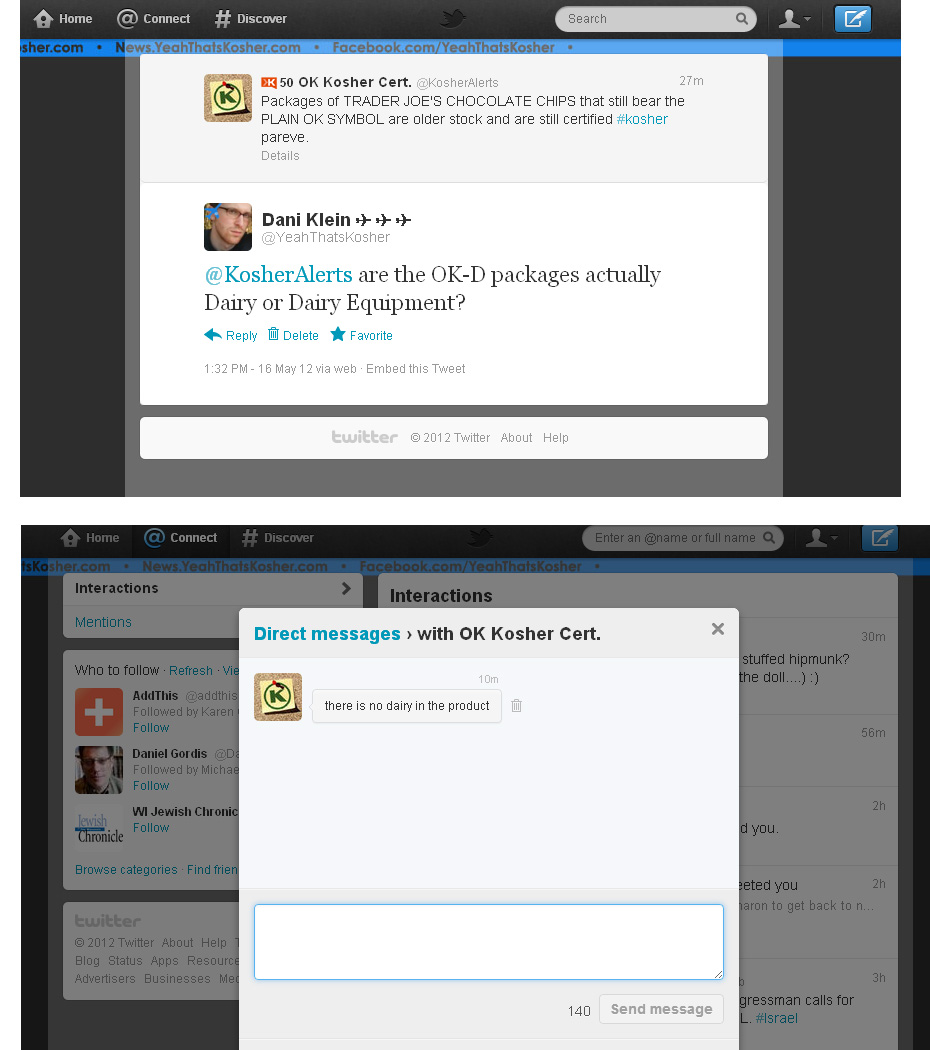
There was also a lot of misinformation about the change. Dani Klein of the YeahThatsKosher blog posted a private Direct Message from Twitter that he received back from the OK Kosher Certification agency stating that the chocolate chips will not contain dairy, but will be labeled as such. There were also discussions that the new designation would actually be "DE" for dairy equipment, a relatively new kosher status that means the product is not dairy but the equipment could be used for dairy products. The Dairy Equipment designation means that food products with that status cannot be eaten with a meat meal, but can be eaten following that meal.

The news that it would be a dairy equipment hekhsher and not a bona fide dairy label resulted in several discussions on Facebook about that designation, how food labeled with the DE should be treated, and what the ramifications of a DE label are for dairy allergic individuals who rely on a pareve hekhsher for health reasons. Were people reacting too quickly? Was Trader Joe's even changing the production process of the chocolate chips?

Today, Dani Klein actually contacted the OK Kosher Certification Agency today and got to the bottom of this story. He was told that the chocolate chip product itself is not dairy, but the product is bagged at the end of the assembly line and neither Trader Joe's or the OK Kosher Certification Agency can guarantee that dairy chocolate chips don't also mix into the bag. This means that a bag of Trader Joe's pareve chocolate chips may or may not have some dairy chips mixed into a bag. That is why the OK is taking the position that these bags of chocolate chips should bear the OK-D certification as if they were dairy. Further, Klein was told by OK officials that the response he received via Twitter was an error and should have been redacted.

So, the bottom line is that the chocolate chips probably should have been labeled as "dairy" all along because they couldn't guarantee no dairy chips were mixed in by accident (although if it's less than 1/60th of the total volume of the bag it would still be pareve based on the principle of batel b'shishim).

There are other pareve chocolate chips available on the market, but Chocolate Chip-Gate demonstrates just how much Trader Joe's fans have come to rely on the market's specialty products.

While I am involved in the kosher certification industry through Kosher Michigan, this blog does not seek to set forth any kosher guidelines. Individuals should consult with their local rabbinic authority as to how they will treat Trader Joe's kosher chocolate chips in the future.

Sunday, May 06, 2012

Could Miguel Cotto Be Sued By Orthodox Union Over Kosher Tattoo?

Boxer Miguel Cotto lost to Floyd Mayweather Jr. last night in a unanimous decision in the MGM Grand Garden Arena in Las Vegas. As I've written about before on this blog, Miguel Cotto sports a tattoo on his right collarbone that represents the kosher symbol used by the Orthodox Union (a circle containing the letter "U"). Cotto got the well-known and internationally recognized symbol tattooed on him as a gesture for a Jewish friend. Seeing Cotto's tattoo again last night during his fight made me wonder if there might be any legal ramifications to Cotto sporting a trademarked image in such a public way.


The Union of Orthodox Congregations of American is the largest kosher certification agency in the world with its hekhsher (kosher certification symbol) on over 500,000 products worldwide. The OU, as it is commonly called, has been unrelenting in its protection of its famous trademark. As the most recognized kosher symbol, many food manufacturing businesses (especially in the Far East) think that the OU symbol is a generic kosher code and place it on their product without permission.  As Sue Fishkoff reported in her book Kosher Nation, the OU employs a large legal department whose mission is to locate violations of usage of the OU symbol anywhere in the world, issue a cease and desist order, and file a suit if there's no compliance.

In the past week I've read two articles about ongoing lawsuits filed by the Orthodox Union against companies using the OU symbol. Watching Miguel Cotto dance around the ring last night with his OU tattoo in full sight, I considered if this might be a trademark violation on the radar screen of the OU's legal department.

The Orthodox Union recently sued a Maine organic dairy for trademark infringement. The OU claims that Maine’s Own Organic Milk Company L3C used the OU trademark without authorization. The Orthodox Union said it initially contacted the dairy about its unauthorized use of the hekhsher in June 2010 and the dairy, known as MOOMilk, applied for certification that month and received an initial inspection, but the dairy never paid the fees and continued to use the kosher symbol on its cartons without authorization. The Orthodox union said it’s harmed by the unauthorized use of the mark, and that kosher consumers are likely to be confused and misled when they see it on MOOMilk’s products.


That's the most common example of violation against a kosher symbol. But the OU also has to deal with companies using the OU symbol as an innocent mistake. Also this week it was reported that a coffee roastery in New Zealand, Christchurch's Underground Coffee, is being sued for using a logo that is similar to the OU's registered trademark. Underground Coffee has been using that logo since 1998, but it only became known to the Orthodox Union recently when Starbucks stores in New Zealand began selling the product.

The OU claims that the coffee's logo is "likely to deceive or cause confusion" to consumers. Apparently many travellers to New Zealand asked local rabbis if Underground was kosher and others had reported it to the union as an infringement.

There's no confusion as to Miguel Cotto's kosher status and it's entirely possible that the Orthodox Union appreciates the free publicity. But who knows what the OU legal department will think of Cotto's tattoo, which could be considered an unauthorized use of a registered trademark.

Legal experts: What do you think?