Monday, June 04, 2012

Savvy Auntie Blessings

There is something very special about an aunt and uncle's relationship with their nieces and nephews. No one has demonstrated the importance of the relationship between an aunt and her nieces and nephews better than Melanie Notkin, who launched SavvyAuntie.com. Here is the second column I have published on the SavvyAuntie.com blog and it is in honor of my children's Aunt Stephanie:


Blessing my children is something I do every Friday night before we begin our family Sabbath dinner. Last week, I had the opportunity – actually the honor – to bless my children’s Savvy Auntie. Officiating at the wedding of my sister-in-law Stephanie made me realize just how meaningful she is in the lives of my children. More important than being my wife’s sister or my sister-in-law is her role as “Auntie Steffi.”

Friday, June 01, 2012

Harold Grinspoon Invests in Jewish Families Through PJ Library

Jewish philanthropists of the "mega" variety are always looking for the best ways to use their fortune to benefit the Jewish community. Many of them have set up philanthropic foundations and have paid professionals advising them how to realize the best return on investment for their substantial donations.

In the past two decades, billionaire donors like Les Wexner, Michael Steinhardt, Lynn Schusterman, Sheldon Adelson and the Bronfman family have infused millions of dollars into free 10-day trips to Israel for young adults (Birthright Israel), entrepreneurial programs for rabbis and Jewish educators (STAR Foundation), Jewish teen (BBYO) and college campus initiatives (Hillel), Shabbat enrichment endeavors for synagogues (SYNaplex), and educational programs for adults (Wexner Heritage).

The mega donor whose large scale creative giving has impressed me the most over the past few years is an unassuming, Jewish immigrant who made his fortune in the real estate market. Harold Grinspoon established his foundation to promote Jewish life among young people, adults and families. To date, he's infused north of $110 million into the Jewish community and has done so without much fanfare.

Harold Grinspoon recognized early on that Jewish summer camps for children have the ability to provide a 24/7 enriching Jewish experience to the future leaders of the Jewish people. While he had the ability to donate millions to Jewish camps to afford underprivileged children with a Jewish camp experience, he went several steps further.

With Harold Grinspoon at Camp Maas in Ortonville, Michigan.

Through the Grinspoon Institute for Jewish Philanthropy, Harold Grinspoon set out to enhance the long-term effectiveness of nonprofit overnight camps. Rather than simply sending more Jewish children to summer camp Grinspoon was determined to improve the camps through intensive leadership training of the staff (young future leaders), enhancing the internal philanthropic environment of each camp, and making capital improvements to allow for more and better programming. Dozens of Jewish camps around North America share their success stories on the Grinspoon Institute's website.

While large philanthropic giving to Jewish summer camps is not a novel idea, the way Harold Grinspoon leveraged his investments to Jewish camps was creative and will have lasting positive implications for the Jewish community.

But Jewish camping is not Grinspoon's only philanthropic love. In February 2010 I read an article in the Boston Globe by Eric Moskowitz about Grinspoon's PJ Library that had just given away its 2 millionth book. I made some notes on a hard copy of the article and planned to write about it on this blog. Somehow the article got filed away and I missed the opportunity.

And then I received an email message yesterday from close friends Cindy and Neil Goldstein of Livingston, NJ. We became friends with the Goldsteins when my wife and I lived in Caldwell, NJ during the final three years of my rabbinical training at the Jewish Theological Seminary. We had our first children just days apart and have remained good friends since.

The Goldstein's email message explained that Harold Grinspoon arrived at their home on Wednesday to present their daughter Jordana with the PJ Library's 3 millionth book, Noah's Swim-a-Thon. I immediately pulled that Boston Globe article out of my file cabinet.

PJ Library Founder Harold Grinspoon reads to Jordana Goldstein at her home in Livingston, NJ

Harold Grinspoon's creative philanthropic idea for the PJ Library, which distributes free Jewish-themed books and music CDs to children all over North America each month, came from none other than Dolly Parton. Grinspoon explained to the Boston Globe, "I’m in the car one day listening to public radio and I hear that a gal by the name of Dolly Parton is giving away free books to disadvantaged families."

Grinspoon, who is dyslexic, had not read to his own children when they were young, but he had just been on a flight where he was captivated by a father comforting a crying child with a book. He immediately called Parton’s Imagination Library and arranged to sponsor her program in the Springfield area, where he lives. 
That same spring, he attended a Passover Seder at his son’s house. Around the table in Weston, Grinspoon watched his daughter-in-law give picture books with Jewish themes to each guest. “He was just mesmerized,’’ said Winnie Sandler Grinspoon, his daughter-in-law. “He didn’t even know [such books] existed.’’ 
Grinspoon was surprised by the quality of the stories and illustrations, and more amazed still that his adolescent grandchildren cherished these books from their childhood as much as titles like “Goodnight Moon.’’
He gave his daughter-in-law $500 and told her to buy him a crate of her favorites, which he devoured. Then he dispatched a young assistant to consult with Jewish educators and institutions, with the Imagination Library and packing companies, and present him a report about whether - and how - a Jewish version of Parton’s project might work.

Grinspoon's PJ Library now sends over 100,000 free books and music to families each month (that figure was only 200 per month in 2005). The program has grown to include, Sifirat Pajama b'America, a division that sends children's books in Hebrew to Israeli families in North America. Not only have young children and their families been positively affected by Grinspoon's amazing generosity, but the book publishing industry has seen tremendous growth through the purchasing and distributing of 3 million books in recent years.

Grinspoon reflected at the Goldstein's home, "While we are thrilled to be delivering the 3 millionth PJ Library book, we won’t rest until we know that every family with Jewish children who wants these wonderful Jewish books is able to receive them... We look forward to delivering the 4 millionth book and 5 millionth book and beyond — and knowing that all across North America and around the world, parents and children are snuggling around PJ Library books, and having special conversations in which parents are transmitting our heritage to the next generation."

Jewish camping experiences are enduring and have lasting effects on our Jewish community. Those experiences take place outside of the home. Harold Grinspoon's PJ Library invests in Jewish families by giving parents and grandparents the resources to educate children in the home.

Harold Grinspoon's dyslexia precluded him from reading to his own children when they were young. As a father who has read dozens and dozens of PJ Library books to my children at bedtime over the past eight years I can honestly say that Harold Grinspoon's generosity is having a real and meaningful effect. In a way, Harold Grinspoon is now reading to over 100,000 children each month.

Wednesday, May 30, 2012

Mark Zuckerberg Eats Kosher in Rome

I'm all for letting Mark Zuckerberg and his new wife Priscilla Chan honeymoon in peace, but I couldn't resist blogging about two noteworthy events that occurred during the newlyweds' Italian vacation.

First, the Facebook Founder and CEO took his bride to a *kosher restaurant in the Jewish area in Rome. The couple dined at Nonna Betta where they spent 32 euros on lunch. There's no word on why Zuckerberg decided to visit the Jewish section of Rome or why he and Priscilla chose a kosher restaurant for lunch.

Mark Zuckerberg and his wife Priscilla Chan at a kosher restaurant in Rome.

At Nonna Betta, Zuckerberg and Chan ate traditional Roman Jewish delicacies including deep-fried artichokes, fried pumpkin flowers and ravioli stuffed with sea bass and artichokes. To drink they each had a glass of water and shared a pot of hot tea.

In addition to Zuck's decision to eat kosher ("When in Rome!") the second notable aspect of the couple's Roman visit was the young billionaire's failure to tip at the restaurant. Waiters at Nonna Betta reported that Zuckerberg acknowledged he was Mark Zuckerberg and then neglected to leave a gratuity. That's an odd omission from someone who's portfolio increases by approximately a billion dollars every time the Facebook stock goes up two points (since its IPO the stock has actually decreased by about 25%).
The restaurant receipt from Mark Zuckerberg's lunch at a kosher restaurant in Rome.

It's possible that Zuckerberg thinks that it's unnecessary to tip in Rome since he reportedly didn't leave a tip the night before at a dinner at Pierluigi (not kosher), a historic trattoria in the heart of Rome. In all fairness to Zuckerberg, it doesn't look like there was any place to add a tip on the receipt (above).

Perhaps Zuckerberg and Chan will continue to seek out kosher fare when they return to Palo Alto. On behalf of the waitstaff I just hope he learns to tip!


*UPDATE: Nonna Betta restaurant in Rome is no longer certified kosher. Tourists should consult a local rabbi regarding the kosher status of this restaurant.

Tuesday, May 29, 2012

Rap Videos Okay in Synagogue But Not Politicians

It is often said that politics and religion make strange bedfellows. Strange or not, it is important to remember that politics and religion are bedfellows in just about every nation in the world (some more than others).

I've noticed that in the United States, where we have a supposed separation of Church and State, it is often the synagogues that are the only ones concerned about such a separation. I hear rabbis and synagogue leaders express concern about keeping politics out of the congregation because it could jeopardize the institution's 501(c)3 tax exempt status. While these rabbis are worrying about their nonprofit status, the local churches are allowing political candidates to deliver stump speeches from the pulpit and many churches are notorious for outright endorsing candidates.

Synagogues have always had politicians address the congregation, but in recent years as the American Jewish community has become more politically polarized it has become more commonplace. While this used to occur without incident or at least with only minor dissent, there is now a guarantee of backlash from congregants and lay leaders from both sides of the aisle.

Debbie Wasserman Schultz's speaking engagement at a Miami temple was cancelled

Rep. Debbie Wasserman Schultz, the chair of the Democratic National Committee, will speak this evening at Adat Shalom Synagogue in Farmington Hills, a suburb of Detroit. The congresswoman is speaking at the annual meeting of the Jewish Community Relations Council of Metropolitan Detroit. There hasn't been any public opposition to Wasserman Schultz's appearance, but this event is for a communal organization and is not connected to the synagogue.

That was not the case in Miami last week. Debbie Wasserman Schultz was slated to speak at Temple Israel on Friday night, but the day before her appearance was canceled. According to the Miami Herald, the debate about whether the chair of the DNC should be allowed to speak in shul pitted a prominent Republican donor against a prominent supporter of the Democratic Party. At the end of the day, the temple's president Ben Kuehne decided to cancel Wasserman Schultz's presentation, but that didn't stop Stanley Tate from resigning. Tate is a past president of the congregation and a major donor to the Republican party who is the co-chair of Mitt Romney's campaign in Miami-Dade County. Kuehne, the current president, is an attorney who was retained by the Gore campaign back in 2000 during the recount.

What's interesting is that this is not the first time I've written about Miami's Temple Israel on this blog. In fact, just last month I mentioned Temple Israel as the congregation where Drake's bar mitzvah music video was filmed. I wonder if either Ben Kuehne or Stanley Tate has heard the lyrics in Drake's song that was performed on the bimah of their beloved congregation. I would think that would be more offensive than Debbie Wasserman Schultz speaking about the U.S.-Israel relationship on that same bimah on a Friday evening.

U.N. Ambassador Susan Rice's appearance at a Boca shul this month was met with protests

In his explanation to Temple Israel congregants about the cancelled Debbie Wasserman Schultz event, synagogue president Ben Kuehne cited security concerns rather than Tate's opposition. He also included a video of the protest at Congregation B'nai Torah, a Conservative synagogue in Boca Raton, when U.N. Ambassador Susan Rice spoke there on May 10. 

Having heard Debbie Wasserman Schultz speak on several occasions (including at a small gathering at a private home last November and at the recent AIPAC Policy Conference in D.C. in March), I can honestly say that when she speaks about the U.S.-Israel relationship it is not a political speech. Her support of Israel is unquestionable and I'm sure that had Temple Israel's leadership asked her not to speak about divisive domestic political issues she would have complied.

So, for Temple Israel in Miami it looks like some of their members are fine with vulgar and misogynistic rap lyrics sung from their bimah, but they're not okay with a well-respected Jewish member of Congress speaking from their pulpit about the importance of the U.S.-Israel relationship.

Friday, May 25, 2012

I Was at Mt. Sinai: A Personal Revelation Story

Cross-posted to the Huffington Post

Much of the disharmony in the Jewish community today can be attributed to the divergence of opinions concerning the revelation of the Torah at Mt. Sinai. Regardless of what individual members of the Jewish faith believes actually occurred at that mountain, the essential issue for the Jewish people on the eve of the Shavuot festival is that we feel a part of divine revelation.

How do we internalize the midrashic tradition that all Jews stood at Sinai as the Jewish Bible was revealed to Israel? Just as we Jews seek the spiritual connection to see ourselves as having escaped Egyptian slavery on Passover, we also attempt to envision ourselves at Sinai as the Torah was revealed several millennia ago.

Never has the spiritual force of revelation affected me more than it did on the early morning of May 31, 1998. I had recently graduated college and was spending the Shavuot holiday at a synagogue in Metro Detroit where I was serving as youth group adviser. The new assistant rabbi decided that the congregation would offer an all-night Tikkun Leil Shavuot (study session) for the first time, and then at dawn, we would participate in outdoor morning prayer services complete with a special reading of the Torah.

The Israelites standing at Mt. Sinai - Photo: Zipiyah

It was a memorable night with many opportunities for Torah study with several wonderful teachers. With delicious snacks and caffeinated beverages, about 30 of us managed to stay up the entire night. At around 5 in the morning we convened outside in the courtyard so we could enjoy the sunrise while we prayed.

The Torah service that morning took on new meaning for me. The Torah was paraded around and I had the sense that we really were at Mt. Sinai claiming what God had lovingly gifted to us. I was called up for an honor, and as I stood at the Torah for my alliyah the sky began to get dark again. The Torah reader pronounced, "On the third day, as morning dawned, there was thunder, and lightning..." As the words "thunder" and "lightning" were uttered, a huge thunderstorm ensued. The Torah reader managed to get out a few more words, chanting "...and a dense cloud upon the mountain, and a very loud blast of the horn; and all the people who were in the camp trembled. Moses led the people out of the camp toward God, and they took their places at the foot of the mountain."

At that point, the sky opened up and the heavy rains began. I grabbed the Torah and ran inside to the chapel where the scriptural reading was completed. As I wiped the raindrops from my glasses, I remember thinking that this must be what divine revelation felt like. This was the epitome of holiness. This existential experience was full of awe and majesty, thunderclaps and lightning bolts. Best of all, it was shared with community.

This was a liminal moment in my life. The experience has had a lasting effect on my life in the ensuing years. Being shaken by the thunder, seeing the lightning and hearing the words of our Torah convinced me that I really did stand at Mt. Sinai. We were all there together. As a community.

That was my revelation. That spiritually charged moment had the three ingredients that shape the lives of the Jewish people: God, Torah and Israel. I felt the awesome force of the Holy One, I was touched by the words of Torah, and I stood together with my fellow Jews.

What's your personal story of revelation?

Sunday, May 20, 2012

Mark Zuckerberg Gets Interfaith Married to Priscilla Chan

In the run up to the big Facebook initial public offering this past week, the media went Facebook crazy and tried to get interviews from everyone who has ever been connected to Mark Zuckerberg. Of course that included the rabbi of his childhood congregation.

In an article on The Scarsdale Daily website, Rabbi David Holtz of Temple Beth Abraham was quoted about his memories of Mark Zuckerberg attending his Reform temple in Tarrytown, New York. Rabbi Holtz reminisced about Zuckerberg's family and recalled the Facebook founder's "Star Wars" themed bar mitzvah fifteen years ago. Rabbi Holtz also mentioned a congregational trip to Israel that the Zuckerberg family took when Mark Zuckerberg was fifteen-years-old. Rabbi Holtz called Zuckerberg a thoughtful and insightful teen. I don't know if Zuckerberg plans to donate any of his fortune to the synagogue of his youth, but hopefully, at the very least, he'll be willing to help the congregation improve its website.


As if this week wasn't already exciting enough for Zuckerberg with his billion dollar company going public, he also made a very important change to his Facebook profile's status tonight when he updated it to "Married". Mark Zuckerberg's Facebook Timeline now features the headline "Married Priscilla Chan" (with over 1 million likes). With that update, Zuckerberg is added to the list of famous Jews who have married outside of the faith.

Apparently the timing of the wedding had no connection to Facebook's IPO. Rather, the couple was waiting for Priscilla Chan to graduate from medical school at the University of California San Francisco. Zuckerberg's bride graduated on Monday from UCSF Medical School, which was coincidentally Zuckerberg's 28th birthday.

Zuckerberg and Priscilla Chan were married earlier today in a small ceremony in the backyard of his Palo Alto home. There is no word yet on who officiated the ceremony. However, I know the family has a nice relationship with Rabbi Laura Baum of Congregation Beth Adam and OurJewishCommunity.org (she's also my colleague through the CLAL Rabbi's Without Borders fellowship). Rabbi Baum officiated at the bris of Mark Zuckerberg's nephew Asher a year ago. It is possible that Rabbi Baum officiated at the wedding through her connection with Zuckerberg's sister and brother-in-law Randi Zuckerberg and Brent Tworetzky.

As an adult Mark Zuckerberg has claimed he is an atheist, so it is also possible that his wedding ceremony was not officiated by a rabbi, but was a completely secular ceremony conducted by a justice of the peace, or even a friend who became licensed in California for the occasion.

According to the AP, the wedding guests all thought they were coming to celebrate Priscilla Chan's graduation from medical school, but were told after they arrived that the event was in fact a wedding. From the wedding photo released by Facebook, it does not appear that Mark Zuckerberg was wearing a yarmulke as he did at his sister Randi's wedding to Tworetzky on a beach a few years ago.


I'm sure that more information will be released about Zuckerberg's wedding this coming week. Of course, the big question for the Jewish community will be whether Zuckerberg and Chan plan to raise their future children in the Jewish faith. In other words, will a future Zuckerberg heir also have a "Star Wars" themed bar mitzvah?

Thursday, May 17, 2012

The Deal With Trader Joe's Kosher Chocolate Chips

At some point yesterday Chocolate Chip-Gate began on Facebook. Word got out that Trader Joe's popular kosher chocolate chips were being re-designated as "kosher dairy" rather than "kosher pareve". Immediately, words like "tragic" and "devastating" were being used to describe the change. Facebook users were recounting their urgent visits to local Trader Joe's locations to grab up the pareve (non-dairy) chocolate chips from the shelf in a way that brought back memories of Coca-Cola fans in the 1980s stockpiling cans of Coke when New Coke came out.


Kosher consumers appreciate the pareve designation on chocolate chips because it allows for the substitution of non-dairy chocolate chips in baking for desserts following a meat meal, which is customary among most kosher-observant carnivores for Shabbat dinner.

As soon as the news that Trader Joe's would substitute the OK pareve hekhsher (kosher certification symbol) for a dairy one, discussion threads were launched on Facebook describing how favorite recipes for trail mix and chocolate chip challah would be an impossibility without the pareve chocolate chips from Trader Joe's. An online petition was started to urge Trader Joe's to reverse the decision.

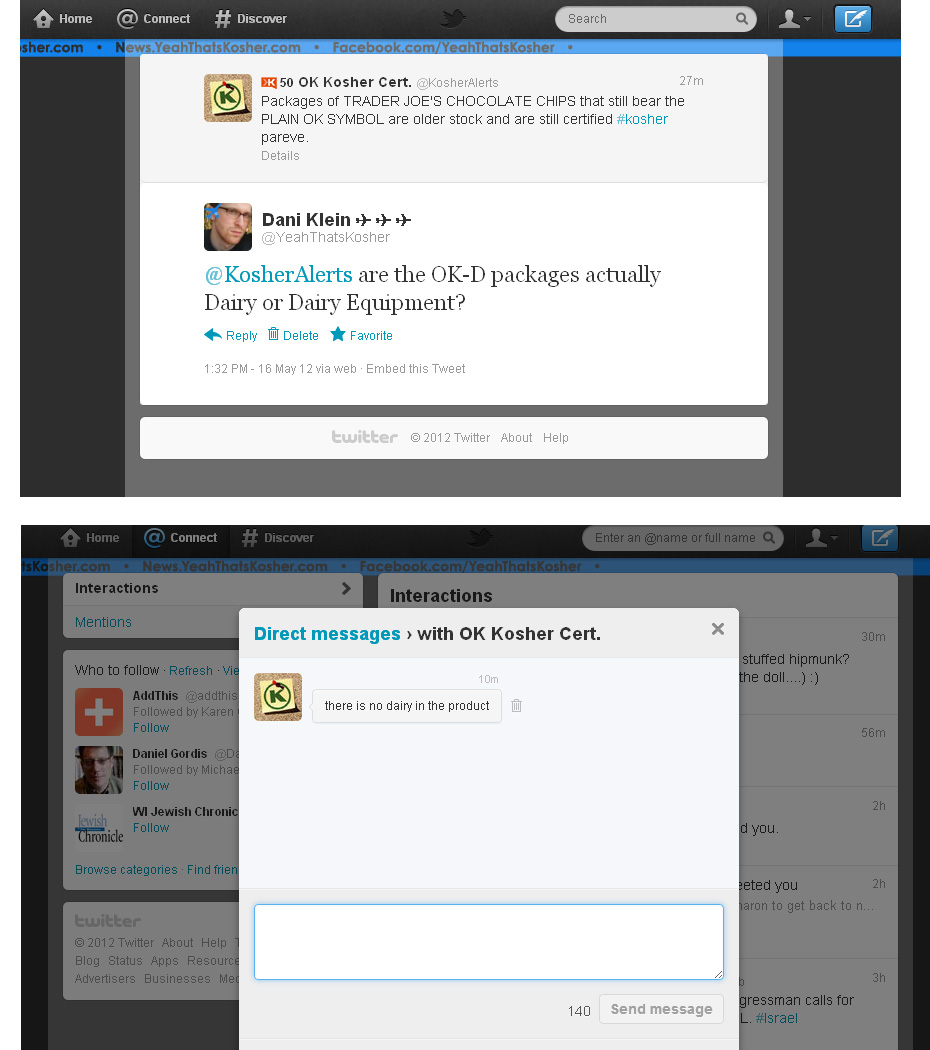
There was also a lot of misinformation about the change. Dani Klein of the YeahThatsKosher blog posted a private Direct Message from Twitter that he received back from the OK Kosher Certification agency stating that the chocolate chips will not contain dairy, but will be labeled as such. There were also discussions that the new designation would actually be "DE" for dairy equipment, a relatively new kosher status that means the product is not dairy but the equipment could be used for dairy products. The Dairy Equipment designation means that food products with that status cannot be eaten with a meat meal, but can be eaten following that meal.

The news that it would be a dairy equipment hekhsher and not a bona fide dairy label resulted in several discussions on Facebook about that designation, how food labeled with the DE should be treated, and what the ramifications of a DE label are for dairy allergic individuals who rely on a pareve hekhsher for health reasons. Were people reacting too quickly? Was Trader Joe's even changing the production process of the chocolate chips?

Today, Dani Klein actually contacted the OK Kosher Certification Agency today and got to the bottom of this story. He was told that the chocolate chip product itself is not dairy, but the product is bagged at the end of the assembly line and neither Trader Joe's or the OK Kosher Certification Agency can guarantee that dairy chocolate chips don't also mix into the bag. This means that a bag of Trader Joe's pareve chocolate chips may or may not have some dairy chips mixed into a bag. That is why the OK is taking the position that these bags of chocolate chips should bear the OK-D certification as if they were dairy. Further, Klein was told by OK officials that the response he received via Twitter was an error and should have been redacted.

So, the bottom line is that the chocolate chips probably should have been labeled as "dairy" all along because they couldn't guarantee no dairy chips were mixed in by accident (although if it's less than 1/60th of the total volume of the bag it would still be pareve based on the principle of batel b'shishim).

There are other pareve chocolate chips available on the market, but Chocolate Chip-Gate demonstrates just how much Trader Joe's fans have come to rely on the market's specialty products.

While I am involved in the kosher certification industry through Kosher Michigan, this blog does not seek to set forth any kosher guidelines. Individuals should consult with their local rabbinic authority as to how they will treat Trader Joe's kosher chocolate chips in the future.

Friday, May 11, 2012

Barack Obama, Marriage Equality and Lag Ba'Omer

On Tuesday, October 28, 2003 I clicked "Publish" for the first time on this blog. This is my 1,000th blog post.

In my first blog post I simply wrote, "Welcome to my new Blog. I haven't yet decided what I will use this forum for, but we'll see. It will likely have some of my writings, as well as some news articles that I find of interest. Thanks for visiting and enjoy!" No one read it.

Now, over eight-and-a-half years later my blog has been visited over half-a-million times and each post averages 1,000 readers.

So, what should my 1,000th blog post be about I wondered. I decided to take the advice I give to would-be-bloggers all the time: "Write about what's happening in the world and how it affects you and your community."

Yesterday was Lag Ba'Omer, the thirty-third day of the Counting of the Omer. During this time of year almost 2,000 years ago, the Jewish tradition teaches, a plague killed thousands of Rabbi Akiva's students because they did not treat one another respectfully. According to a medieval tradition, this plague ended on Lag Ba'Omer. Thus, in modern times Lag Ba'Omer is treated as a festive day with celebration.

Yesterday, on Lag Ba'Omer 2012, President Barack Obama became the first sitting president to fully endorse same-sex marriage. There will be those who will surmise that the President's statements were made for political gain, but his words were powerful and historic and appreciated by millions.


Homosexuality is not an easy subject to deal with in Judaism. Based on a few words in the Torah, the issue is one of the most divisive in Jewish communities today. However, in very recent years and based on several monumental decisions, many in the more progressive Jewish communities have come to see this issue as a matter of human dignity (Hebrew: k'vod habriyot).

For gays and lesbians who have fought for marriage equality, Lag Ba'Omer 2012 was an epic day in which a plague ended.

Marriage in the minds of millions is the joining of a man and a woman in a holy union. We all have that traditional image of marriage because that is all we have known. However, times change. And with the changing of the times, the conventions we have long maintained change as well.

For many Jewish people, the Torah's stance on homosexuality will continue to be clear, certain and immutable. However, for a good many people, there is much room for interpretation. And the interpretation of the Torah will be impacted by several factors including the dignity of real, living and breathing human beings who desire to love and be loved. Human beings who seek the equal rights of marriage regardless of their sexual orientation.


When I began my rabbinical studies at the Jewish Theological Seminary (JTS) in New York in 1998, I believed that homosexuality was a sin in Judaism. Admittedly, I hadn't spent much time studying the applicable texts in the Torah or the commentary on the subject. I also didn't know any gay or lesbian people (or at least I didn't know they were gay or lesbian at the time). Throughout the course of my time at JTS, I came to understand how our community's treatment of gays and lesbians has real and lasting effects on people's lives. I got involved in a group called Keshet (rainbow), which advocated for the inclusion of gays and lesbians in the rabbinical and cantorial schools of JTS.

During my final year at JTS I served as President of the Rabbinical School Student Organization. On the last day of my term in office, I signed off on a major allocation of funds to be directed to Keshet and used for programming to educate the Seminary community about LGBT issues. During my first years as a rabbi I watched with great interest as JTS students worked hard to encourage the Seminary to open its doors to gays and lesbians who wished to lead the Jewish community as rabbis and cantors. With great admiration and appreciation from afar, I witnessed change being implemented.

The passing of a teshuva (religious opinion) by the Conservative Movement's Committee on Jewish Law and Standards in December 2006 paved the way for gays and lesbians to enter JTS in the rabbinical and cantorial schools. The teshuva was co-authored by my teacher and friend, Rabbi Danny Nevins, who now serves as the dean of the rabbinical school there. It was his understanding that LGBT issues fit into the category of human dignity that served as the foundation of the teshuva.

Just as we've seen major change occur with regard to domestic partner benefits, the ordination of gay and lesbian rabbis and cantors, and the ability for rabbis to perform commitment ceremonies, we are now witnessing the epic moment when marriage equality will be realized for the LGBT community. President Obama's statement will be regarded as a watershed moment for this cause.

Same-sex marriage does not mean we no longer take the word of the Torah to heart. It doesn't mean we are overruling God. It means that we are giving homosexuals the same rights to be in a committed, loving relationship that has been blessed and sanctified. That is certainly a matter of human dignity in my opinion.

Kabbalah, the Jewish mystical tradition, teaches that the appearance of a rainbow will bring redemption just as a rainbow appeared following the great flood in biblical times.

In addition to Lag Ba'Omer being the day on which the plague was lifted from the students of Rabbi Akiva and they stopped dying, it also corresponds with the date on which Rabbi Shimon bar Yochai died. While the anniversary of a great sage's death seems an odd time to celebrate, we learn that on the day Rabbi Shimon passed away a great light of endless joy filled the day. The happiness on that day was to the sage and his students "like that of a groom while standing under the canopy at his wedding." In modern times, religious Jews flock to the grave of Rabbi Shimon bar Yochai in the city of Meron on Lag Ba'Omer where they sing and dance.

Another tradition on Lag Ba'Omer is for children to play with bows and arrows. The "bow" symbolizes a rainbow because it is believed that a rainbow was never seen during the lifetime of Rabbi Shimon bar Yochai. Tradition tells us that the sage himself was the sign of the rainbow.

And so, it is inspiring and meaningful that on Lag Ba'Omer, a day celebrated for a plague ending and the anniversary of the death of a great sage who was compared to a rainbow (Hebrew: keshet), the symbol of the LGBT pride movement, the President of the United States articulated his convictions that gays and lesbians should have the right to marry.

May the gentle radiance of the rainbow be a sign of God's blessings on all of us who seek dignity and equality for all human beings. May the love that two people have for each other, regardless of sexual orientation, be blessed and made sanctified for the entirety of their lives together. Thank you Mr. President for helping to bring about this necessary freedom of equality.

Tuesday, May 08, 2012

The Jewish Flavor of Maurice Sendak

Originally published on JTA.org

A few months after my first child was born, I went to a bookstore to buy a few books that I thought needed to be on the bookshelf of my new baby’s nursery. Maurice Sendak's "Where the Wild Things Are" was one of those books.

A childhood favorite of mine, I knew the day would come when I would read it to my son as part of our bedtime ritual. I immediately recalled that bookstore visit when I heard the news that Sendak had died Tuesday from complications of a stroke. He was 83.

Much has been written about Sendak’s imagination and his uncanny ability to create characters to whom children can relate. Many of the characters in his books were developed based on the Torah stories that his father told him as a child. Sendak has said that he embellished those stories to make them more interesting for children.


It wasn’t until I was an adult that I saw the Jewish flavor that peppers Sendak’s works.

The characters in his most well-known children’s story are based on his old Jewish relatives. In some of his stories, Yiddish words are interspersed with his poetic English.

“Where the Wild Things Are” is even based on the Yiddish vilde chaya (wild beast), which Jewish parents for generations have used to describe rambunctious children.

Some of Sendak’s stories, including “In the Night Kitchen,” speak to his own fears of the Holocaust. His immigrant parents lost most of their family members in the Holocaust and reminded him that he would have had many more cousins were it not for the Nazis.

Having learned that Sendak was influenced by his father’s nightly bedtime stories drawn from the Torah, I have found real value and meaning in reading Sendak’s books to my own children at bedtime. His children’s stories are my kids' most requested bedtime books.

Over the years, I've read “Where the Wild Things Are” to my children many times. In fact, I recently read it to them in Hebrew.

Just a week ago, my daughter brought home a Hebrew version of Sendak’s masterpiece. His brilliance comes through no matter the language.

Turning the pages of the Hebrew translation, I began to laugh as I recalled the author’s uproarious appearance on "The Colbert Report" earlier this year.

Even at 83, Sendak was still entertaining both children and their parents.

His memorable illustrations and ability to turn scary monsters into lovable friends will live on into future generations, and I look forward to the day when my own children will read the stories of Sendak’s wonderful imagination to my grandchildren.

Sunday, May 06, 2012

Could Miguel Cotto Be Sued By Orthodox Union Over Kosher Tattoo?

Boxer Miguel Cotto lost to Floyd Mayweather Jr. last night in a unanimous decision in the MGM Grand Garden Arena in Las Vegas. As I've written about before on this blog, Miguel Cotto sports a tattoo on his right collarbone that represents the kosher symbol used by the Orthodox Union (a circle containing the letter "U"). Cotto got the well-known and internationally recognized symbol tattooed on him as a gesture for a Jewish friend. Seeing Cotto's tattoo again last night during his fight made me wonder if there might be any legal ramifications to Cotto sporting a trademarked image in such a public way.


The Union of Orthodox Congregations of American is the largest kosher certification agency in the world with its hekhsher (kosher certification symbol) on over 500,000 products worldwide. The OU, as it is commonly called, has been unrelenting in its protection of its famous trademark. As the most recognized kosher symbol, many food manufacturing businesses (especially in the Far East) think that the OU symbol is a generic kosher code and place it on their product without permission.  As Sue Fishkoff reported in her book Kosher Nation, the OU employs a large legal department whose mission is to locate violations of usage of the OU symbol anywhere in the world, issue a cease and desist order, and file a suit if there's no compliance.

In the past week I've read two articles about ongoing lawsuits filed by the Orthodox Union against companies using the OU symbol. Watching Miguel Cotto dance around the ring last night with his OU tattoo in full sight, I considered if this might be a trademark violation on the radar screen of the OU's legal department.

The Orthodox Union recently sued a Maine organic dairy for trademark infringement. The OU claims that Maine’s Own Organic Milk Company L3C used the OU trademark without authorization. The Orthodox Union said it initially contacted the dairy about its unauthorized use of the hekhsher in June 2010 and the dairy, known as MOOMilk, applied for certification that month and received an initial inspection, but the dairy never paid the fees and continued to use the kosher symbol on its cartons without authorization. The Orthodox union said it’s harmed by the unauthorized use of the mark, and that kosher consumers are likely to be confused and misled when they see it on MOOMilk’s products.


That's the most common example of violation against a kosher symbol. But the OU also has to deal with companies using the OU symbol as an innocent mistake. Also this week it was reported that a coffee roastery in New Zealand, Christchurch's Underground Coffee, is being sued for using a logo that is similar to the OU's registered trademark. Underground Coffee has been using that logo since 1998, but it only became known to the Orthodox Union recently when Starbucks stores in New Zealand began selling the product.

The OU claims that the coffee's logo is "likely to deceive or cause confusion" to consumers. Apparently many travellers to New Zealand asked local rabbis if Underground was kosher and others had reported it to the union as an infringement.

There's no confusion as to Miguel Cotto's kosher status and it's entirely possible that the Orthodox Union appreciates the free publicity. But who knows what the OU legal department will think of Cotto's tattoo, which could be considered an unauthorized use of a registered trademark.

Legal experts: What do you think?