Showing posts with label Barack Obama. Show all posts

Tuesday, February 24, 2015

Why Netanyahu Should Address Congress Next Month

When it comes to politics, I've always thought that it's fair game for rabbis to weigh in. After all, I have a pulpit and a blog and I'm not afraid to use them. However, the caveat I have always made is that I am not a political pundit. I have no more expertise in U.S. foreign policy than the next guy who reads the Wall Street Journal every day and gets weekly email briefings from AIPAC, my undergrad degree in International Relations notwithstanding.

So, when the whole brouhaha broke about Rep. John Boehner inviting Israeli Prime Minister Benjamin Netanyahu to speak before Congress without the blessings of the Obama Administration, I kept my opinion to myself. It certainly didn't seem like a controversy. Boehner's the Speaker of the House and is entitled to invite foreign dignitaries to speak there as he sees fit. I certainly wouldn't want the invitation to Netanyahu to compromise the unique relationship (or as AIPAC calls it, "The Friendship") between the United States and Israel to be tarnished, but that shouldn't happen I reasoned. Not to mention, Netanyahu is an intelligent and charismatic speaker who could certainly enlighten members of Congress about the situation with Iran's nuclear program.

Israeli Prime Minister Benjamin Netanyahu (WikiCommons)
The day after the news broke that President Obama was not happy about Boehner's invitation to Netanyahu, I had the privilege of hearing WSJ columnist Bret Stephens speak at Adat Shalom Synagogue at a Michigan AIPAC event. When asked about the Boehner-Netanyahu-Obama turbulence, Stephens reminded everyone in attendance about what we learned back in 5th grade about the U.S. structure of governance. The system of checks and balances is such that Congress doesn't have to ask permission from the Executive Branch before inviting a foreign head of state to speak to its members. That makes sense.

Thursday, April 17, 2014

The White House Passover Seder Tradition (As Told By Eric Lesser)

I led a Birthright Israel trip in December 2004 with half of the college student participants on our bus from the University of Michigan and the other half from Harvard. Before the trip I was a little concerned as to how the two groups of students would get along on the ten day experience.

However, not only did the Harvard and Michigan undergrads get along great in Israel, but there were some lifelong friendships that were formed. I had a wonderful time co-leading the trip with Gabi Soble, a kindhearted, talented staff member from Harvard Hillel. I also got to know some really impressive young people from Harvard including Eric Lesser. It was clear to me that Eric would go on to do big things in his career and the former President Obama aide is currently on leave from Harvard Law School to run for State Senate in Massachusetts. Of course, he has my full endorsement.

Eric Lesser for State Senate - Rabbi Jason Miller (Israel)
On a Birthright Israel trip with Eric Lesser packing food for the homeless in Israel

Tuesday, November 06, 2012

The Jewish Value of Voting

I don't recall "The Jewish Vote" ever being such a widely discussed topic during a presidential election in my lifetime. Not only is there speculation about how American Jews will vote today, but opinion polling of Israelis is making world news as well.

A Times of Israel survey of 400 adult Israelis showed they prefer GOP candidate Mitt Romney (45%) to President Barack Obama (29%) for president. And according to "exit polling" of Israeli expats who voted absentee in the U.S. elections (up over 400% this election) conducted by ivoteisrael.org, a full 85% reportedly voted for Romney. President Obama only received 14.3%, which is 40% lower than the vote he received from Israel in 2008 thereby making Israel even more Republican-leaning than Utah, Oklahoma or Wyoming.


Friday, August 31, 2012

Clint Eastwood Talks to Obama's Empty Chair

Watching Clint Eastwood's speech at the Republican National Committee convention last night I just knew it would turn into a meme and a Twitter frenzy. And it did.

Clint Eastwood performing an old comedic routine of talking to an empty chair made international news immediately. Some called it funny, while others thought it was disrespectful to the sitting President of the United States. Most people thought the shtick made Eastwood look a bit crazy.

This morning I tweeted the following joke: "Flipping through channels last night & watched few mins of Gran Torino. Confused. Don't remember scene where Clint Eastwood talks to chair." That tweet immediately got this funny response from Twitter user ‏@skii_bum1985: "@RabbiJason I learned something important the other night: Don't invite Clint Eastwood to a Seder, he might yell at the empty chair."

That would turn out to be the first of many connections made between the imaginary seat of Barack Obama to the empty seat of Elijah. My colleague and friend Rabbi Rachel Gurevitz submitted a wonderful post to the PopJewish.com blog that compares Obama's empty seat with Elijah's at every bris. She writes:

Elijah's Chair was the original empty chair. It shows up at a Bris (circumcision) in particular, but there are other community occasions when the idea of an empty chair - an extra seat that indicates openness to receiving an unexpected visitor or guest - is commonly referred to as 'Elijah's chair'. On Passover, we also have the tradition of 'Elijah's Cup'. The story behind this tradition is that there were certain questions that the Sages of the Talmud were unsure how to answer, specifically with regard to how they designed the Passover Seder ritual, but on other occasions as well. Elijah, who is held in Jewish tradition to return to announce the arrival of the Messiah, would be able to resolve our unanswered questions when he did so.


Of course a meme has been started based on Clint Eastwood's performance last night. I thought this one was pretty funny:

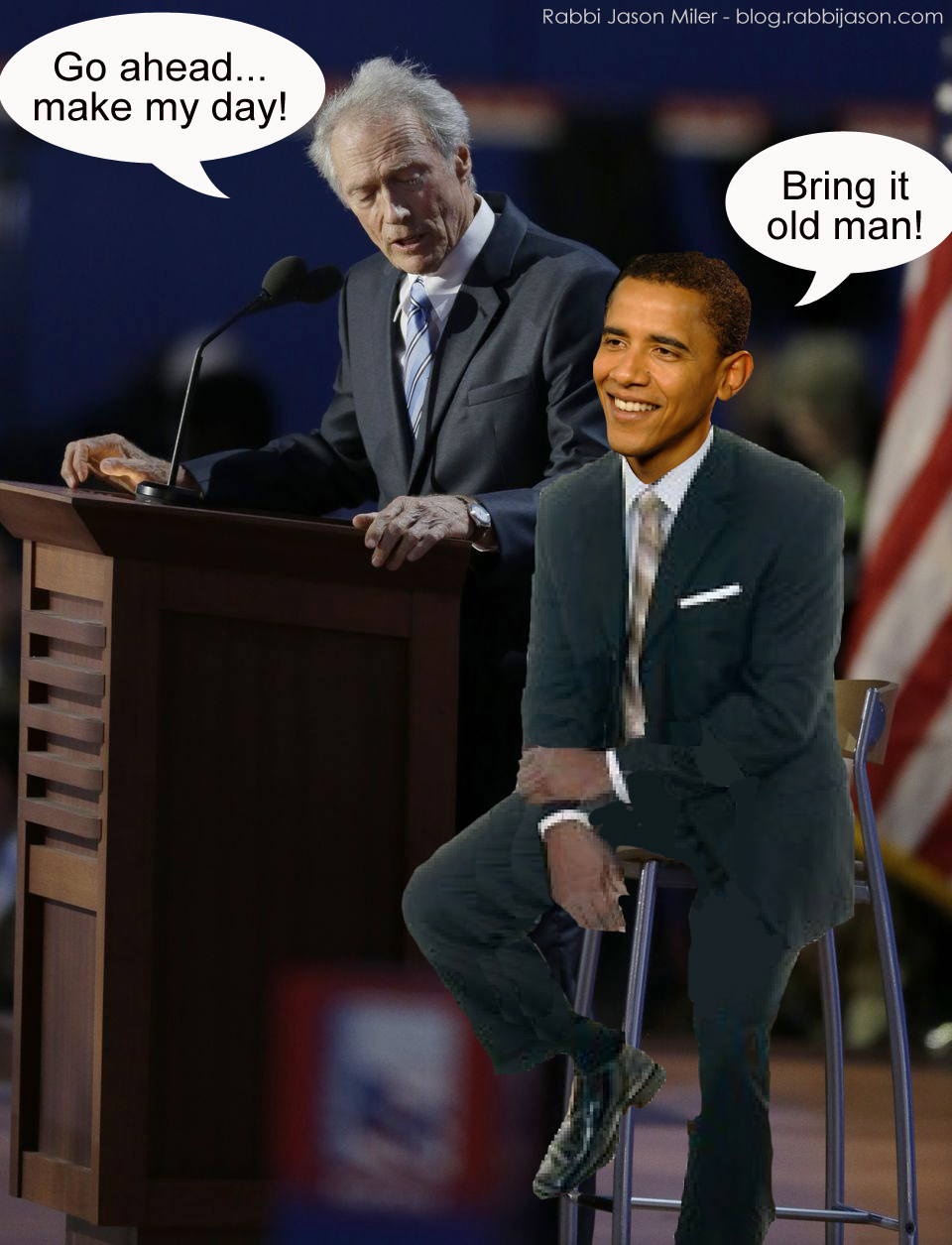
I created my own contributions to the meme using Photoshop. Here is Clint Eastwood at Barack Obama's bar mitzvah as he hoists him up in the chair during the Hora dance:


 And here's the imagined conversation if President Obama were actually sitting in the chair:


As Rabbi Gurevitz notes, the idea of an "Elijah chair" for Obama isn't such a stretch. Tablet, an online journal, related a few months ago that some of Obama's donors use the term "Elijah's Chair" to refer to the empty chair left at the tables of certain major donors just in case the President comes by to sit and shmooze.

Well, at least Clint Eastwood brought some fun to what are usually pretty dull conventions.

Friday, May 11, 2012

Barack Obama, Marriage Equality and Lag Ba'Omer

On Tuesday, October 28, 2003 I clicked "Publish" for the first time on this blog. This is my 1,000th blog post.

In my first blog post I simply wrote, "Welcome to my new Blog. I haven't yet decided what I will use this forum for, but we'll see. It will likely have some of my writings, as well as some news articles that I find of interest. Thanks for visiting and enjoy!" No one read it.

Now, over eight-and-a-half years later my blog has been visited over half-a-million times and each post averages 1,000 readers.

So, what should my 1,000th blog post be about I wondered. I decided to take the advice I give to would-be-bloggers all the time: "Write about what's happening in the world and how it affects you and your community."

Yesterday was Lag Ba'Omer, the thirty-third day of the Counting of the Omer. During this time of year almost 2,000 years ago, the Jewish tradition teaches, a plague killed thousands of Rabbi Akiva's students because they did not treat one another respectfully. According to a medieval tradition, this plague ended on Lag Ba'Omer. Thus, in modern times Lag Ba'Omer is treated as a festive day with celebration.

Yesterday, on Lag Ba'Omer 2012, President Barack Obama became the first sitting president to fully endorse same-sex marriage. There will be those who will surmise that the President's statements were made for political gain, but his words were powerful and historic and appreciated by millions.


Homosexuality is not an easy subject to deal with in Judaism. Based on a few words in the Torah, the issue is one of the most divisive in Jewish communities today. However, in very recent years and based on several monumental decisions, many in the more progressive Jewish communities have come to see this issue as a matter of human dignity (Hebrew: k'vod habriyot).

For gays and lesbians who have fought for marriage equality, Lag Ba'Omer 2012 was an epic day in which a plague ended.

Marriage in the minds of millions is the joining of a man and a woman in a holy union. We all have that traditional image of marriage because that is all we have known. However, times change. And with the changing of the times, the conventions we have long maintained change as well.

For many Jewish people, the Torah's stance on homosexuality will continue to be clear, certain and immutable. However, for a good many people, there is much room for interpretation. And the interpretation of the Torah will be impacted by several factors including the dignity of real, living and breathing human beings who desire to love and be loved. Human beings who seek the equal rights of marriage regardless of their sexual orientation.


When I began my rabbinical studies at the Jewish Theological Seminary (JTS) in New York in 1998, I believed that homosexuality was a sin in Judaism. Admittedly, I hadn't spent much time studying the applicable texts in the Torah or the commentary on the subject. I also didn't know any gay or lesbian people (or at least I didn't know they were gay or lesbian at the time). Throughout the course of my time at JTS, I came to understand how our community's treatment of gays and lesbians has real and lasting effects on people's lives. I got involved in a group called Keshet (rainbow), which advocated for the inclusion of gays and lesbians in the rabbinical and cantorial schools of JTS.

During my final year at JTS I served as President of the Rabbinical School Student Organization. On the last day of my term in office, I signed off on a major allocation of funds to be directed to Keshet and used for programming to educate the Seminary community about LGBT issues. During my first years as a rabbi I watched with great interest as JTS students worked hard to encourage the Seminary to open its doors to gays and lesbians who wished to lead the Jewish community as rabbis and cantors. With great admiration and appreciation from afar, I witnessed change being implemented.

The passing of a teshuva (religious opinion) by the Conservative Movement's Committee on Jewish Law and Standards in December 2006 paved the way for gays and lesbians to enter JTS in the rabbinical and cantorial schools. The teshuva was co-authored by my teacher and friend, Rabbi Danny Nevins, who now serves as the dean of the rabbinical school there. It was his understanding that LGBT issues fit into the category of human dignity that served as the foundation of the teshuva.

Just as we've seen major change occur with regard to domestic partner benefits, the ordination of gay and lesbian rabbis and cantors, and the ability for rabbis to perform commitment ceremonies, we are now witnessing the epic moment when marriage equality will be realized for the LGBT community. President Obama's statement will be regarded as a watershed moment for this cause.

Same-sex marriage does not mean we no longer take the word of the Torah to heart. It doesn't mean we are overruling God. It means that we are giving homosexuals the same rights to be in a committed, loving relationship that has been blessed and sanctified. That is certainly a matter of human dignity in my opinion.

Kabbalah, the Jewish mystical tradition, teaches that the appearance of a rainbow will bring redemption just as a rainbow appeared following the great flood in biblical times.

In addition to Lag Ba'Omer being the day on which the plague was lifted from the students of Rabbi Akiva and they stopped dying, it also corresponds with the date on which Rabbi Shimon bar Yochai died. While the anniversary of a great sage's death seems an odd time to celebrate, we learn that on the day Rabbi Shimon passed away a great light of endless joy filled the day. The happiness on that day was to the sage and his students "like that of a groom while standing under the canopy at his wedding." In modern times, religious Jews flock to the grave of Rabbi Shimon bar Yochai in the city of Meron on Lag Ba'Omer where they sing and dance.

Another tradition on Lag Ba'Omer is for children to play with bows and arrows. The "bow" symbolizes a rainbow because it is believed that a rainbow was never seen during the lifetime of Rabbi Shimon bar Yochai. Tradition tells us that the sage himself was the sign of the rainbow.

And so, it is inspiring and meaningful that on Lag Ba'Omer, a day celebrated for a plague ending and the anniversary of the death of a great sage who was compared to a rainbow (Hebrew: keshet), the symbol of the LGBT pride movement, the President of the United States articulated his convictions that gays and lesbians should have the right to marry.

May the gentle radiance of the rainbow be a sign of God's blessings on all of us who seek dignity and equality for all human beings. May the love that two people have for each other, regardless of sexual orientation, be blessed and made sanctified for the entirety of their lives together. Thank you Mr. President for helping to bring about this necessary freedom of equality.

Thursday, February 23, 2012

The Barack Obamulke Yarmulke

There is much discussion about "The Jewish Vote" in the ongoing presidential race. While "Jews for George" made headlines during the 2004 campaign and more Jews than expected voted for McCain in 2008, in the 2012 election the political pundits are already predicting a large shift among Jewish voters, who historically have voted overwhelmingly Democrat.


Aside from polling numbers, another way to determine how the Jewish vote is shaping up will be from yarmulke sales. In the past few presidential elections the nominees from both major parties have had their name and logo embroidered on suede yarmulkes (or kippahs) as one more way for supporters to promote their candidate.

Already, yarmulkes featuring President Obama's re-election campaign logo are being offered for sale on the Web. The Obama Yarmulkes were famously known as "Obamulkes" when they first appeared in 2007. The ivory suede yarmulkes with the 2012 Obama re-election logo are available for pre-order online or in person at J. Levine Books & Judaica in NYC. Of course, it is being emphasized that these kippahs are made in the USA as it would be scandalous if they were made anywhere else. The yarmulkes are selling for $9 each at Obamulkes.com (with a $5 shipping charge). No doubt they'll be on the heads of many Obama supporters at the upcoming AIPAC Policy Conference at the Washington Convention Center in early March and on college campuses around the country.

Matthew Walters, the creator of the Obamulkes, isn't naive. He knows that there will be many Jews who aren't fans of the president and won't like seeing the Obama re-election campaign logo featured on a Jewish religious item. But he offers a different perspective: "As a Jewish American who's also a vocal supporter of President Obama, I see the Obamulke yarmulke as a unique conversation starter. With so much at stake at the ballot box in 2012, there's a real value in wearing your politics on your sleeve -- or in this case, keppe (Yiddish for head)," he explains.

During the 2008 campaign, more than 1,500 Obamulkes were delivered to Jewish supporters all around the country, but the most memorable recipient turned out to be Barack Obama himself. "In November 2007, then-candidate Barack Obama came to New York to give an historic speech at the Apollo Theater in Harlem," Walters remembers. "I had a chance to meet him, so I handed him one of our 2008 Obamulkes. He laughed and showed it to his Secret Service guys. I think he got a little kick out of it."

Monday, January 09, 2012

Jack Lew, Obama's New Chief of Staff is Shomer Shabbat

Will President Barack Obama's new Chief of Staff answer the President's phone call on Shabbat? It would appear that the answer to that question will be yes (even though he's Shomer Shabbos).

Obama's pick to succeed William Daley as his Chief of Staff is Jack Lew. Lew is currently a senior administration official who has served as the Director of the Office of Management and Budget. Jack Lew is a practicing Orthodox Jew who observes Shabbat, the Jewish day of rest. He has been an active member of both Congregation Beth Sholom of Potomac, Maryland and the Riverdale Jewish Center the Hebrew Institute of Riverdale (HIR) in New York.

Jack Lew, a Sabbath Observant Jew, will become Obama's third Chief of Staff

While serving as Director of the Office of Management and Budget in the Bill Clinton administration, Lew received a phone call from the president. He decided to take it and later consulted with his rabbi, who said that taking an important phone call from the President of the United States would be permissible on the Sabbath under the Talmudic teaching that work on the Sabbath is allowed in order to save a life.

President Obama's first Chief of Staff was Rahm Emanuel who now serves as Mayor of Chicago. Rahm Emanuel considers himself to be a Conservative Jew and is not Shomer Shabbat -- Sabbath observant. (Emanuel attends both the Modern Orthodox Anshe Sholom B'nai Israel Synagogue and the Conservative-affiliated Anshe Emet Synagogue in Chicago.) That makes Jack Lew the first Sabbath observant holder of the Chief of Staff office (Reagan's former Chief of Staff Ken Duberstein was an observant Jew but was not Shomer Shabbat).

The transition from Daley to Lew is set to take place at the end of this month.

Sunday, December 18, 2011

Obama's Bar Mitzvah Speech

President Barack Obama gave what even he described as a "Bar Mitzvah speech" at the Union for Reform Judaism (URJ) Biennial on Friday afternoon. Love him or hate him, the President gave an impressive speech that earned him no less than 70 rounds of applause.


In the speech, he not only defended his administration's record on Israel, but claimed that, "no U.S. administration has done more in support of Israel's security than ours. None. Don't let anybody else tell you otherwise. It is a fact."

Telling the audience that his daughter Malia has been on the bar and bat mitzvah circuit, he took his daughter’s advice and gave a D’var Torah about this week's Torah portion. Obama's message focused on the Hebrew word "Hineini" (I Am Here) saying that like Joseph from the Torah, he is here and ready to take on challenges even if he can’t predict them all. He also dropped some other Hebrew words, but didn't pronounce all of them well. He struggled to pronounce the term "Tikkun Olam" but fared better with other words and received a rousing ovation when he wished the audience a "Shabbat Shalom."

Obama's "Shabbat Shalom" came with the acknowledgement that he knew it was still a few hours before the Jewish Sabbath. He said, "Even though it is a few hours early, I'd like to wish all of you Shabbat shalom." His former Chief of Staff Rahm Emanuel (or any other Jewish adviser for that matter) could have informed him that we Jews start wishing each other "Shabbat Shalom" as much as 24 hours prior to the actual Shabbat. My sense is that Obama knows this and his statement was a tongue-in-cheek reference to the criticism he received for hosting the White House Hanukkah party two weeks before the actual holiday.

Who knows if "Hineini" will replace "Hope" as Obama's 2012 campaign slogan, but here are some Obama Hineini t-shirts and products just in case (available online).


Thursday, November 10, 2011

Celebrity Shabbat Shalom Greetings

Sending out a weekly e-mail newsletter to friends has become a passion for Lisa Mark Lis.

Lis, a suburban Detroit-based community activist and philanthropist, in her Friday morning e-mail posts to friends and family not only wishes her readers a “Shabbat Shalom,” but she often has a celebrity extend their wishes, too.

Lisa Mark Lis videos U.S. Representatives Debbie Wasserman Schultz and Gary Peters.

Lis has videotaped such notable performers as James Taylor, Carole King, Paul Simon, Neil Sedaka and David Broza sending Shabbat best. Politicians as far up as President Obama, with first lady Michelle Obama, have offered “Shabbat Shalom” wishes on camera for Lis, as have U.S. Rep. Debbie Wasserman Schultz (D-Fla.), the chair of the Democratic National Committee, and U.S. Sen. Debbie Stabenow (D-Mich.). Other celebs who have participated include "Millionaire Matchmaker" Patti Stanger and actor Wallace Shawn, who perhaps is best known for his role in “The Princess Bride.”

Lis isn't shy about asking for a quick “Shabbat Shalom” greeting when running into a celebrity. When she told Marvin Hamlisch about some of the famous people who had recorded messages, the composer raised a glass of champagne to Lis’ camera phone and said, “I’m not Paul Simon and I’m not James Taylor. I’m Marvin Hamlisch and yes, I know how to say 'Shabbat Shalom.' "

She's been sending her weekly greeting every Friday for nearly 2 1/2 years. She isn’t sure how many people are on her distribution list, but it includes friends and family from around the world, including a large contingent in Israel (her husband, Hannan, is a native Israeli).

Lis says she sends out the messages to wish as many people as possible a good weekend and to stay in touch with her connections.

“I do it to say 'Shabbat Shalom,' and then anything else I add is my soapbox,” Lis said. “I started to include the video messages of famous people saying 'Shabbat Shalom' as a fun addition to the e-mails. It makes people smile. Now people have come to expect them.”

Political views are included in some of her weekly messages. So are reminders to attend local fundraising events for causes she supports. A paragraph encouraging her readers to remember Israeli soldier Gilad Shalit during his captivity was a staple of each week’s e-mail message until his release last month. Every message includes wishes of “Happy Birthday” and “Mazel Tov” to her friends and family celebrating milestones in the upcoming week.

Lis plans to continue finding the chutzpah to ask celebs and politicians to utter those two Hebrew words for her camera phone. After all, it’s not every Friday that an e-mail arrives with a video of the leader of the free world wishing you a “Shabbat Shalom.”

President Barack Obama's "Shabbat Shalom" Greeting


David Hasselhoff's "Shabbat Shalom" Greeting


Cross-posted to JTA.org

Wednesday, December 23, 2009

White House Comedian Ari Teman Gets a Laugh Out of Obama

Ari Teman is having a great year. First, the Jewish comedian and founder of Jcorps wins the highly competitive Jewish Community Hero award. Next, he gets invited to the White House Hanukkah party. I'm pretty sure it was a legit invite and that he didn't just crash an official White House party like Tareq and Michaele Salahi did last month.

Seth Galena, one-half of the Bangitout.com duo, reported on Facebook about Ari Teman's White House experience. Apparently, he didn't just shake the president's hand in the receiving line, but actually used the time to tell Barack Obama a joke. The party was a who's-who of Jewish D.C. including an assortment of Jewish leaders from across the nation.


Here's the apparent conversation between Ari Teman and the 44th president of the U.S.:

Ari: Mr. President, I'm a comedian from New York --
Obama: Are you funny?
Ari : I tell jokes about you on stage every night, can I tell you one?
Obama: Sure.
Ari: I'll say "Obama" instead of "Mr. President."
Obama: Sure.
Ari: So, they're calling Obama a Nazi --
Obama: Oh yeah (nodding)
Ari: Which I think is fantastic... because if you thought the Presidency was a tough job for a black guy to get!
[Obama starts cracking up.]
Ari: ...Nazi... we have overcome! Mr. President, you have broken down color barriers.
[Obama, still laughing, shakes Teman's hand again and gives him a hug]
Obama: That's great!!