Showing posts with label Kosher. Show all posts

Thursday, August 12, 2021

I Knew Jack - Remembering Jack Aronson

 I found it very telling when I received a phone call from a contributing writer at the Detroit Jewish News the day after Jack Aronson passed away. She said she was working on an obituary for Jack but was confused. I asked what she was confused about and she told me that she was having trouble verifying if Jack was Jewish. I started to laugh.

Jack Aronson was not Jewish. But I immediately understood why she was confused. The man was so beloved throughout the Jewish community and he received loving tributes from notable Jewish leaders in the immediate hours after his death that it was not surprising this Jewish News writer had begun working on his obituary before realizing that he wasn’t a member of the Jewish community — at least not officially.

Jack Aronson of Garden Fresh Gourmet with Rabbi Jason Miller in Taylor, Michigan


I looked up to Jack Aronson. Both literally and figuratively. Jack was a big man. He was tall, but he loomed even larger when it came to business. And to the community. And to philanthropy. In the food industry, he was legendary.

The first time I met Jack, I told him about my kosher certification agency. He said he wasn't happy with the agency that Garden Fresh was using and so I jokingly told him to have his people give me a call. Not long after that, I received a call from his manager to set up a meeting. Before that meeting ever took place, Jack had sold Garden Fresh to Campbell's for almost a quarter billion dollars. What stuck with me is not that Jack actually followed through and had someone contact me, but that several people told me that he had contacted them to learn more about me and Kosher Michigan. Jack did his research.

Sunday, December 13, 2015

The White House Hanukkah Party 2015

White House Hanukkah Party invitation 2015My wife, Elissa, and I returned home Thursday following a busy two days in Washington D.C. Since becoming parents, we have both really made it a point to not go out in the evenings during Hanukkah, let alone travel out of town away from the kids. However, when I received an invitation to the annual Hanukkah Reception at The White House, we (of course) decided to make an exception knowing it would be quite the experience.

Like so many rabbis and Jewish community leaders I have enthusiastically followed the excitement of the annual Hanukkah party at The White House in past years from the outside looking in by scanning the photos and videos guests upload to Facebook and other social media. This year when the invitation arrived asking for my presence along with a guest, I knew Elissa and I would have a different perspective from the inside. After posting several photos (okay, a lot of photos!) on Facebook and Instagram during the party Wednesday evening, several friends asked me to blog about the experience, so here are some reflections:

We had heard a few fun tidbits from past attendees and they all proved to be true. The line of invited guests on the street outside The White House waiting to be processed by Secret Service security truly is an unofficial Jewish leadership reunion and a "Who's Who" of the American Jewish world. On the advice of some White House Hanukkah Party veterans, we got in line about an hour before the time on the invitation. We were surprised to see that the line was already about 40 people deep when we arrived. From our Uber car we could already see several friends and colleagues walking down the street toward The White House. At the front of the line I was excited to see Rabbi Burt Visotzky, one of my favorite teachers from rabbinical school at the Jewish Theological Seminary.

The other rumor that is completely true is that the lamb chops at The White House are out of this world. Never have I eaten such delicious lamb chops before. They were enough to turn a vegan back into a carnivore. Just delicious! And of course, as in all years, The White House was made kosher and kosher supervised by Rabbi Levi Shemtov, Executive VP of American Friends of Chabad Lubavitch. In addition to all the photos guests post of themselves in front of the portraits of Past Presidents, one of the most common photos is of the sign from Rabbi Shemtov explaining the strict kashrut standards for the evening.

Rabbi Jason Miller with Rabbi Levi Shemtov, Kosher Supervisor at The White House
With Rabbi Levi Shemtov, Kosher Supervisor for the annual Hanukkah Reception at The White House


The security process was very intense, which is not surprising considering it is The White House and the President and First Lady were in attendance. After having our identification checked twice by Secret Service against the list of attendees we were then taken into a small security house one by one to be sniffed by a German Shepherd before going through the security scanners. Once inside The White House, however, it was a very warm and relaxing atmosphere without any concern for our safety.

With Matt Nosanchuk
Each year the annual Hanukkah reception at The White House is organized by the liaison to the Jewish community, a position currently held by Matt Nosanchuk. I had the honor of meeting Matt, a Detroit expat, at the Hanukkah party and I was amazed at what a spectacular job he does. Let's face it, it is not an easy task to produce two back-to-back parties for hundreds of Jewish leaders on the same day. I had a chance to also meet Jarrod Bernstein, a past liaison to the Jewish community position in the Obama administration, at the reception. Waiting for the President to speak, I also spotted Jay Footlick, who was the Jewish liaison in the Clinton Administration.

The Hanukkah party was, as I presumed, not a political event at all. There were Democrats and Republicans in attendance. It really was an opportunity to celebrate Hanukkah and not to debate any divisive political issues. I was, however, concerned about inappropriate comments that some people might make on photos I posted to social media that evening and I didn't want to have to be occupied with monitoring my Facebook account while at the party. So, before I left for Washington, I gave my assistant the task of monitoring my social networks for anything overtly offensive. At the end of the night, I'm happy to say that she only had to remove three comments that were inappropriate.

Rabbi Jason Miller and Elissa Miller at The White House Hanukkah Party


The best piece of advice about the party came from Rabbi Steven Wernick, the CEO of United Synagogue of Conservative Judaism, who had attended the afternoon party. Before we headed out that evening, I asked him for any pointers and he was emphatic about wearing comfortable shoes. I told Elissa and she quickly threw a pair of comfortable shoes into her purse. After standing for a long time waiting for the President and First Lady to enter the room, she switched shoes and was grateful for Steve's advice, especially a few hours later as we made our way from The White House to the Library of Congress for Representative Debbie Wasserman Schultz's Hanukkah party (the "after party" as some refer to the congresswoman's annual get-together).

Rabbi Jason Miller and Elissa Miller with Rep. Debbie Wasserman Schultz
My wife and I with Rep. Debbie Wasserman Schultz at her Hanukkah party at the Library of Congress


The White House is beautiful inside and even more so during the holidays. Guests of the party were free to roam from room to room. Some of the highlights were viewing the portraits of Past Presidents and First Ladies, looking through books in the library, checking out the beautiful candid photos of the First Family that adorned the walls, and admiring the display of the official White House dishes and holiday cards from past administrations. With The White House decorated for Christmas, it was comical to see so many rabbis -- of all denominations -- posing for photos in front of Christmas trees and wreaths.

Elissa Miller with First Lady Michelle Obama at the White House Hanukkah Party
My wife, Elissa Miller, with First Lady Michelle Obama at The White House Hanukkah Party


One of the highlights, of course, was actually shaking hands with President Obama and Mrs. Obama. A White House staff member told Elissa where the best place to stand would be and we took his advice. It was fun watching as the President shmoozed with the kids next to us, asking about their school and sports teams. Before we left for Washington I asked one of my children what he wanted me to bring back for him. I was thinking a t-shirt, but he asked me to get a video of President Obama saying "hi" to him. Surprisingly, I was able to comply!


Many people have asked me about the differences between the afternoon Hanukkah party and the evening Hanukkah party. I too was curious and asked William Daroff earlier in the day. He explained that both parties are essentially the same. The food is the same at both parties and each have a Jewish a capella group perform (The Maccabeats from Yeshiva University sang at the afternoon party and the Chai Notes from Cornell sang in the evening). This year, the afternoon party included a visit from Reuven Rivlin, the President of Israel, and Vice President Joe Biden and Ambassador Ron Dermer were there too. The evening party included all three Jewish Supreme Court justices, Ruth Bader Ginsburg, Stephen Breyer and Elena Kagan, although we only saw Justice Ginsburg who stood right by us during the ceremony (the President jokingly referred to by her nickname, "The Notorious RBG").

Rabbi Jason & Elissa Miller, Ruth Messinger of AJWS and Rep. Eliot Engel
With my wife, Elissa Miller, Ruth Messinger of AJWS and Rep. Eliot Engel


President Rivlin lit the Hanukkah candles at the afternoon party, while at the evening party we had the honor of watching as Holocaust survivor Manny Lindenbaum lit the chanukkiyah with his granddaughter Lauren. President Obama talked about Lindenbaum's story of being born in Germany, deported to Poland, and eventually escaping to England with his brother via the Kindertransport. His parents and sister perished at Auschwitz. The President also shared the story of of how Lindenbaum, at age 81, rode his bicycle 200 miles with his children and grandchildren last year retracing his voyage in Europe and raising money for HIAS (the Hebrew Immigrant Aid Society).

With Holocaust survivor Manny Lindenbaum


After the ceremony, Elissa and I had the pleasure of speaking with him and he explained to us what he was talking with President Obama about when they huddled together following the ceremony. It turns out that when he received the call from The White House asking him to light the menorah, Lindenbaum was looking at a photo of his sister who was very young when she was murdered at Auschwitz. He brought a print out of that photo with him to The White House so his sister's memory would be with him. He teared up as he showed the President the photo.

Rabbi Jason & Elissa Miller with Michigan Rep. Sandy Levin at The White House
With my wife, Elissa, and longtime Michigan Congressman Sandy Levin at The White House


The rabbi who spoke at the afternoon party made news for her speech, which I heard from the C-Span recording of that ceremony. While I agree with her message that we must stand together against hatred and that we should welcome refugees to our great nation, I think that she took a unique honor and used it inappropriately. The way in which she expressed all of her activist positions was undignified in that setting. Rabbi Sid Schwarz, who spoke at the evening party, on the other hand set the perfect tone and spoke beautifully about Hanukkah and its message for us today. I was very impressed by his words, which were meaningful and inspirational. Rabbi Schwarz's father fled Germany right before Kristallnacht and arrived to America on the St. Louis, the final voyage of that ship that arrived safely in America. The next voyage would be turned back to Nazi Europe as the passengers could see Miami and their fate was set. Rabbi Schwarz, like the skillful rabbi he is, used his personal story as a message about the importance of welcoming in refugees. He did it in a very dignified way and I feel honored that he was chosen to speak at the reception we attended.

Manny & Lauren Lindenbaum, Michelle Obama, President Obama & Rabbi Sid Schwarz
Manny and Lauren Lindenbaum, Michelle Obama, President Obama and Rabbi Sid Schwarz


The rich history of The White House was palpable for me as Elissa and I sat on the sofas and touched the doorknobs. I had the opportunity to speak to a woman who was serving glasses of wine. She told me that she began working at The White House a few days following the assassination of President Kennedy, and that while she left her job for a few years she felt compelled to return because it was so rewarding. At the end of the evening we walked over to the windows in the Blue Room and looked out onto the Ellipse as we could see the National Menorah, the National Christmas Tree, and the Washington Monument. It was a moment we'll never forget.


Finally, the part about this experience I will cherish the most is what it means to me as an American to be able to celebrate a Jewish holiday in The White House. Our world is a very dark place right now with a scary amount of hate, violence and divisiveness. There are so many countries in which it is no longer safe to be Jewish, and yet, in its 240th year the United States of America opens the doors of "The People's House" to the Jewish community so we may celebrate our religious holiday in which we bring light into the world. With great humility, I feel truly blessed and honored to have been included in this memorable experience.

Video of the menorah lighting ceremony at The White House Hanukkah Reception 2015:

Tuesday, July 23, 2013

Conan O'Brien Teaches Halacha (Jewish Law)

As the founder and director of a kosher certification agency, people often send me anything and everything having anything to do with kosher certification. So last week when the Rabbinical Council of California first certified a sexual lubricant product as kosher and then rescinded the certification, you can imagine I received several articles about the story.

While I wasn't surprised to see coverage of this story making the rounds on late night TV talk shows, I was taken aback when I saw Conan O'Brien's uber-esoteric halachic schtick on last night's episode of "Conan".

Jewish jokes aren't anything new for Conan O'Brien, who is Irish Catholic. One of Conan's long-time writers is Rob Kutner (@ApocalypseHow), who once wrote for "The Daily Show with Jon Stewart". Kutner has become something of a maven when it comes to writing funny Purim shpiels and created The Shushan Channel, a mail-order Purim shpiel business.

Monday, August 27, 2012

Monday Morning Caption Contest

Leave your funniest caption for the photo below in the comments section:


Tuesday, June 19, 2012

Are Hebrew National Hot Dogs Kosher?

When I awoke this morning to find a few news articles in my "Kosher" Google News Alerts regarding a lawsuit against ConAgra claiming Hebrew National hot dogs aren't kosher, I didn't give it much thought. That's because a large segment of the kosher observant population hasn't considered Hebrew National hot dogs to be kosher for many years.

Wednesday, May 30, 2012

Mark Zuckerberg Eats Kosher in Rome

I'm all for letting Mark Zuckerberg and his new wife Priscilla Chan honeymoon in peace, but I couldn't resist blogging about two noteworthy events that occurred during the newlyweds' Italian vacation.

First, the Facebook Founder and CEO took his bride to a *kosher restaurant in the Jewish area in Rome. The couple dined at Nonna Betta where they spent 32 euros on lunch. There's no word on why Zuckerberg decided to visit the Jewish section of Rome or why he and Priscilla chose a kosher restaurant for lunch.

Mark Zuckerberg and his wife Priscilla Chan at a kosher restaurant in Rome.

At Nonna Betta, Zuckerberg and Chan ate traditional Roman Jewish delicacies including deep-fried artichokes, fried pumpkin flowers and ravioli stuffed with sea bass and artichokes. To drink they each had a glass of water and shared a pot of hot tea.

In addition to Zuck's decision to eat kosher ("When in Rome!") the second notable aspect of the couple's Roman visit was the young billionaire's failure to tip at the restaurant. Waiters at Nonna Betta reported that Zuckerberg acknowledged he was Mark Zuckerberg and then neglected to leave a gratuity. That's an odd omission from someone who's portfolio increases by approximately a billion dollars every time the Facebook stock goes up two points (since its IPO the stock has actually decreased by about 25%).
The restaurant receipt from Mark Zuckerberg's lunch at a kosher restaurant in Rome.

It's possible that Zuckerberg thinks that it's unnecessary to tip in Rome since he reportedly didn't leave a tip the night before at a dinner at Pierluigi (not kosher), a historic trattoria in the heart of Rome. In all fairness to Zuckerberg, it doesn't look like there was any place to add a tip on the receipt (above).

Perhaps Zuckerberg and Chan will continue to seek out kosher fare when they return to Palo Alto. On behalf of the waitstaff I just hope he learns to tip!


*UPDATE: Nonna Betta restaurant in Rome is no longer certified kosher. Tourists should consult a local rabbi regarding the kosher status of this restaurant.

Thursday, May 17, 2012

The Deal With Trader Joe's Kosher Chocolate Chips

At some point yesterday Chocolate Chip-Gate began on Facebook. Word got out that Trader Joe's popular kosher chocolate chips were being re-designated as "kosher dairy" rather than "kosher pareve". Immediately, words like "tragic" and "devastating" were being used to describe the change. Facebook users were recounting their urgent visits to local Trader Joe's locations to grab up the pareve (non-dairy) chocolate chips from the shelf in a way that brought back memories of Coca-Cola fans in the 1980s stockpiling cans of Coke when New Coke came out.


Kosher consumers appreciate the pareve designation on chocolate chips because it allows for the substitution of non-dairy chocolate chips in baking for desserts following a meat meal, which is customary among most kosher-observant carnivores for Shabbat dinner.

As soon as the news that Trader Joe's would substitute the OK pareve hekhsher (kosher certification symbol) for a dairy one, discussion threads were launched on Facebook describing how favorite recipes for trail mix and chocolate chip challah would be an impossibility without the pareve chocolate chips from Trader Joe's. An online petition was started to urge Trader Joe's to reverse the decision.

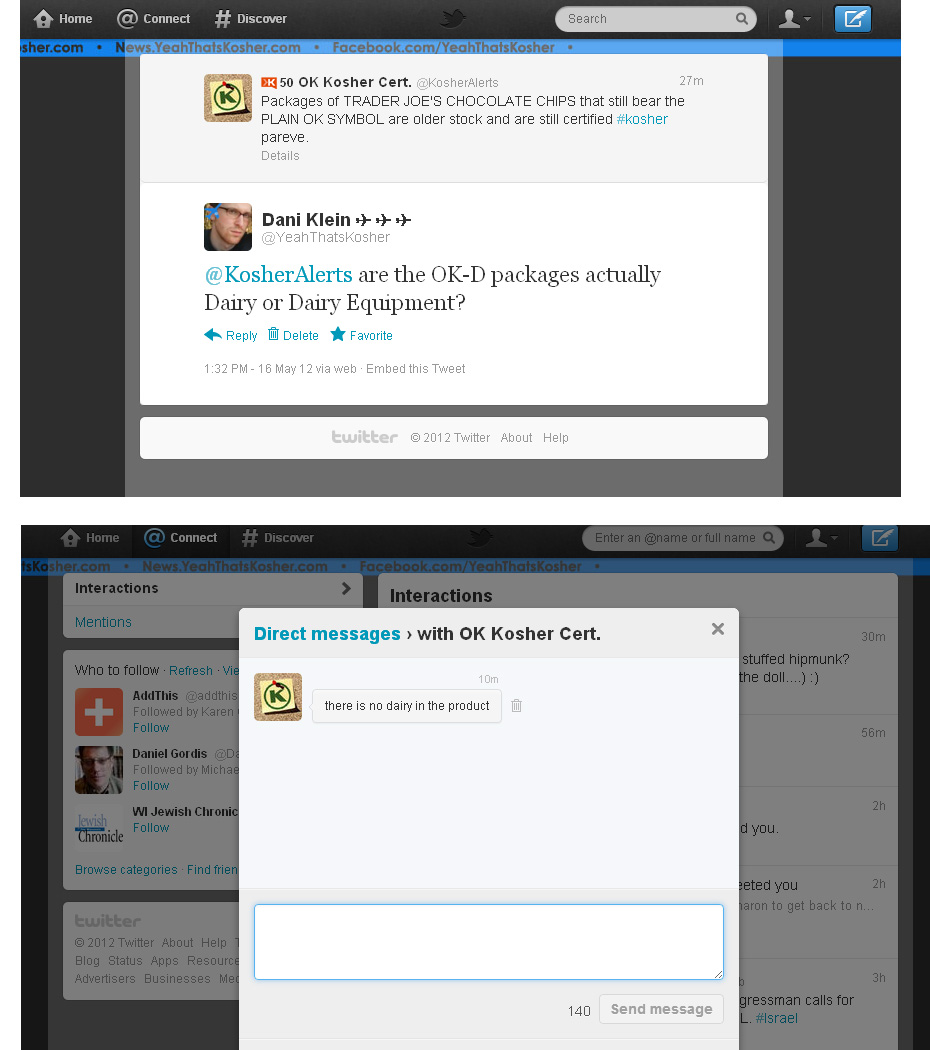
There was also a lot of misinformation about the change. Dani Klein of the YeahThatsKosher blog posted a private Direct Message from Twitter that he received back from the OK Kosher Certification agency stating that the chocolate chips will not contain dairy, but will be labeled as such. There were also discussions that the new designation would actually be "DE" for dairy equipment, a relatively new kosher status that means the product is not dairy but the equipment could be used for dairy products. The Dairy Equipment designation means that food products with that status cannot be eaten with a meat meal, but can be eaten following that meal.

The news that it would be a dairy equipment hekhsher and not a bona fide dairy label resulted in several discussions on Facebook about that designation, how food labeled with the DE should be treated, and what the ramifications of a DE label are for dairy allergic individuals who rely on a pareve hekhsher for health reasons. Were people reacting too quickly? Was Trader Joe's even changing the production process of the chocolate chips?

Today, Dani Klein actually contacted the OK Kosher Certification Agency today and got to the bottom of this story. He was told that the chocolate chip product itself is not dairy, but the product is bagged at the end of the assembly line and neither Trader Joe's or the OK Kosher Certification Agency can guarantee that dairy chocolate chips don't also mix into the bag. This means that a bag of Trader Joe's pareve chocolate chips may or may not have some dairy chips mixed into a bag. That is why the OK is taking the position that these bags of chocolate chips should bear the OK-D certification as if they were dairy. Further, Klein was told by OK officials that the response he received via Twitter was an error and should have been redacted.

So, the bottom line is that the chocolate chips probably should have been labeled as "dairy" all along because they couldn't guarantee no dairy chips were mixed in by accident (although if it's less than 1/60th of the total volume of the bag it would still be pareve based on the principle of batel b'shishim).

There are other pareve chocolate chips available on the market, but Chocolate Chip-Gate demonstrates just how much Trader Joe's fans have come to rely on the market's specialty products.

While I am involved in the kosher certification industry through Kosher Michigan, this blog does not seek to set forth any kosher guidelines. Individuals should consult with their local rabbinic authority as to how they will treat Trader Joe's kosher chocolate chips in the future.

Sunday, May 06, 2012

Could Miguel Cotto Be Sued By Orthodox Union Over Kosher Tattoo?

Boxer Miguel Cotto lost to Floyd Mayweather Jr. last night in a unanimous decision in the MGM Grand Garden Arena in Las Vegas. As I've written about before on this blog, Miguel Cotto sports a tattoo on his right collarbone that represents the kosher symbol used by the Orthodox Union (a circle containing the letter "U"). Cotto got the well-known and internationally recognized symbol tattooed on him as a gesture for a Jewish friend. Seeing Cotto's tattoo again last night during his fight made me wonder if there might be any legal ramifications to Cotto sporting a trademarked image in such a public way.


The Union of Orthodox Congregations of American is the largest kosher certification agency in the world with its hekhsher (kosher certification symbol) on over 500,000 products worldwide. The OU, as it is commonly called, has been unrelenting in its protection of its famous trademark. As the most recognized kosher symbol, many food manufacturing businesses (especially in the Far East) think that the OU symbol is a generic kosher code and place it on their product without permission.  As Sue Fishkoff reported in her book Kosher Nation, the OU employs a large legal department whose mission is to locate violations of usage of the OU symbol anywhere in the world, issue a cease and desist order, and file a suit if there's no compliance.

In the past week I've read two articles about ongoing lawsuits filed by the Orthodox Union against companies using the OU symbol. Watching Miguel Cotto dance around the ring last night with his OU tattoo in full sight, I considered if this might be a trademark violation on the radar screen of the OU's legal department.

The Orthodox Union recently sued a Maine organic dairy for trademark infringement. The OU claims that Maine’s Own Organic Milk Company L3C used the OU trademark without authorization. The Orthodox Union said it initially contacted the dairy about its unauthorized use of the hekhsher in June 2010 and the dairy, known as MOOMilk, applied for certification that month and received an initial inspection, but the dairy never paid the fees and continued to use the kosher symbol on its cartons without authorization. The Orthodox union said it’s harmed by the unauthorized use of the mark, and that kosher consumers are likely to be confused and misled when they see it on MOOMilk’s products.


That's the most common example of violation against a kosher symbol. But the OU also has to deal with companies using the OU symbol as an innocent mistake. Also this week it was reported that a coffee roastery in New Zealand, Christchurch's Underground Coffee, is being sued for using a logo that is similar to the OU's registered trademark. Underground Coffee has been using that logo since 1998, but it only became known to the Orthodox Union recently when Starbucks stores in New Zealand began selling the product.

The OU claims that the coffee's logo is "likely to deceive or cause confusion" to consumers. Apparently many travellers to New Zealand asked local rabbis if Underground was kosher and others had reported it to the union as an infringement.

There's no confusion as to Miguel Cotto's kosher status and it's entirely possible that the Orthodox Union appreciates the free publicity. But who knows what the OU legal department will think of Cotto's tattoo, which could be considered an unauthorized use of a registered trademark.

Legal experts: What do you think?

Thursday, April 05, 2012

Passover and Pet Food

As a kosher supervisor (mashgiach) and the owner of a kosher certification agency, I am constantly impressed by the level of attention, respect and genuine care that non-Jewish business owners demonstrate for their kosher observant customers. I once again witnessed this first hand when I met the owner of Premier Pet Supply last week.

Mike Palmer, who is half Chaldean and half Italian, owns the pet food and supply store with his uncle, the store's founder. Located in Beverly Hills, a suburb of Detroit, the store has received a lot of positive attention of late because of Mike's knack for publicity and his people skills (he obviously has great pet skills too!). The store is consistently named best pet supply store in the area and Mike was just named one of the Elite 40 Under 40 for Oakland County, Michigan.

Mike called me a few weeks ago and asked if I would come by his store before Passover to answer some questions about kosher for Passover pet food. Since my family doesn't own any pets and I haven't certified kosher dog food in over a year (the dog treat company Kosher Michigan certified went out of business in 2010), I decided to brush up on the laws concerning pet food on Passover. And it's a good thing I did because when I got to the store I was overwhelmed by the amount of knowledge Mike possessed concerning the kosher laws and Passover. He knew more about the intricacies of the holiday than many Jewish people I know.

As we walked the aisles of his store I checked the pet food that he had labeled as being appropriate for Passover and there were no errors. He explained that he had read an article by the Star-K kosher certification agency and felt he had a good understanding of what makes pet food kosher for Passover, but he wanted to run some questions by me. We had a long conversation about kitniyot (legumes, which most Ashkenazi Jews don't eat on Passover) as well as the custom of feeding the family dog in the garage on Passover, which many families follow. Over and again, I heard Mike express how important he believes it is to provide quality service to his Jewish customers and ensure that they can purchase the best food for their pets on Passover while adhering to the holiday's regulations.


In terms of what Jewish law says about pet food on Passover, the most important thing to remember is that chametz (leavened products) from the five grains (barley, oats, rye, spelt, or wheat) is forbidden to eat or derive benefit from. Feeding chametz to one's pet would be deriving benefit from it. Additionally, a Jewish person is not allowed to even possess any chametz on Passover. 

As I explained to Mike, while kitniyot (legumes) are not eaten by most Ashkenazi Jews, they may be fed to pets on Passover. Also, one does not need to change over the dishes for pets, meaning that the usual food bowls for pets can be used on Passover but they should be cleaned out first.

A 2009 article in the NY Times featured a Passover Seder for dogs that took place at a Chicago pet food store to promote Evanger’s Dog and Cat Food Company which sells Kosher for Passover products. (Joshua Lott/Chicago Tribune)

There is a custom of "selling" one's pet to a non-Jew on Passover. The reason for this has to do with deriving benefit from chametz. Thus, if one leaves a pet with a non-Jew during Passover the pet owner will still derive benefit from chametz when the non-Jewish friend feeds the pet. Therefore, some observant Jews will "sell" the pet to the non-Jewish friend on the condition it is sold back at the conclusion of the holiday in the same fashion as the "legal fiction" sale of chametz.

While many Jews are not familiar with the laws governing pet food on Passover, it is reassuring that there are pet supply store owners like Mike Palmer who are concerned about this. It is admirable that he has taken the time to research this subject and has gone out of his way to help his Jewish customers find the right pet food for Passover.

Friday, February 03, 2012

A Very Jewish Super Bowl

This year's Super Bowl Sunday will place two major Jewish philanthropists against each other. The New York Giants are co-owned by the Tisch family and the New England Patriots are owned by the Kraft family.

Joint Media News Service's Jacob Kamaras provided the "who's who" for both families and which Jewish organizations they all lead. In the Giants' owners' box you have "film and television producer Steve Tisch, son of Bob, as the team’s chairman and executive vice president. Bob’s brother, Larry, was the father of Jim — former president of the UJA Federation of New York and former board chairman of the Conference of Presidents of Major American Jewish Organizations. Jim’s wife, Merryl, chairs the board of the Metropolitan Council on Jewish Poverty."

On the other side of the field you have the Tisch family with "owner Robert Kraft’s wife Myra—who passed away last July—served as chair of the Boston-based Combined Jewish Philanthropies’ (CJP) board of directors and was twice co-chair of CJP’s annual fundraising campaign."

Both families are responsible for donating mega amounts of charitable gifts to major Jewish organizations, both here and in Israel. So, which Jewish owner's team will come out victorious on Sunday night? For that we have to go to Rabbi Joshua Hammerman, who each year uses his Torah erudition to select the Super Bowl winner.


This year, the Connecticut-based Rabbi Hammerman decides to not make a Super Bowl prediction because "this year's matchup hits too close to home - and, more to the point, my prediction before Super Bowl 42 (of a Pats win) did not work out too well. So, because I prefer not to jinx my team, no prediction this year." He does use the Torah narrative to provide some background on the game:

Just before Super Bowl 42, you recall, the Patriots were busted for spying. In my prediction before that Super Bowl, which I am not repeating here, I noted that in the book of Numbers when the Israelite spies confronted "giants" as the scouted out the land, they reported back that they felt "like grasshoppers." I noted that anyone who has ever been to Boston knows that high above that home of the original Patriots, Faneuil Hall, there sits a weathervane in the shape of, you guessed it, a grasshopper!

I also noted (in that prediction, which I'm not repeating here) that the Patriots wandered for just over 40 years before winning the first championship in 2002. So they had already served their time for the sin of the spies, which, as you recall from Numbers, was 40 years. For 40 years, the Patriotic spies were never able to stand up to the Giants...or the Raiders or Steelers or Dolphins, for that matter. But no more. First they sacrificed the Rams in Super Bowl 36, then they pillaged the Panthers and flew on wings of Eagles. Now, coached by a former Giant, they have become giants - in their own eyes, and the eyes of the other teams in the league. 
I then noted (but am not repeating here) that Giants are called both Nefilim and Anakim in the Torah. The Nefilim were mythic humanoids that filled the earth before the flood, much like the Titans of Greek mythology (a Giant-Titan Super Bowl would have been a doozy), while the Anakim were the ones who petrified the Israelite spies. There is one other giant of note in the Bible: Goliath. But it isn't just Goliath who bit the dust, folks. When Rashi tried to explain the term Nifilim, he related it to the Hebrew word "nafal," "to fall." As Rashi (he was so good at predicting games that they called him "Rashi the Greek") understood it, the Giants fell.

Based on Rashi, I concluded then that the Giants would fall. What I didn't account for was the heroism of an unexpected David, whose last name is Tyree, who also happened to be a Giant. That was then, this is now. I can't repeat my prior prediction, lest I tempt fate and repeat the result.

Many people enjoy Super Bowl Sunday, but not for the actual football match up. It is after all the second biggest eating day of year after Thanksgiving. So many people look forward to the food. I found this very non-kosher, but very cool looking Super Bowl food creation. It could very easily be adapted to a kosher creation by using only kosher deli meats and getting rid of the cheese and cheese snacks. And while we're at it, how about substituting some rye bread and onion rolls for that white bread? I know one former NFL player who would enjoy this treif tray. Former New England Patriots punter Josh Miller, who is Jewish, played for the Patriots in Super Bowl XXXIX and was recently quoted as saying that he was craving a ham sandwich with less than a minute to play in that game, which the Patriots won 24-21 over the Philadelphia Eagles.

Finally, I feel inclined to give some credit to Yeshiva University for offering a learning opportunity during halftime of the Super Bowl. The YU Torah Halftime Show incorporates Torah into the Super Bowl experience. It is a series of three 8 minute presentations on “Torah and Sports” topics, featuring leading faculty members Rabbi Ely Allen, Rabbi Lawrence Hajioff and Dr. Yitzchak Schechter. The Torah learning show will be available for viewing on YU's dedicated website on Sunday. Here's the promo video for the YU Torah Halftime Show:

Tuesday, January 31, 2012

Newt Gingrich's Robo Call Not Kosher

Mitt Romney managed to win the Florida primary today despite Newt Gingrich's attempt to convince Florida's Jewish population that Romney forced Holocaust survivors to eat non-kosher food.

Gingrich's Robocall emanated from a 2003 veto that Mitt Romney cast while he was governor of Massachusetts for denying $600,000 in additional funds for poor Jewish nursing-home residents to receive kosher meals. Last week, the the New York Post reported that Romney prevented the funding of $5 per day because he thought it would "unnecessarily" lead to an "increased rate for nursing facilities." (Eventually, the Massachusetts State Legislature approved an amendment to restore the funding for the Jewish nursing home facilities.)

What is funny is that four days ago Zach Silberman wrote on JTA.org about Romney's 2003 veto leading to kosher meal cuts for poor nursing-home seniors and concluded with this question: "Will Romney opponents try to make hay of the story in a state loaded with elderly Jewish voters?" The answer was: Of course they will.

Here is the text of Newt Gingrich's Robocall:

As governor of Massachusetts, Mitt Romney vetoed a bill paying for kosher food for our seniors in nursing homes. Holocaust survivors, who for the first time, were forced to eat non-kosher, because Romney thought $5 was too much to pay for our grandparents to eat kosher. Where is Mitt Romney's compassion for our seniors? Tuesday you can end Mitt Romney's hypocrisy on religious freedom, with a vote for Newt Gingrich. Paid for by Newt 2012.

Here's Newt Gingrich's Robocall:


Sunday, December 11, 2011

Chef Roble Goes Kosher for Matisyahu

I had never heard of the reality TV cooking show "Chef Roble and Co" when a friend texted me tonight and ordered me to turn on the Bravo channel. As my wife flipped through 400 cable channels trying to find the Bravo channel for the first time I quickly did a Web search to figure out why my friend felt it was so urgent that I tune in.

What I found was Chef Roble trying to prepare a meal for the Hasidic singer Matisyahu and a few dozen of his guests before he went away for several months on tour this past summer. The name of the episode was "Babysitter in the Kitchen," which referred to the mashgiach (kosher supervisor) from OK Kosher (a certification agency).

Matisyahu's tweet promoting his appearance on Chef Roble and Co (Bravo)

The famous chef (I guess he's famous because he has his own cooking show, but I had never heard of him) not only had to prepare strictly kosher meals for Matisyahu and his guests but they also had to be Thai and Vegan. Oh, and he had to please Matisyahu's whiny mother-in-law and kvetchy wife Tahlia Miller (who doesn't appear to be as strictly Vegan as her husband).


I'm guessing that this is the first time on national TV that the intricacies of hashgacha (kosher supervision) were made known in such detail. The OK Kosher mashgiach told the chef that only the mashgiach could light the stoves, but once the pilot light was lit the chef could adjust the flame. However, the mashgiach never provided a reason for this (it's because of bishul akum -- the prohibition on having a non-Jew cook food for Jews). They also showed the mashgiach painstakingly checking each mint leaf for bugs. There were definitely some uncomfortable events that occurred as the catering crew prepared for the sit-down, plated dinner. When they opened the boxes with the kosher plates, they found that each plate was either chipped or dirty (Chef Roble claimed he found human hair on some of the plates, exclaiming "There was DNA on those plates."). Nice!


The chef and his team (including sub-contracted servers who had to be dressed modestly) pulled off the dinner for Matisyahu and his guests. Everyone seemed pleased with the Vegan Thai food that was prepared with the babysitter mashgiach in the kitchen. Everyone that is except for Matisyahu's wife who claimed there wasn't enough sauce. The meal ended with a food/wine fight, Matisyahu throwing a glass of water into his mother-in-law's face, and the event planner being hoisted in a chair. Bottom line: I don't think Matisyahu, his family, or mashgichim (kosher supervisors) are very well represented in this reality TV episode. I think he would have been better off turning down Bravo's offer to film this event and just pay the famous chef to cater it instead.

Friday, December 02, 2011

Alan Dershowitz Sees Potential in "Curb" Episode

When I blogged about Larry David's brilliant "Palestinian Chicken" episode of Curb Your Enthusiasm, I focused on the role that the yarmulke played in that episode and didn't really get into the meatier (get it?) issue that chicken can potentially play in Israeli-Palestinian relations. I figured someone would find value in that comical episode and try to use it to bring the two sides in the Mid-East crisis together for dialogue. I was just surprised when I heard it was Alan Dershowitz.

Speaking with Prof. Alan Dershowitz in my office at the
University of Michigan Hillel Foundation in 2005.

In an interview with the Columbia Current, Dershowitz explained his role in making sure Israeli Prime Minister Bibi Netanyahu saw the Curb Your Enthusiasm episode:

"I recently sent a copy of ‘Palestinian Chicken,’ that Larry David gave me, to Prime Minister Netanyahu -- with the suggestion that he invite Abbas over to watch it together,” he said, referring to the episode of “Curb Your Enthusiasm” centered around the heated competition between a kosher deli and a Palestinian chicken joint in Los Angeles. “And maybe if they both get a good laugh, they can begin a negotiating process … So it may be that Larry David will not only win Emmys, but he may even qualify for the Nobel Peace Prize, if his episode could bring together Netanyahu and Abbas, and bring Abbas to the negotiating table."

Was it a coincidence that Larry David named the Palestinian Chicken restaurant
Al-Abbas or was it a wink at Mahmoud Abbas, President of the Palestinian National Authority?

Wow! I really think it would be fun to watch Abbas and Netanyahu viewing that episode of Curb together. The only thing that would top that would be if Larry David, Jeff Garlin and Bob Einstein were there in the room too. What would they all be eating during the viewing? Obviously, (kosher) Palestinian chicken!

Monday, November 21, 2011

What is Glatt Kosher

As a panelist for Jewish Values Online, I am asked to weigh in on various values-based questions from the perspective of a Conservative rabbi. A recent question I was asked to respond to was odd in that it wasn't a question that had to do with values. I was asked to answer the difference between "glatt kosher" and "kosher". This struck me as having to do less with values and more with a general misunderstanding.

Here is my response from the Jewish Values Online website:

Literally speaking, the term "glatt" is a Yiddish word that means smooth (it is called "chalak" in Hebrew). It is used most commonly as a kosher designation referring to the lungs of an animal. If the animal's lungs were smooth and free of any adhesion that would render it non-kosher, the animal is designated as "glatt." The term only applies to kosher animals whose meat can be eaten (not fowl or fish). Therefore, kosher food like chicken, fish, lamb, or dairy products can never be "glatt."

The term has come to mean "kosher to a higher level" leading many people to erroneously think that non-beef food items can be "glatt." In fact, I have been asked if pizza that I certify as kosher is "glatt" to which I responded that if they're concerned about the melted cheese atop the pizza being smooth, they should be fine.

Rabbi Ari Z. Zivotofsky wrote an insightful explanation of why the "glatt" designation is important. He explains, "In colloquial discourse treif refers to anything that is not kosher. The technical definition of treifa is based on Exodus 22:30 (Do not eat meat from an animal torn [treifa] in the field) and refers to an animal with any of a specific group of physical defects that are detailed in the Talmud. Examples of these "defects," which often go far beyond the health inspection of the USDA, include certain lesions, lacerations, broken limbs, missing or punctured organs, or the result of an attack by a larger animal. Such defects can occur in and thereby render both animals and fowl treif. Because most of these defects are uncommon, it may be assumed that most animals are healthy and hence there is no requirement to inspect every animal for them. An exception is the lung of an animal, on which adhesions and other problems may develop. While these problems are not common, they do occur more frequently than other treifot. Their relative prevalence led the rabbis to mandate that the lungs of every animal be examined, both manually while still in its natural position in the animal, and visually following its removal from the thoracic cavity."

Most types of adhesion on the animal would make the animal a treifa and therefore forbidden to be eaten by a Jewish person. Rabbi Moshe Isserles (the Ramah) allows for a method of peeling and testing many types of adhesions, which results in many more animals being designated as kosher. This leniency allows kosher observant individuals to eat meat that is not from a "glatt" animal, but one whose adhesions had been checked through peeling and testing. Isserles ruled only for Ashkenazi Jews, but Rabbi Yosef Karo did not rule that this was acceptable practice and therefore his Sephardic followers only eat "glatt" kosher meat.

This led to the "glatt" designation being considered a stringency that the pious would uphold. The misconception is that if meat is not "glatt" then it is not kosher. In truth, non-glatt meat that has been thoroughly inspected is considered fully kosher for Ashkenazic Jews.

There are kosher certification agencies that only certify meat that is "glatt". Those who only eat "glatt" meat are known as mehadrin, meaning "embellished." Maintaining a kosher diet leaves room for leniencies and stringencies. One who follows a more stringent level of kosher observance is considered to have embellished God's commandments and thus is said to be keeping kosher l'mehadrin. The terms "glatt" and "mehadrin" have come to describe a higher level of kosher status, but has also been misapplied to such things as water.

These terms can colloquially mean "extra strict supervision," but it is important that the actual definition is lost along the way. Rabbi Reuven Hammer of Jerusalem has written about the fact that this stringency of the pious seems to apply to kosher food, but seldom to matters of ethics. He writes, "If people want to be extra strict with themselves, that is their right, but I often wonder why this extra strictness seems to be confined to ritual mitzvot rather than to ethical ones. Whenever I hear about Glatt I am reminded of [Rabbi Abraham Joshua] Heschel's comment that we need a mashgiah [kosher supervisor] not just for food for other things such as lashon ha-ra – gossip – as well.

So, the bottom line is that "glatt" means smooth and refers to the lungs of animals like cows. When its applied to other food it is being misapplied, but colloquially means "kosher to a higher standard."

Sunday, October 02, 2011

Honey for Rosh Hashanah

The following was published on the HuffingtonPost and on several Patch.com sites before the Rosh Hashanah holiday:

At no time during my experience in a New York City rabbinical school did I think I would ever be donning full beekeeper regalia and watching as thousands of bees made honey on a farm in Michigan's Amish country. But that is precisely what I found myself doing for the first time this past spring.

In addition to learning about the honey-making process, I've also learned about colony collapse disorder, the unexplained phenomenon of worker bees disappearing from hives causing a shortage of bee honey in recent years. I learned this from Don and Carol Ragan, a lovely couple who own the Windmill Hill Farm in Croswell (located in the "thumb" of Michigan). Carol first contacted me in February immediately after reading an article in the Detroit Free Press about Kosher Michigan, the kosher certification agency I started. She wanted to know what was involved in obtaining certification for her bee honey.

I told her that I would have to get back to her because I really wasn't sure what it took to certify bee honey as kosher. The mere fact that bee honey is kosher is itself odd. After all, it is a product of the non-kosher bee (no insects except for certain locust species are deemed kosher by the Torah). So, how can a product of a non-kosher animal be kosher? It is believed that honey is kosher since it is produced outside of the body of the bee. But that isn't totally true. In actuality, bees suck nectar from flowers with their proboscis (mouth) and this nectar mixes with saliva and is swallowed into the honey sac, where enzymes from the saliva break down the nectar into honey. The nectar is never digested, but rather transformed into honey by the saliva. The honey is regurgitated when the bee returns to the hive and the water is evaporated, thereby thickening it into honey which is then sealed in the honeycomb. The rabbis of the Talmud explain that bee honey is kosher since it is not an actual secretion of the bee, but rather the bee functions as a carrier and facilitator of the honey-making process.

All of this is interesting because honey is a staple food of the Jewish New Year's holiday of Rosh Hashanah, which begins this year on Wednesday, Sept. 28. Honey sales increase in heavily populated Jewish areas thanks to this seasonal honey custom. Among the familiar traditions of Rosh Hashanah are the dipping of apple slices in honey and eating honey cake.

The Ragans knew that that adding kosher certification to their jars of honey would make their products more popular before Rosh Hashanah. Their Windmill Hill Farm produces 30,000 pounds of honey annually from more than 500 hives. All of their products are now certified kosher through my Kosher Michigan agency. Like many beekeepers around the country, the Ragans' operation has grown from a hobby to a successful business. They began with only four hives that they discovered when they purchased the Croswell farm, but they quickly recognized how their passion could turn into profits.

"We're passionate about making honey," said Carol Ragan. "When we first discovered hives on our Croswell farm we were excited to experiment with making honey. We never realized how much we would come to enjoy it or how much of a market there is for honey products."

Even with colony collapse disorder, beekeeping is on the rise throughout the country. New York City legalized recreational beekeeping last year, and even Michelle Obama had a beehive installed outside the White House.

Many members of the Jewish faith prepare dishes and baked goods with honey in time for Rosh Hashanah. Dan Sonenberg, owner of Johnny Pomodoro's Fresh Market in Farmington Hills, Michigan, explained, "My honey sales increase ten-fold during the holiday season and we build honey displays next to our apple offerings in the store. This cross-merchandising makes it easier for our Jewish customers to purchase both during this time of year. Honey products are also featured in our kosher baked goods department where our most popular items are the apple fritter challah (Jewish egg bread) and the honey apple cake."

While the Bible describes Israel as "the land flowing with milk and honey," it was more than likely referring to date honey. Bees were not common in Israel thousands of years ago, but today Israel has about 500 beekeepers with approximately 90,000 beehives that produce more than 3,500 tons of honey annually.

The basis of using honey in baked goods and dipping apples into honey on Rosh Hashanah is to have a sweet year. While the secular New Year is kicked off with toasts of champagne, the Jewish New Year is launched with the sweet taste of honey. And maybe a little sugar high too.

Wednesday, June 01, 2011

The Food Truck that Drove Right Over Kosher Politics

Article first published as The Food Truck That Drove Right Over Kosher Politics on Technorati.

Kosher certification in the nation’s capital has become much like everything else in D.C. – political and divisive. The Vaad Harabanim of Greater Washington has long had a monopoly on kosher certification and it doesn’t want to give up its stronghold anytime soon.

Over the past several decades, reports have surfaced of the Vaad refusing to certify sit-down restaurants as kosher because it will lead to socializing between single Jewish men and women (which could in turn violate strict Jewish law). The Vaad even insists on charging for its own certification on top of already established certifications. As Jay Lehman recently wrote to the editor of the Washington Post, “The Vaad has made it clear that other kosher-certifying authorities are not welcome in the area to supervise these establishments. In addition, all kosher meat and poultry wholesale suppliers who wish to sell to kosher establishments are expected to submit to Vaad supervision, even if they are already certified by another nationally recognized kosher certifier.”

These tactics, which seem to violate the Sherman Anti-Trust Act, have come to light as a result of the local D.C. Vaad refusing to grant a kosher certificate to Sixth and Rye, the new food truck run by the Sixth and I Historic Synagogue. Last year, the non-denominational congregation offered an iPad as a prize to the individual who came up with the synagogue’s next big idea. The winning submission was a kosher deli restaurant housed in a truck to jump on the country’s trend of food trucks that roll out at certain times as announced via a Twitter feed.


The main reason the synagogue leaders launched the Sixth and Rye food truck wasn’t because they thought D.C. needed another kosher restaurant (though it does), but rather to increase its out-of-the-building engagement with local Jews in the District. The plan was to run the food truck at lunch each Friday afternoon. Everything seemed to be in place after they found a truck to rent, arranged for it to be made strictly kosher, purchased the signage, and contracted with celeb “Top Chef” contestant Spike Mendelsohn. The only thing that kept Sixth and Rye from opening as planned was the local Vaad’s refusal to certify the truck.

The popular synagogue, which functions more like a Jewish center with no membership, only had the best of intentions. In creating Sixth and Rye, they were planning to reach out to young Jews and provide a delicious, kosher deli lunch to workers in downtown Washington. The Vaad, in refusing to certify the food truck as kosher, missed a great opportunity. Thankfully, along came a rabbi from Baltimore who agreed to give Sixth and Rye his hekhsher (kosher seal of approval).

Rabbi Y. Zvi Weiss, the Baltimore kosher certifier, essentially broke the Vaad’s monopoly when he gave the food truck his okay. Hopefully, this will demonstrate to Washington’s kosher observant community that alternative options to the Vaad exist. With more than one kosher certifying agency in our nation’s capital there will be more kosher restaurants and a price decrease on kosher food. The Washington Post article about Sixth and Rye painted a clear picture of the misperceptions in the kosher marketplace. It reported that a young Washington local called the Vaad Harabanim of Greater Washington and was told that they were not certifying the truck, sohe didn’t bother getting in line to order his deli lunch. If the Vaad doesn’t certify it, he was certain it couldn’t be kosher. Alternatively, he could have inquired about the food truck’s certification and then learned from Baltimore’s Rabbi Weiss about his supervision and standards thereby making an informed decision.

Unfortunately, the local Vaad in D.C. (and in many other communities around the country) has convinced people that only they have the power to pronounce what is kosher. This only leads to ignorance and knee jerk reactions. When I spoke to Esther Safran Foer, the director of Sixth and I, she told me that another Orthodox rabbi in town sent a letter of support to her. Not only that, but he promoted the kosher food truck on his Facebook page and then bought over a dozen sandwiches for the Torah class he teaches on Capitol Hill.

Kudos to Sixth and I Historic Synagogue for putting this innovative idea in motion. In addition to the convenience of kosher deli lunches once a week in downtown Washington, perhaps this food truck will jumpstart a national conversation to curtail the political nature of kosher certification. While these local Orthodox kosher certification agencies may enjoy their monopoly, some competition will be best for the consumers. Wouldn’t it be wonderful if in the future the only thing Sixth and I had to worry about with their food truck was whether they had enough challah on hand to serve the hundreds in line?

Tuesday, March 29, 2011

Twins Beat Mets in Kosher World Series

The Minnesota Twins have never played the New York Mets in a World Series, but when it comes to having Kosher food at the ballpark the Twins win.

Kosher Sports Inc. had been the exclusive Glatt Kosher provider at Shea Stadium, the former stadium of the NY Mets, since 2006. In 2008, the and Kosher Sports Inc. announced a multi-year agreement for the kosher concession company to continue as the exclusive Glatt Kosher concessionaire at Citi Field, which opened in 2009. However, things haven't gone so smoothly in this agreement.

Kosher Sports Inc. says its contract with the Mets allows it to offer its kosher food at every game at Citi Field, the New York Daily News reported. The Mets' management, however, issued a ban on sales during the Jewish Sabbath -- between sundown Friday and sundown Saturday. This is likely the first case of a Major League Baseball team being more strict on kosher standards than a kosher food supplier. (There are of course those who would contend that a Jewish person attending a baseball game and purchasing food there on the Jewish Sabbath may not be that punctilious about the kosher laws.)

So, the case was all set to be heard by a federal judge who was to decide whether a vendor can sell kosher food during Mets games on the Jewish Sabbath. However, that federal judge had to recuse himself from the case because he was seen wearing a Mets baseball hat during a break in the trial and once wore a necktie with the Mets team colors during the trial.

Things seem to be going much more swimmingly in the Midwest. Kosher food will be offered at Target Field for the first time. In Target Field's second season as the Minnesota Twins' home field, fans will be able to purchase Hebrew National hot dogs and all the fixings from a strictly kosher card behind home plate.


My friend and colleague, Rabbi Avi Olitzky of Beth El Synagogue in St. Louis Park will provide the kosher certification and supervision. I was honored to provide some counsel to Rabbi Olitzky when he launched his kosher certification agency, MSP Kosher, a year ago. It's wonderful to see other Conservative rabbis in the kosher certification arena, helping to create more options for the kosher consumer while maintaining strict standards, transparency, and sound business ethics.

The Star Tribune reports that "The cart will still be open Fridays and Saturdays but won't be supervised." I'm glad to see the Twins organization is not causing the same ruckus that led the Mets to a courtroom where Kosher Sports is seeking $1 million for breach of contract.

Congratulations to Rabbi Olitzky for bringing kosher hot dogs to the ballpark in Minnesota and to the Minnesota Twins for not messing up a good thing.

Thursday, December 09, 2010

Ending Kosher Nostra: How to Bring Sanity to the Kosher Certification Industry

Here is my recent post on The Detroit Jewish News blog:

There’s a joke I often tell about a conversation regarding the kosher laws between Moses and God. God dictates the Jewish dietary laws to the Israelite leader in easy to understand terms, but Moses repeatedly complicates these statutes. Finally, frustrated, God gives up and tells Moses to just do whatever he wants.

From the commandments to not cook a calf in its mother’s milk and the prohibition on eating certain animals, the kosher laws have become a very complex system of eating restrictions. To ensure the compliance of the kosher standards from the farm to the factory to the grocery store to the restaurant, an entire industry of supervision and certification was been established. In recent years, I’ve found myself entrenched in this world of hashgacha.

In her recently published book, Kosher Nation, Sue Fishkoff provides the reader with an insider’s perspective about what goes on in the kosher food industry on a daily basis. Each chapter details another aspect of the Jewish dietary ethic – how kosher food has conquered the U.S. market, the business of kosher certification, the rise and fall of the Jewish deli, the kashering of a hotel for a wedding, and the often scandalous production of kosher slaughtered meat. Fishkoff circles the country to explain the subtle nuances of “keeping kosher” in the 21st century. She travels as far as China to shadow a kosher supervisor checking for compliance in several factories. Fishkoff provides insight into the sometimes dirty politics in which the kosher certification agencies have notoriously engaged. From extortion and price gouging to fraud and general dishonesty, kosher certification has gotten a bad name.

My journey to the kosher certification profession was not planned. In 2008, I was hired as the rabbi of Tamarack Camps, with my main focus to supervise of the agency’s kosher kitchens. To adequately prepare for this new role, I returned to the Jewish Theological Seminary in New York where I was ordained. Though I had served as a mashgiach (kosher supervisor) in the cafeteria as a rabbinical student, I required detailed instruction to oversee the large camping agency’s many industrial kitchens as a rav hamachshir (certifying rabbi).

This new position led to my private certification of a few bakeries, bagel stores, and a vegetarian restaurant with the eventual formation of my own kosher certification agency – Kosher Michigan. This experience has been nothing less than fascinating. I now certify a paper mill that makes paraffin wax paper for kosher foods, olive oil bottling at a spice company, a gourmet chocolate factory, a foodservice corporation that provides shelf-stable meals to areas hit by natural disasters, as well as several other businesses. I’m frequently called upon to kasher industrial and residential kitchens, consult Jewish organizations on kosher matters, and speak about the kosher food industry.

I have become accustomed to fielding many questions about my kosher certification. People want to know if “the Orthodox” (as if it’s a monolithic group) accepts my imprimatur. They want to know if “Conservative kosher” (their phrase) is really legitimate. I’m frequently asked to articulate my standards and demonstrate my knowledge. Without even understanding the term, they want to know if all of the food I certify is glatt (even the bagels!). Some are surprised that I conduct unannounced spot checks more often than many of my Orthodox colleagues.

As Fishkoff demonstrates in Kosher Nation, the kosher business has changed drastically over the past several years. She writes, “Kosher has become one of the country’s hottest food trends… A generation ago, kosher was a niche industry, the business of the country’s small minority of observant Jews… Today one-third to one-half of the food for sale in the typical American supermarket is kosher. That means more than $200 billion of the country’s estimated $500 billion in annual food sales is kosher certified.” Not bad for a religious tribe that accounts for less than 2% of the U.S. population.

And it’s not just that there’s more kosher food out there. The rules of the game have radically changed as well. So many proverbial fences have been erected around the kosher laws that no 19th century rabbi would recognize them. Rabbis today can make a modest living washing leafy vegetables and checking them for miniscule bug infestations. The ultra-Orthodox have ruled that such innocuous items as strawberries, Romaine lettuce, Brussels sprouts, smoked salmon, and water cannot be consumed because of either insects or microscopic copepods. Non-observant Jewish owners of kosher grocery stores, meat markets, and restaurants are no longer trusted to hold the keys to their own businesses.

A Mafia-like reputation (“Kosher Nostra”) has been attributed to the kosher certification industry. Fishkoff tells stories of strong-arm tactics and extortion when it came to kosher meat. “Corruption and scandal also plagued the processed food industry,” she writes. “Keeping kosher is a mitzvah, but giving kosher certification is a business. And that means money, politics, and all the other unpleasant temptations that can distract a Jew from fulfilling God’s commandments.” There’s a sordid history of lax supervision of kosher-for-Passover food, substitution of cheaper treif meat in butcher shops, and rabbis selling high priced kosher certifications with no oversight in exchange. Rabbi Don Yoel Levy, the head of the OK kosher agency was interviewed by Fishkoff. He told her, “Kashrus today is power and money. And unfortunately, it’s extremely competitive. Instead of people working together to improve kashrus, everybody tries to get business away from the other one.” Levy even blames kosher politics for his father’s death. He attributes the 1986 scandal that included death threats against the state inspectors to be the cause of his father’s demise.

I am frequently called by local business owners who have been interested in acquiring kosher certification for years, but have been turned off by the methods of the established agencies. I recently met with a store owner to discuss certifying her food market, which had previously been under kosher certification. When I told her that I wouldn’t confiscate her set of keys to her store even though she is not an observant Jew and that I donate the majority of my profits to local charities, she told me that I was “a breath of fresh air.”

Positive change, however, is afoot in the kosher world. Today, more people are increasingly concerned about the food they eat, where it comes from, and who is making it. They want to be assured that it is clean, fresh, safe, and healthy. More people have specialized diets because of lifestyle choices, health reasons, or religious values. Kosher is just another option in a category that includes vegan, organic, gluten-free, and heart smart. There is a growing non-Jewish demographic that is maintaining some form of a kosher diet. And the leaders of Reform Judaism, which once shunned kashrut, are now promoting adherence to the kosher laws on some level.

Like me, other Conservative rabbis around the country are launching kosher certification agencies. There may be four major agencies, but there are close to a thousand smaller ones. Getting rid of the monopoly enjoyed by some kosher agencies in communities will only help reduce the price of kosher food. Kosher certification, I maintain, is about trust. When dirty politics and corruption are allowed to enter, they only diminish the holiness that kosher observance intends. Ending “Kosher Nostra” will add sanity to the kosher industry.

We have become so far removed from the kosher laws of the Torah and Talmud that we focus less on why we keep kosher and more on how punctilious we can be, only to “out frum” the next person. We have become so concerned about everyone else’s kosher standards that the same laws enacted to keep our community united are being used to keep us from ever being able to eat together. I’m reminded of the joke about the ultra-pious man who dies and goes to heaven. When a colossal feast of the choicest, most expensive foods is laid out in front of him, he inquires with the ministering angel about the kosher certification there in heaven. When he’s told it is the Holy One, God himself, who has sanctioned the kashrut of the food he decides to play it safe and just orders a fruit plate.

My goals for Kosher Michigan are simple. I want to help create more options for the kosher consumer without exorbitant prices. I want to shift the focus of kosher certification to trust and the compliance of sensible standards, regardless of denominational affiliation. It does not necessarily follow that a restaurant owner who does not observe the Sabbath cannot therefore be trusted to maintain the strictures of the kosher laws in his establishment. And just because a non-Jew has looked at a bottle of wine does not mean it is no longer suitable for Jewish consumption. I want to help people ask educated, thoughtful questions about kosher certification, rather than resort to pejorative comments that seek to divide our people.

I consider it a great honor to have the responsibility of keeping my eye on food production and preparation to ensure proper compliance of our kosher laws. No matter why people choose to eat kosher, I want them to feel confident trusting my certification. I’m only one person, but if I can help make the kosher industry more “kosher,” it’s an important start.

Kosher Restaurant in NYC Gets Shot Down by New York Jets

The Vos Iz Neias blog reports that a New York Jets team official discovered that Prime KO Japanese Steakhouse, a popular kosher restaurant on the Upper West Side of Manhattan was serving menu items with a New York Jets theme. She ordered them to pull the “Green on Green Jets Salad” and “Jets Dragon Roll” off the menu.

Jets spokeswoman Jessica Ciccone called the Kosher Japanese Steakhouse a few weeks ago to complain that the restaurant's items were not authorized by the team.

The dishes were created by Jets fan and restaurant chef Makoto Kameyama, who grew up in Tokyo playing football on his high-school team, the Mean Elephants (no word about any mean elephant entrées on the menu). On Sundays, Kameyama would watch NFL games on a big screen at the Sony Building in Ginza. The Jets' decision to kill the salad and sushi roll might have brought some bad karma to the team -- they lost to the Patriots 45-3 this past Sunday!