Showing posts with label Leadership. Show all posts

Thursday, September 03, 2026

Michael Brooks, the Legendary University of Michigan Hillel Director

Everyone remembers their first boss. Michael Brooks was mine.

Michael was an iconoclast in the American Jewish community. To me, he was a mentor and a motivator. Sometimes he inspired me by saying the most outrageous thing. Other times, he left me scratching my head because he had said the most outrageous thing.

I was very active at Michigan State Hillel during my undergraduate years, so I had heard about the legendary Michael Brooks, who grew the University of Michigan Hillel into the powerhouse that it was.  But I met Michael only once before he called me to interview for a job in Ann Arbor. After a terrible fire destroyed the MSU Hillel building and forced the institution to rebuild, Michael came to East Lansing to meet with our Hillel board. We had no full-time director at the time and were distraught. He sat at the table with us, the smell of smoke still lingering, and said, “This is a wonderful thing!” It was only many years later that I fully understood what he meant. Sometimes we need to build anew for the sake of future generations.

Looking back, working with Michael at Michigan Hillel in my first job after rabbinical school was a gift. Whenever I was feeling bored, Michael would challenge me to take on a new project. When we had lunch together, he would begin the conversation by saying, “I want to know what’s on your mind.” It is not hyperbole to say that Michael Brooks understood community better than almost anyone I have known in the Jewish professional world.


Michael was odd, witty, and famously an outside-the-box thinker. He taught me how to sit back and give others the opportunity to put their visions into practice. He taught me to allow people to fail before stepping in. He understood that leadership was not always about being the person with the answer. Sometimes it meant creating the space for someone else to discover it.

But for all his wisdom and mentorship, one of my favorite memories of Michael will always be on the racquetball court. Michael beat almost everyone he played, but before our first match, I conveniently forgot to mention that I had been playing racquetball regularly since middle school. Being thirty years his junior certainly gave me an edge, but I proudly became one of the few people who actually beat Michael Brooks on the racquetball court!

I am grateful to Michael for giving me my first job more than 22 years ago, and I feel tremendously fortunate to have had the blessing of being inspired, challenged, and mentored by the legendary Michael Brooks.

May his memory be for a righteous blessing. Yehi zichro baruch.


Friday, September 29, 2017

Remembering Dick Lobenthal - A Legend

And the king said to his soldiers, “You well know that a prince, a great man of the Jewish people, has fallen this day" (II Samuel, 2:38).

I took Richard Lobenthal out for breakfast six years ago with the purpose of interviewing him about his life. My editor at The Detroit Jewish News gave me the go-ahead to write an extensive article about Dick's career with the ADL (Anti-Defamation League), which spanned four decades. At that breakfast I took copious notes -- over 10 pages filled with anecdotes from a decades-long mission of fighting hate. Several times over the past 6 years I considered writing that article, but it always felt too soon. I felt that if the article was published, he would soon die. So, I never wrote that article, but I still have the notes and plan to write it this year.

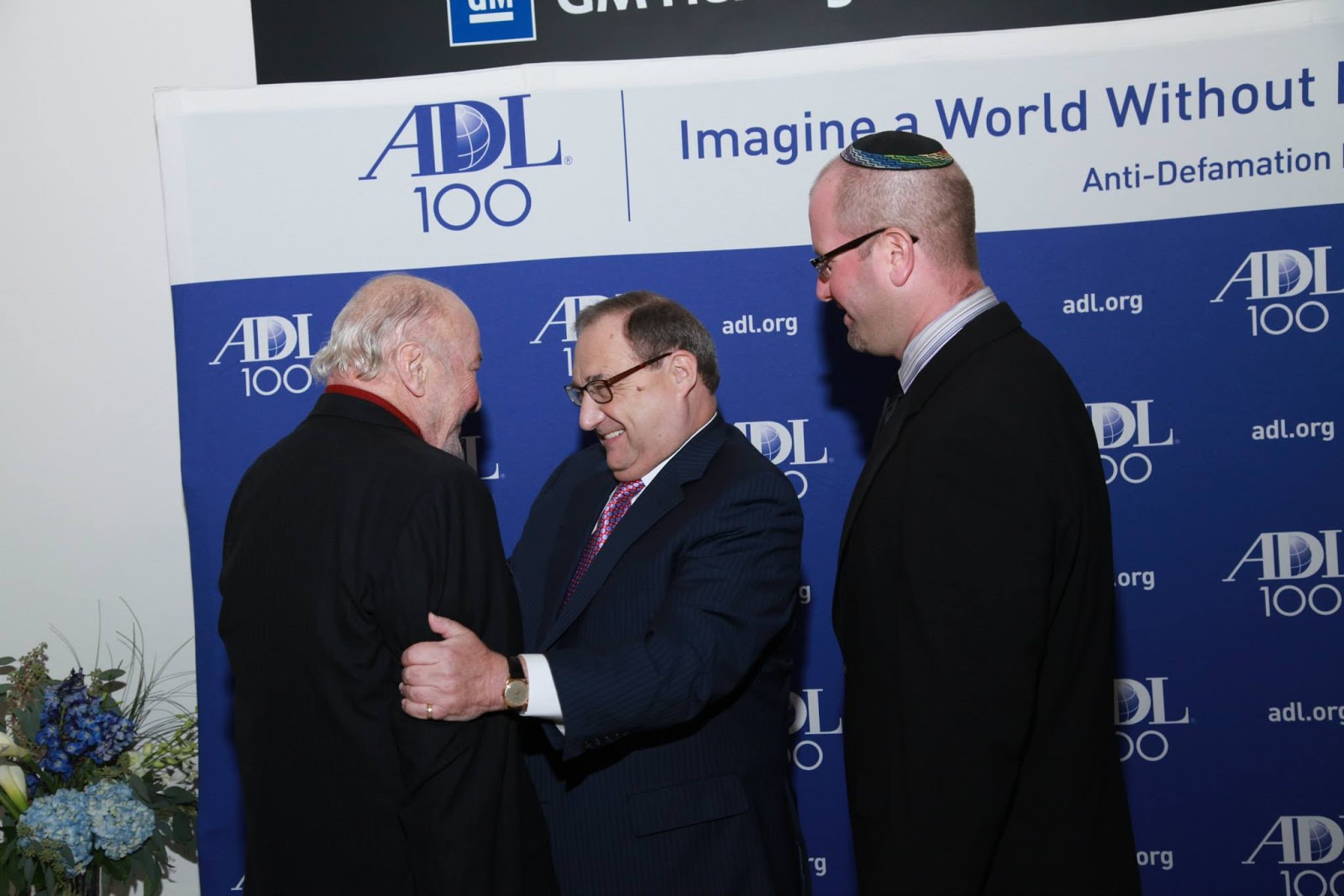
With Dick Lobenthal at the Anti-Defamation League's Centennial Celebration in 2013


I first met Dick Lobenthal at Michigan State University because he was the guy we called whenever there was anti-Semitism on campus or an anti-Israel speaker was coming. I got to know him very well in the summer of 1996 when Daniel Harold and I were his interns at the ADL office in Southfield. After that summer, I returned to MSU to discuss my summer "field experience" with my professor, Michael Schechter. He asked what I thought of my time at the ADL and I said something to the effect of, "This summer I had the honor to get to know a Living Legend."

Watching as Abe Foxman greets Richard Lobenthal at the ADL's Centennial Celebration in Detroit


The last time I saw Dick was when I took him out for lunch before his surgery. He seemed so brave about his prognosis and kept saying that he'd rather talk about me and my family. I honestly didn't think he'd live this long after the surgery, but it shows what a determined fighter he was. Dick's daughter, Lisabeth, asked me to share some stories about this great man at his funeral:

When the Detroit Jewish News emailed me yesterday and asked me to write Dick’s obituary for the paper, I did the normal thing. I went to the Jewish News archives online and did a search for Dick’s name. My eyes got about this big! Dick Lobenthal is mentioned in about 600 different issues of the Detroit Jewish News from the early 1960's to as recently as a couple years ago. Now, that’s pretty impressive considering it means that he’s mentioned in something like 10% of all issues printed during his time here in Metro Detroit.

Now, if you think that’s impressive, consider that, in addition to being quoted in articles – mostly about combating anti-Semitic attacks both locally and abroad – and the mentions about basic ADL business, the vast majority of those mentions are promoting Dick’s speaking engagements. In addition to the radio shows, the phone calls, the letter writing, the op-ed publishing, the advocacy work, the fundraising, the reading and research that he was doing, Dick Lobenthal was doing speaking engagements all the time. Those speaking engagements were not because Dick Lobenthal liked to hear himself talk. They were because he was teaching… he was an educator. He was teaching people to love, not hate. He was preaching tolerance and understanding. And he was indefatigable in this work. Our world, as we all know, is still a very fractured place, BUT, I truly believe the world is a BETTER place because of Dick Lobenthal and the godly work that he did.

In 2005, I invited Dick Lobenthal to speak to students at the University of Michigan Hillel

Two Stories:

It was my Freshman year at Michigan State. Admittedly, I was a naïve, Jewish kid from Metro Detroit who hadn’t been exposed to anything! I went to Hillel Day School, was active in a Synagogue Youth Group, went to Camp Tamarack, etc. Now, here I was an 18-year-old at MSU and now involved with the Jewish Student Union. It seemed like each week that Fall, another Nation of Islam representative, Israel-basher or Holocaust denier was coming to campus. Put simply, there was A LOT of “Hate on campus.” We college kids didn’t know what to do. Do we sit in silently in the audience to witness these speeches? Do we protest? Picket outside? Sit down in the crowd and wait for them to say something offensive and then get up and walk out?


Sunday, February 12, 2017

Raising the Bar for a Bar Mitzvah: Leadership, Questioning and Continuity

At the conclusion of the seven day mourning period in Judaism known as shivah, it is customary for the mourners to take a cathartic walk around the neighborhood as a symbolic return to the community. Many mourners have commented to me that this walk is a therapeutic way to clear their head and move from a state of mourning into the next phase of beginning to adjust to life without their loved one.

A week ago my family celebrated the milestone of my oldest child becoming a bar mitzvah. For our family, this was truly an event we anticipated for many years, if not from the moment he was born. Our son spent a year preparing himself to be able to chant beautifully from the Torah and Haftorah, lead the Shabbat morning services, and deliver a thoughtful and inspiring d'var Torah about the importance of being persistent as a leader. He was amazing and made us extremely proud of his accomplishments. For the entire week following his bar mitzvah, we were still reveling in the celebration.

bar mitzvah boy in synagogue with torah scroll


Yesterday, as Shabbat was in its final hours I asked if anyone in my home wanted to join me for a walk outdoors. The next thing I knew, my wife and I were joined by our three children for a brisk walk around the neighborhood for about an hour. It was the perfect way to reflect as a family on the past Shabbat, what joy we all felt as we celebrated this milestone with family and close friends, and a symbolic way to now come down from the clouds and return to reality. I pray that we should all experience such moments of extreme pride in our children's accomplishments and joyous celebrations for the future vitality of the Jewish people.

What follows is the sermon I delivered last Shabbat at my son's bar mitzvah:


Leadership, Questioning and Continuity
Parashat Bo

Together with my beautiful bride who stood with me under a chuppah on this very bimah almost eighteen years ago, I say zeh hayom asah Adonai, nagilah v'nishmecha bo. We are so grateful to God who has created this day and we will surely celebrate it with joy.

I must tell you that my intent was to just be a Dad this morning. After all, "Dad" is my favorite job! But when Rabbi Bergman asked if I'd like to deliver the sermon this morning, I was honored and decided that I would attempt to share some insights from our Torah portion that might convey just a fraction of the message I want to impart to my son. But make no mistake -- this is not me talking directly to my son. Rather, I hope you too will take to heart the three themes I share this morning. Three themes I believe convey a few lessons to us as parents.

But first a joke: A Jewish mother is with her son at the beach, a son of whom she is of course very proud as he recently passed his medical exams. Within minutes of entering the water for a swim he gets pulled under by a big wave and it's obvious he doesn't know how to swim.

Urgently, trying to get someone to come to her son's assistance, she screams, "HELP! HELP! My son the doctor is drowning!"


Thursday, June 23, 2016

Teaching Clergy to Exploit Social Media

This summer I went back to college. To be honest, it felt nothing like being on my own college campus -- Michigan State University, which is a large Big-Ten university on 5,200 sprawling acres with over 50,000 students. I spent a week at Kenyon College in rural Ohio; a 1,000 acre campus where less than 1,700 students study each year. Walking around Kenyon, I felt like I was on the campus of one of those fictional colleges in the movies, which makes sense since Kenyon alum Josh Radnor actually returned to his alma mater to film "Liberal Arts."

The reason for my one-week sojourn at Kenyon College in Gambier, Ohio was to serve as a faculty member of a new institute for clergy called Beyond Walls. The concept of this program, part of the Kenyon Institute, is that religious leaders are writing every day to their congregants in sermons, newsletters, legal decisions, and on social networks. Much of their writing is internal -- within their synagogue or church -- yet clergy of all faiths recognize that it is increasingly important to write outside of their institution’s walls among those who aren’t there for services, but are reading, thinking and caring about living a moral and spiritual life.

Kenyon College's Beyond Walls Writing Institute for Clergy
Teaching social media and blogging at Kenyon College's Beyond Walls Writing Institute for Clergy


The goal of the one-week writing intensive program was to teach dozens of rabbis, priests, ministers and other clergy members to be more expressive and authentic while writing skillfully in media as diverse as op-eds, blogs, personal essays and social media. When the director of the Kenyon Institute was looking for a religious leader who could teach clergy to be better writers when it comes to social media and blogs, Clal's Rabbi Brad Hirschfield, an adviser to the institute, recommended me for that role. I was honored to be part of the Beyond Walls faculty along with Rabbi Hirschfield and fellow Rabbis Without Borders alum Rabbi Rachel Barenblatt. Other faculty members included authors Rodger Kamenetz and Amy Frykholm, Rabbi Stephen Pearce, and Professor Richard Rosengarten. This coming summer, fellow Rabbis Without Borders alum Rabbi Rebecca Einstein Schorr will join me on faculty.

I spent my days at the institute lecturing spiritual leaders on the best practices for reaching a wider audience through social media and was intrigued by the vast range of experience. Some clergy were already using social networks and blogs to inspire thousands on a daily basis, while others were hesitant to use Facebook or Twitter to share their wisdom. Many of the participants were talented writers, who desperately wanted to start blogs to grow their reach, but the technology was a hindrance for them.

In teaching colleagues across the religious spectrum about the vital tools of social media and blogging, we all discovered new opportunities to engage our audience and impact more people within our own respective faith traditions and beyond with our religious insights. Personally, I also learned a great deal about other faiths, the modern challenges of their leadership, and new ways for these religious leaders to exploit 21st century communication models to teach, preach and inspire a new generation.

Thursday, April 21, 2016

Conservative Rabbis Are Missing an Opportunity with Kitniyot Ruling

Passover hasn't even begun, and I'm already frustrated with so much talk about food. Well, this year it's not hametz that is at the root of so many debates in the Jewish community, but rather kitniyot. Kitniyot is the Hebrew term for non-hametz food products like corn, rice, beans, and legumes, such as soybeans, peas, lentils, and peanuts that Ashkenazi Jews traditionally have not eaten on Passover for the past 700 years.

The Conservative Movement, of which I affiliate, announced a major change this past fall with regard to the permissibility of consuming kitniyot on Passover. Throughout the holiday, we are forbidden from eating (or even possessing) the five grains designated as hametz -- wheat, barley, spelt, oats, and rye. While Sephardic Jews have always eaten kitniyot, Ashkenazic Jews have regarded them in the category of forbidden Passover foods for a few reasons that don't make sense anymore. The recent teshuvah (responsum) approved by the Conservative Movement’s Committee on Jewish Law and Standards really isn't as monumental as it sounds, because in 1989 Conservative Rabbi David Golinkin, in Israel, essentially overturned the ban on kitniyot with his own teshuvah.

Conservative Movement of Judaism Approves Kitniyot on Passover
The Conservative Movement of Judaism has approved eating kitniyot (legumes) on Passover.


While there has been so much debate over the past several weeks on the issue of eating kitniyot, that is actually not my concern. With the crazy political nature of the kosher certification world, I'm actually cautious about expressing my own opinion on the kitniyot debate as it would have significant ramifications for the kosher certification agency I founded eight years ago. My concern is not whether we should be eating rice cakes with peanut butter and corn tortillas with refried beans on Pesach (Passover). My focus is on the nature of these debates taking place this spring in Conservative synagogues throughout North America.

Sunday, December 07, 2014

Are Rabbis Getting Trained In Entrepreneurship?

About a year ago, my teacher and friend Rabbi Hayim Herring asked me to submit a guest post for his blog about how well I think rabbinical school programs prepared us rabbis for the rabbinate and what was missing from that experience. I was honored he asked me to submit this essay, but too busy at the time to sit down and contemplate what was absent from my rabbinical school program.

Finally, I gave it some thought and realized that many of the "tasks" I perform today as a rabbi draw upon skills I honed during my years at the Jewish Theological Seminary, but others are what I attribute to having an entrepreneurial spirit. While I personally enjoyed a wonderful experience while a rabbinical student and feel indebted to my teachers for helping to shape me as a rabbi, I realized that entrepreneurship as a subject was not something I remember being part of the curriculum at the Seminary during my time there.

In fact, during my final year of rabbinical school at JTS (2003-2004) I served as president of the Rabbinical School Student Organization and found myself, together with faculty members, my peers, and the school's deans, on a committee to begin the process of reshaping the rabbinical school curriculum. My contribution to this process was in proposing to offer an option for rabbinical students to take a few classes at the business school down the street at Columbia University. The problem that we faced on that committee was that there were only so many courses to put into the rabbinical school curriculum along with the requisite fieldwork, rotations and internships. Further, the faculty members were all protective of their courses and their individual department's role within the curriculum.


Sunday, December 22, 2013

Edgar M. Bronfman Sr. - Jewish Philanthropy At Its Best

I awoke in the middle of the night last night unable to sleep. It was a little before 4:00 AM. I know what time it was because I looked on my phone since the power was out from the winter storm. Shockingly, I noticed from a few email messages, tweets and Facebook postings that the world lost a giant in the field of Jewish philanthropy.

I only had the opportunity to meet Edgar Bronfman, Sr. twice and both were for only fleeting moments. At a Hillel staff conference in New Jersey he seemed to enjoy walking the hotel shmoozing with Hillel staffers and thanking us for our work on campus. It was he who should have been thanked. In the middle of the night I read his very lengthy obituary in the New York Times. As long as this tribute was it still failed to mention so many of the causes he championed and the philanthropic efforts he backed with his family's fortune.


In October at The Conversation, Gary Rosenblatt's annual convening of Jewish leaders at the Pearlstone Retreat Center in Maryland, I ate lunch with Dana Raucher, the executive director of The Samuel Bronfman Foundation. I listened to Dana share her fondness for Edgar Bronfman, Sr. and articulate how genuine and authentic is his love for the Jewish people and the many causes he supports through his foundation. Upon his passing at his home yesterday on Shabbat, Dana publicly shared the following about her boss:

"Edgar was deeply committed to making Judaism relevant to all those who were seeking it. He sought to build a big tent, open for vigorous debate, impassioned questioning, and full of joy. He loved the energy and exuberance of young people, and took them quite seriously because he recognized that they would be the ones shaping their own Jewish future."


Monday, October 14, 2013

Case of Mistaken Identity for Good

In the past decade Google's email application Gmail has grown in popularity. With around half a billion active Gmail email accounts, it has become the free email provider of choice for most people. However, with such a popular email application like Gmail, one of the inherent problems is that of mistaken identity. That is, it is very easy to send an email to the wrong person and that can often have interesting results.

Such was the case recently with an invitation for a retreat for Jewish leaders. In 2005 Gary Rosenblatt, the editor and publisher of The Jewish Week, created an annual conference called The Conversation. Each year Gary invites some 50 participants (a cross-section of artists, rabbis, entrepreneurs, educators, philanthropists, activists and communal leaders) who converge on the Pearlstone Conference and Retreat Center outside of Baltimore, to discuss the issues of day in an Open Space forum.

Rabbi David Ingber of Romemu


Tuesday, December 04, 2012

Ford's New Jewish Leader

Originally published at JTA.org

It's no secret that Henry Ford was a notorious anti-Semite, and his company's dealings with the Nazi Party during the Holocaust are well documented. But the company's story has changed drastically in recent years.

The Ford family's donation of a rare 500-year-old Torah scroll to a suburban Detroit synagogue and the appointment of a Jewish chief operating officer demonstrate a marked shift in the company's narrative when it comes to the Jewish community.

Mark Fields became the first Jewish COO of Ford Motor Company on December 1


Friday, November 30, 2012

MSU Hillel: If You Build It

Like many rabbis I’m often asked why I chose to become a rabbi. People are interested to know if there was a pivotal moment in my upbringing that steered me to the rabbinate. In responding to that question I’ve always cited my years as a student leader at Michigan State University Hillel.

A few weekends ago I spent a memorable weekend in East Lansing my eldest child and attended Shabbat festivities at MSU Hillel. It was the first Shabbat I experienced on the MSU campus since my graduation from the university almost fifteen years ago. It proved to be a nostalgic weekend for me and one in which I truly gave thanks for the many gifts that MSU Hillel provided for me.

My son in front of the MSU Hillel building earlier this month.


Friday, July 13, 2012

D'var Torah: Prince Fielder, Inheritance & Fatherhood

I was emotionally moved as I watched Detroit Tigers' slugger Prince Fielder accept the 2012 Home Run Derby award on Monday night in Kansas City with his two adorable sons proudly standing next to him. But it also struck me as sad that Prince's father Cecil Fielder wasn't in that photo op as well.


I still remember back in 1990 when Cecil Fielder (a Detroit Tigers All-Star 1st baseman like his son is today) was the favorite to win the All-Star Game Home Run Derby. Competing against the likes of Jose Canseco, Mark McGwire and Ken Griffey, Jr., Cecil failed to hit even one homer in the contest that night. This week, Prince Fielder became the first player ever to win the Home Run Derby in both leagues (he won in 2009 as a Milwaukee Brewer too).

There's no question that Prince Fielder inherited the gift of hitting the long ball from his father. This week's Torah Portion, Parshat Pinchas, is all about inheritance and succession. Moses was an impressive leader of the Jewish people in the desert as they made their journey to Israel. This week, however, we learn that Moses will not lead the Israelites into the Promised Land. Although he has worked tirelessly to be a great leader and inspirational figure, his career will end before the reward of entering the land with his people.

Friday, June 29, 2012

Domestic Violence is Real (Chukat)

In this week’s parsha, Chukat, Moses is once again feeling the stress of leadership. Tired and quickly losing hope following the death of his sister Miriam, the Israelites complain to Moses that they would have rather died in Egypt. They go so far as to wish they had died a horrible death along with those punished for joining Korach’s rebellion. They grumble that they were happier during their slave years in Egypt, where at least they had certain assurances compared to their current nomadic experience. They protest that they have been brought to a wretched place with no good food to eat or water to drink.

Thursday, June 21, 2012

Korach Challenges the Leadership of Moses with a Tallit

This D'var Torah for Parashat Korach was published in the Detroit Jewish News:

The Tallit: A Reminder of Our Relationship With God

Hanging in the back of my closet is a beautiful tallit that was hand-woven in Ethiopia. This colorful prayer shawl was purchased by my grandmother several years ago when the renowned “Mitzvah Man” Danny Siegel visited Adat Shalom Synagogue. The tallit is waiting in my closet until my oldest son becomes a bar mitzvah and, God willing, my grandmother can present it to him as a gift.

Friday, January 20, 2012

Action More Than Words

In this week's Torah portion called Vaera, the Lord speaks to Moses, saying, “Go and tell Pharaoh King of Egypt to let the Israelites depart from his land.” However, Moses protests. He raises doubts that the people will listen to him. He uses a kal vachomer – the hermeneutical device often used by the rabbis in midrashic literature. Applying the outcome from a minor case to a major case, the formula is "If X, then all the more so Y." Moses says to God, “The Israelites [my own people] would not listen to me; how then should Pharaoh heed me, a man of impeded speech?” If his own people will not listen to him because of an inability to speak well, then how can God expect Pharaoh to listen to Moses’ demands?

This is not the first time that Moses appeals to God using his speech impediment as an excuse. In last week’s parsha, Moses claims Lo ish d’varim anokhi – “Please, O Lord, I have never been a man of words, either in times past or now that You have spoken to Your servant.” Ki khvad peh u’khvad lashon anokhi – “I am slow of speech and slow of tongue.”

God negotiates with Moses finally offering his brother Aaron as Moses’ mouthpiece to convey the message to the people. Yet Moses remains the central guiding figure standing at the helm of the Israelite nation. One not familiar with the rest of the Biblical Narrative might presume that Moses’ incompetence in public speaking would immediately disqualify him for the role of leader of the Israelites. Thus, regardless of how we understand Moses’ speech impediment or its negative effect on his self-confidence, we should consider the fact that the Jewish people’s leader par excellence was not an effective speaker. And it did not matter.

Moses says, “I am not a man of words.” So, how is he such a successful leader? He is a man of action. Moses says, “I am slow of speech.” What does he mean by this? He is a man of justice. He might have physical disabilities or limitations precluding him from eloquently conveying a message, but it does not deter him from demonstrating strong and charismatic leadership abilities in other ways. What Moses lacks in oratorical skill, he makes up for in his action, and in his pursuit of justice.


This past week our nation commemorated the life of Dr. Martin Luther King, Jr. on the anniversary of his birthday. Dr. King was one of humanity’s greatest orators. He could steer an audience’s emotions with his booming voice, with his carefully crafted words, with his memorable sound bites. And yet, it was his acts of social justice that ultimately made him the great leader that he was. Many of us have seen the famous photographs of Dr. King walking arm-in-arm with Rabbi Abraham Joshua Heschel at the march in Selma Alabama. Heschel famously commented that on that day, he was “praying with his feet.”

Letter from Dr. Martin Luther King, Jr. to Rabbi Seymour Siegel thanking
him for his honorary degree from the Jewish Theological Seminary on July 3, 1968

Equally moving was the time King and Heschel, two modern masters of words, walked together in silence to Arlington’s Tomb of the Unknown Soldier in protest of the war in Vietnam. They laid a wreath in pledge to lo yilmedu od milchama – that humankind would “no longer know war.” They certainly could have movingly expressed their feelings with words, but it was more powerful to resort to action. They let their actions do the speaking.

We should be curious as to why God does not perform a miracle and correct Moses’ speech impediment. After all, this is a God who only moments later causes miraculous plagues to triumph the Egyptians and opens the sea for our ancestors to cross. The answer must be that actions speak louder than words. Moses leads by example. He leads by doing.

This should become a powerful message of American Judaism. We have the moral imperative to strengthen our social action initiatives. We must apply Jewish ethics to contemporary issues pursuing social justice. From the words in our Tradition, tzedek tzedek tirdof (only justice shall you pursue), we must make it our ethical responsibility to make social action one of our highest priorities. Rabbi Shammai teaches in Pirkei Avot, “Say Little Do Much.” Not everyone is a great speaker. But that should not be a hindrance. Be a “doer.” You can change the world.

Sunday, September 18, 2011

Sheldon Yellen - CEO and Mensch

Yesterday morning, we heard the words from the Torah portion Ki Tavo, which included the blessing that God shall make us the head and not the tail. This blessing is often repeated on Rosh Hashanah Eve and some even have the head of a fish on their holiday dinner table as a reminder of this blessing. According to the Torah, it is good to be the head.

That’s not always the case in the business world however. CEOs may have been blessed to be the “head” and not the “tail,” but it oftentimes seems like more of a curse. Over the past decade we’ve seen many disgraced CEOs who are not good examples of doing what's right. We certainly wouldn't consider the corporate heads of Enron, Tyco, Adelphia or WorldCom to be role models for our children.

There are exceptions. There are CEOs who demonstrate strong leadership skills along with ethical behavior. Several years ago I gave a sermon about Aaron Feuerstein, the CEO of Maden Mills, who after his entire plant burned down spent millions of his own money to keep all of his 3,000 employees on the payroll with full benefits for 6 months. Feuerstein consistently did the right thing even when it was difficult and he was faced with significant challenges. He claimed his strong ethical behavior and sense of justice as a corporate head were due to his faith and Talmud education.

Photo courtesy of Belfor

There is another CEO, who like Feuerstein, is striving to be a mensch and give back to his community. Sheldon Yellen, the CEO of Belfor is not your typical CEO. Tonight he'll be at the Emmy Awards, where his episode of "Undercover Boss" is nominated for an Emmy. Sheldon went undercover in the CBS reality show “Undercover Boss” and received an education about how hard his employees work and how difficult it is for them to make ends meet. Yellen was so moved by all the lower-level employees he met that he eventually broke down and revealed himself as the CEO of the international disaster restoration company that is based in Michigan. The episode is up for an Emmy Award in the category of Outstanding Reality Program.

Yellen’s episode of “Undercover Boss” is a long shot to win an Emmy tonight against the other nominees including “Hoarders,” “Antiques Roadshow,” “Deadliest Catch,” Kathy Griffin’s show, and an episode of “MythBusters” guest starring President Obama. But while Yellen may not win an Emmy tonight, he is quite deserving of a mensch award.

In the episode of "Undercover Boss," Sheldon demonstrated strong moral character and was able to show his emotions on national TV. Sheldon learned a great deal about his employees, their passion for the job, and how hard they work to support their families. He came off as an inspirational leader and the episode proved to be an important lesson for the upcoming Jewish holidays. I’m not the only rabbi who noticed that Sheldon’s experience of going undercover is a lesson for all of us as we approach Rosh Hashanah and Yom Kippur.

Sheldon recently received a phone call from a Connecticut rabbi asking him to be the guest speaker at the community’s Selichot services this year. In his typical humble fashion, Sheldon couldn’t understand why the rabbi would want him to speak. However, he agreed and will be the featured speaker at Congregation Rodeph Sholom in Bridgeport this Saturday night. He’ll speak about his journey from a challenging childhood in Detroit to becoming a wealthy businessman and philanthropist. He'll also talk about system of values he draws on as a CEO.

Yellen and his three brothers were raised on Welfare by their mother in Detroit during the 1950s. Their father was a great person, but became sick and eventually developed an addiction to methadone after having nine stomach operations in the course of only two years. Growing up in an affluent Jewish community in which he and his brothers had to work from a very young age and with a father who was in prison (for dealing drugs) was difficult for Yellen. He told me that his mother didn’t have enough money to belong to a synagogue or send Sheldon to Hebrew School, but right before he turned thirteen she decided that it was important for him to have a bar mitzvah. An Orthodox synagogue agreed to let him have a bar mitzvah, but he didn’t have the Hebrew background. He was called to the Torah for his aliyah with the blessings transliterated in English on a piece of paper. The Orthodox men were expecting him to actually read from the Torah. It is a memory that has lasted with Yellen to this day.

In the past year Sheldon Yellen has made lasting contributions to his community. He bought a financially distressed private Jewish country club in order to keep its Jewish roots alive. He also funded a Toledo, Ohio-based yeshiva that had run out of living space for its young students. He was able to donate enough money so that the yeshiva could move into a new facility in suburban Detroit with enough room for both study and living quarters for its students. Yellen has also committed himself to Torah study at the local Detroit Kollel. The Jewish education he missed out on as a child is now one of his top priorities.

In addition to his philanthropy, Yellen has proved himself to be a very generous individual on a personal level. Recently, Michael Kenwood, a 39-year-old New Jersey volunteer EMT, was killed during Hurricane Irene while trying to save others’ lives. That hero's sister-in-law is Amy Margolis of Birmingham, Michigan. When Amy and her family were unable to get a flight to New Jersey for her relative’s funeral because of the hurricane, they had no choice but to get in the car and drive. She was already on the road making the Michigan-New Jersey trek when she received a call from Sheldon Yellen who offered to meet them on the road and escort them to the airport where they would board one of his two private jets.

Margolis was quoted in the Detroit Jewish News saying that Yellen’s act of kindness makes him a mensch and an angel. “I didn’t do anything anybody else wouldn’t have done,” Sheldon Yellen said.

In an era when CEOs don’t always do the right thing and often act immorally, it is refreshing to see Sheldon Yellen demonstrate that a CEO can also be a mensch and a role model. While he might not win an Emmy Award tonight, he certainly has made a positive difference in his own company and in his community. He’s made a fortune restoring properties, but Sheldon Yellen might just have enough integrity and generosity to restore the reputation of our nation’s disgraced CEOs.