Showing posts with label Electronics. Show all posts

Thursday, April 02, 2015

I Always Rave About Technology, But Here are Some Rants

Originally published in the Detroit Jewish News and on The Huffington Post

As part of a recent panel discussion I was asked how technology has improved our lives in general and made us more productive and efficient in particular. I gave my typical response to such a question, responding that the Internet has vastly made our lives better and provided us with a wealth of information at our fingertips that previous generations could not have imagined. I talked about the communication revolution and some of the technology innovations that I cannot believe we ever lived without like GPS, text messaging and Google Search, not to mention the ability to pause live television.

After giving this response I decided that it would only be fair to rattle off a few rants about technology in the 21st century as well. I'm always raving about the latest innovation so I figured I should also present the other side of the coin. I stopped myself after naming four negative characteristics about technology, but I realized I could keep going. So, here are my 10 rants about technology. Do you agree with these and what would you add to the list?

Technology Rants - Rabbi Jason Miller 2015

Friday, January 09, 2015

Rabbi Jonathan Frankel's Nucleus Intercom

A few months ago I had the opportunity to interview Rabbi Jonathan Frankel, an tech startup entrepreneur who was ordained as an Orthodox rabbi at Yeshiva University. I had heard about his wireless intercom invention for the home and was intrigued. Earlier this week at CES in Las Vegas I had a chance to meet Yonatan in person as he and his business partner Isaac Levy were exhibiting in Eureka Park, the area for technology startups at the Sands Convention Center at CES.

Rabbi Jason Miller with Isaac Levy and Rabbi Jonathan Frankel of Nucleus at CES 2015
With Isaac Levy and Jonathan Frankel of Nucleus at CES 2015


Looking at his doll house as an example of how the Nucleus intercom works I was able to see how he can sit in his third floor office at his home while watching and listening to his baby sleeping on the first floor and interact with his Philadelphia office. With some significant additional funding, 2015 should be a pivotal year for Nucleus and Frankel. This is the article I published in the Huffington Post and the Detroit Jewish News (Renaissance Media) about Nucleus:


Orthodox Rabbi Invents Home Intercom for 21st Century

Rabbi Jonathan Frankel had no problem getting through rabbinical school at Yeshiva University or law school at Harvard. It was keeping track of his three young sons that had him running around his house losing his mind. The tech-savvy Frankel, 30, would often find himself yelling at the top of his lungs to try and get his kids to come to the dinner table. On the way to his job, he’d be unable to communicate with his wife because he didn’t know where she was – and there was usually a baby crying to add to the commotion.

Having grown up in a house with an intercom, Frankel had a feeling that it would be the answer to his family’s communication problem. After graduating from law school, Frankel took a job with Boston Consulting Group and it was there that the idea for a 21st century intercom first came to him. He and his wife were moving into a newly renovated home and he began taking bids for intercom installation. He figured that before all of the drywall was installed would be the perfect time to have professionals set up the intercom system throughout the house.

Rabbi Jonathan Frankel of Nucleus
Jonathan Frankel, an ordained Orthodox rabbi, is the inventor of the Nucleus intercom


Wednesday, August 27, 2014

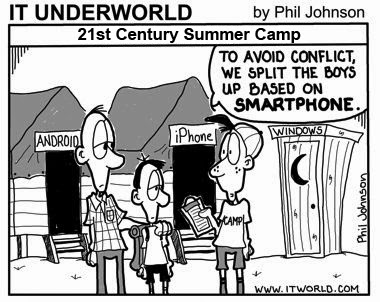
Technology and Electronics at Summer Camp: Will Policy Change?

School is back in session in many parts of the country and that means the summer camp season has come to a close. With each passing summer, I try to evaluate the role that technology plays at sleep-away camp. It seems that each year more summer camps institute "screen free policies" concerning the use of technology and electronics at camp, but other camps are gradually relaxing their policies (e.g., letting staff keep a cellphone in their pockets during the day, not checking for campers' Wi-Fi-enabled devices on trips out of camp, etc.). Last week I published the following piece on The Huffington Post's website about technology and summer camp. It has already generated a lot of discussion about appropriate use of technology at summer camp and what the future might look like.

Sitting with my wife by the lake in Northern Michigan at the beginning of the summer I listened as the director of our family camp, Camp Michigania, recited the rules for the week. "One final thing we ask everyone to abide by," he said to the assembled adults, "please keep your children from using any technology this week and try not to use your own cellphones and computers in public." I noted the irony that he had just read his annual list of policies and procedures from his iPhone.

Is it hypocrisy when a camp director asks campers to unplug while being tethered to his own smartphone? I contemplated this from my spot on the beach watching my kids kayak and paddleboard as I tapped away at my notebook computer, enjoying the gorgeous surroundings as I put the finishing touches on a blog entry.

I am a techie, but I am also an advocate for summer camp. I respect those who believe that our kids should leave anything that requires a rechargeable battery at home before getting on the bus to sleep away camp -- hard as that may be. But I also wonder if we're setting ourselves up for failure. Just how far into the future will we be able to continue banning communication devices from these children of the digital age?

Summer Camp and Electronics and Technology Policy

The argument against allowing these young campers to import their technology to camp is that they need a chance to unplug and to be fully present without any influences from the outside world. But those influences inevitably sneak into summer camps each year. Overnight camp counselors use the Internet after hours and on days off and then keep the campers abreast of what's happening in the world. Communiques in the form of one-way email messages, faxes and even hand-written letters from family members alert them to the goings on back home. Summer camp for our children is akin to a vacation for us, but aren't we all guilty of sneaking a peek at our email while on vacation? Is the expectation that our kids shouldn't have that ability a double standard?

Thursday, August 15, 2013

Silentium: Israeli Tech Startup Wants Silence

It’s no secret that Israel is the Silicon Valley of the Middle East. With thousands of tech companies and start-ups, Israel has become just as well-known as a center for technology innovation as it is for hummus.

Between two visits to Israel earlier this year, I made my annual pilgrimage to the Holy Land for techies – International CES (Consumer Electronics Show) in Las Vegas. Before heading out to the annual convention for “everything technology” I spent some time looking at the Israeli startups that would be exhibiting at the show. One particular company caught my eye, or rather my ear.

Like me, you have probably never heard of Israeli tech company Silentium before. But that will soon change. This company aims to fix something that many people didn’t even realize was a problem. Background noise. We often find ourselves talking loudly to someone standing right in front of us because we have become so used to the background noises of machines and electronics. We live in a very noisy world with a lot of noise pollution, but we’ve become accustomed to these hums and hisses.

Thursday, July 26, 2012

Technology vs. Shabbat: Can We Accommodate Our Electronics Dependency On the Day of Rest?

E-books became the dominant format for adult fiction in 2011 surpassing hardcover books and paperbacks according to the BookStats annual survey. We are increasingly choosing to read our novels, magazine, newspapers and even children’s books on e-readers and tablets. But is it permissible to do this on the one day of the week that Judaism commands us to unplug?

Rabbi Daniel Nevins, a Conservative rabbi who is the dean of the rabbinical school at the Jewish Theological Seminary in New York and the former rabbi of Adat Shalom Synagogue in Farmington Hills, recently published a *teshuva (religious response) regarding the use of electrical and electronic devices on the Shabbat.

In the teshuva, which was passed overwhelmingly by the Committee on Jewish Law and Standards (CJLS), Nevins ultimately ruled that while the operation of electrical circuits is not inherently forbidden according to the laws of Shabbat, the use of electricity to power an appliance which performs melacha (the category of forbidden activity on Shabbat) with the same mechanism and intent as the original manual labor is forbidden in the Torah. Nevins answered some questions about his research and how he arrived at his legal decision: