Monday, May 05, 2008

Max Fisher Highway

The Jewish Federation of Metropolitan Detroit building in Bloomfield Hills, Michigan is appropriately named for Max M. Fisher, the Jewish businessman and philanthropist who died in 2005. In addition to the Federation building, the home of the Detroit Symphony Orchestra ("The Max") and The Ohio State University's Fisher College of Business also bear his name.

Today, at a ceremony at the Fisher Building, Representative Joe Knollenberg dedicated a thirty-mile stretch of Telegraph Road as the "Max M. Fisher Memorial Highway". I happened to be walking into work at Tamarack Camps (located in the Fisher Building) when the dedication ceremony was beginning and I took the photograph below. This is really a wonderful way to honor such a philanthropic, remarkable man.

Max Fisher Highway

Thursday, April 17, 2008

Seder Sidekick

The guys at Bangitout.com (Seth and Isaac Galena) have published a Passover Seder Sidekick. It is 46 pages, contains many song parodies, and is available online at the Bangitout website.


One of my favorite Passover related videos on YouTube is an instructional video in Japanese teaching how to cut a matzah perfectly in half. Check it out:


Of course, there's also the creative JibJab "Matzah" video created by Smooth-E (Eric Schwartz). And I would be remiss if I didn't recommend the cute video of Rabbi Paul Freedman and his wife Nina rapping from their Jerusalem apartment about Passover to the tune of Snoop Dogg's "Gin 'n Juice".

Wishing everyone a chag sameach - a joyous Passover holiday!

Tuesday, April 15, 2008

Top Rabbis & Ketuba Witnesses

Newsweek's second annual ranking of the top rabbis in the country has been posted to the Newsweek website. This year, the list is called "Top fifty influential rabbis in America" and the creators (media execs Michael Lynton, Gary Ginsberg, and Jay Sanderson) explain their point system (20 points for being "known," 10 points for communal leadership, and so on). They also have created a second listing of the top pulpit (congregational) rabbis in the country.

I was thrilled to see my extremely talented classmate, Rabbi Rachel Nussbaum, make that list. She is the founder and rabbi of Kavana in Seattle. It is also wonderful to see that my colleague, Rabbi Sharon Brous, made both lists. She is the founding rabbi of Ikar in Los Angeles.

Of course, Rabbi David Wolpe of Sinai Temple in LA was ranked the #1 pulpit rabbi in the country and deservingly so. Rabbi Jack Moline, a Conservative rabbi in Alexandria, Virginia, was listed at #3. I've always admired Jack and am happy that he was recognized by being ranked so high on the list. I first met Jack in 1999 when I spoke at his congregation, Agudas Achim, for a Seminary Shabbat.

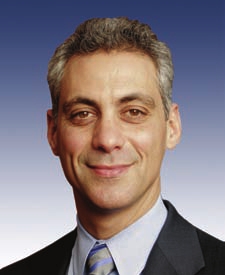
I recall a funny story Jack Moline told me about his first experience meeting President Bill Clinton. Jack visited the White House weekly to study Torah with his friend and congregant Rahm Emanuel (left), the Illinois Congressman. Emanuel, then senior advisor to President Clinton, had an office in the West Wing. Jack always went to the White House with Kosher corned beef sandwiches for Emanuel and him to enjoy. He was also always prepared to stand at a moment's notice and greet the President with the traditional Jewish blessing one says upon meeting a head of state. One day during a Moline-Emanuel chavruta session, the President walked into Rahm Emanuel's office to chat about a basketball game when Jack jumped up with a mouth full of corned beef trying to utter the blessing.

That story came to mind the other day when I read an article about Rep. Rahm Emanuel in Newsweek magazine. The article theorized that Emanuel ("Rahmbo") might be the most likely Democratic Party leader to be the one to encourage Hillary Clinton to drop out of the race should Barack Obama continue to be the front runner. Why Emanuel? Because, the article explains, he is close to the Clintons from his years campaining for them and serving in the Clinton White House. And he is close to the Obama campaign as well based on his long standing friendship with Obama's campaign strategist, David Axelrod.

How close is Emanuel with Axelrod? "So close," Newsweek states, "that Axelrod signed the ketuba, a Jewish marriage contract, at Emanuel's wedding, an honor that usually goes to a best friend."

So there you have it: Newsweek magazine... ranking rabbis and outing politicos as ketuba witnesses!

Tuesday, April 01, 2008

Kippah Krazy

Lisa Flam, an Associated Press Writer, has brought fashionable kippah wearing to the fore with her recent article "Yarmulkes for the Fashionable Faithful".

In an article that could appear in a fashion magazine as much as it could in a religious publication, Flam explains that more stylish and offbeat options abound in addition to your grandfather's black satin yarmulke.

The yarmulke as it's known in Yiddish, or kippa in Hebrew, is a headcovering "worn as a sign of respect to remind one always that God's presence is over us and as a sign of respect whenever we say a blessing," says Rabbi Joel Meyers, a leader of the Rabbinical Assembly, which represents rabbis in the Conservative Jewish movement.

While the skullcap is among the most recognizable Jewish symbols, it is not sacred, which makes it acceptable to adorn it with sports logos or TV characters, says Meyers, who usually wears a knitted yarmulke.

"The important thing is the wearing of the kippa, not what's on the kippa," Meyers said, recalling one given to him with a propeller he thinks signifies "spiritual uplift."

Proving that there has been a move to more stylish Jewish headcoverings, the presumptive Republican presidential nominee Senator John McCain last week sported a knit kippah at the Kotel (Western Wall) in Jerusalem. Compared to President Bush's choice of skullcaps, McCain's choice seems more modern and stylish. Perhaps that is attibutable to his loyal advisor and supporter (and Vice Presidential hopeful?) Senator Joe Lieberman.

I have always enjoyed seeing celebrities don a yarmulke (especially non-Jewish celebrities like athletes and politicians). The first yarmulke I ever gave to a celebrity was in 1999 on the set of his movie "Little Nicky" when I presented Adam Sandler with a blue suede kippah with the Jewish Theological Seminary logo printed on it.

I know I'm not the only one who enjoys seeing celebrities wearing yarmulkes, since, on their BangItOut website, brothers Seth and Isaac Galena have created an entire category of photographs called "Celebrity Kippah".

The AP article described kippot featuring Dora the Explorer, the Miami Heat logo, and guitars. It also reported about a Jewish man who "has a blue seersucker yarmulke to match a blazer he likes to wear to Friday services." Of course, no matter how fun and creative yarmulkes get, there will always be those who prefer the "retro kippah" from a bygone era.

Wednesday, March 19, 2008

New Purim Tradition

Tomorrow night begins Purim, a holiday on which the Jewish people celebrate our survival and rejoice that our ancestors were redeemed from the evil tyrant Haman. It is also a holiday on which we are commanded to share our good fortune with those in need. The mitzvah of sending gifts to the poor is based on Megillat Esther 9:22.

As Lois Goldrich explains the importance of matanot l'evyonim (gifts to the poor) on the United Synagogue of Conservative Judaism website:
Gifts can be given directly, e.g., bringing food and clothing to a homeless shelter, or indirectly, through an organized charity. It is important to keep in mind that whatever additional tzedakah we give throughout the year, donations must still be given on Purim itself. How important is this mitzvah? As Maimonides writes in his Mishneh Torah (Hilkhot Megillah 2:17): "It is better for a person to increase gifts to the poor than to increase his feast or the mishloah manot to his neighbors. There is no joy greater or more rewarding than to gladden the heart of the poor, orphans, widows, and strangers. For by gladdening the hearts of the downtrodden, we are following the example of the Divine."

Rabbi Menachem Creditor has shared a new Purim tradition that he learned from his teacher Marcia Brooks. She encourages people to bring boxes of Kosher pasta to synagogue to use as graggers (noise makers); shaking them for noise and then donating them to a food pantry once the Megillah is completed. With this new tradition, one fulfills the custom of drowning out the name of "Haman" from the Megillah reading while also performing the mitzvah of matanot l'evyonim.

And in my opinion, shaking a box of pasta is much safer than using those dangerous metal graggers that get rusty and sharp and can cut your finger!

Tuesday, February 26, 2008

Spielberg and the Olympics

Rabbi Or RoseNext Monday evening I am bringing my colleague Rabbi Or N. Rose (left) to Detroit to speak to Conservative Jewish teens about the important subjects of Tikkun Olam (social action) and Tzedek (justice). Rabbi Rose is the co-editor of "Righteous Indignation: A Jewish Call for Justice," which was recently published by Jewish Lights. He is also the associate dean of the Hebrew College rabbinical school.

Rabbi Or Rose's article published today at JTA.org about Steven Spielberg's resignation as the artistic director of the 2008 Beijing Olympic Games brings to light the necessity of persuading Summer Olympics host China to reconsider its support of Sudan.

Steven Spielberg JewishSpielberg wrote: "I find that my conscience will not allow me to continue with business as usual... At this point, my time and energy must be spent not on Olympic ceremonies, but on doing all I can to help bring an end to the unspeakable crimes against humanity that continue to be committed in Darfur. Sudan's government bears the bulk of the responsibility for these ongoing crimes but the international community, particularly China, should be doing more to end the continuing human suffering there."

In his essay, Rabbi Rose opines:

Ironically, the theme for the Summer Games is "One World, One Dream." Does this dream include the nightmares of the people of western Sudan? As an American citizen, I would like to see President Bush demonstrate some of the courage and resolve exemplified by the celebrity activists, using his power to try to persuade China to change its behavior. If China does not cooperate, the president should reconsider his plans to attend the Olympics.

In so doing, Bush could rededicate himself to the cause. His record on Darfur is inconsistent at best, and he has done nothing constructive since pledging, ever so briefly, to tackle the issue in his January State of the Union address. What better way for a president to spend his last months in office than to help bring an end to the first genocide of the 21st century? In a culture where celebrities often gain attention for their poor judgment and bad behavior, Spielberg, [Mia] Farrow and the other high-profile activists – they include Don Cheadle and George Clooney -- should be applauded for their justice efforts. Now we must join them in the struggle to save Darfur and to create a permanent anti-genocide movement.

Kudos to Steven Spielberg for doing the right thing by resigning this post. Hopefully his public act will put added pressure on the White House to persuade the Olympic hosts to change their tune on Darfur. And thanks to Or Rose for bringing this issue to a larger audience. With his essay, he certainly does demand a Jewish call for justice.

Wednesday, February 13, 2008

Israel's Sushi Strike

According to a Reuter's article, Israel's Asian restaurants went on a one-day spring roll strike Tuesday to protest the Knesset's new plan to rid their kitchens of foreign chefs. "The restaurants are angry at government plans to purge Japanese, Chinese and Thai eateries of Asian cooks and replace them with Israelis as part of a broader program to cut the number of foreigners working in the Jewish state... Israel attracts virtually no immigrants from Asia since anyone seeking citizenship here must prove they have Jewish family or links to the country."

The restaurant owners threatened that sushi and noodles would be the next items off the menu. I would think they would strike hard and "86" the sushi in the beginning since it has become so popular in Israel. But apparently they thought it was best to go with the egg rolls first.

Personally, I think they should have taken soup off the menu just so every Asian waiter throughout Israel could say "No soup for you!"

Hopefully, a deal will be struck before Israel becomes sushi-free. Jews and Asians should be able to co-exist peacefully. There might be hope because a restaurant once existed in suburban Detroit during the 1980's called "Shanghai Shapiro's," which was half Chinese and half Jewish deli. But then of course, that restaurant did close its doors.

Monday, February 11, 2008

Rabbinical Assembly Speakers

Last month I blogged about Rep. Tom Lantos, the only Holocaust survivor ever elected to Congress, when he announced his retirement as a result of his being diagnosed with cancer of the esophagus. Tom Lantos passed away this morning in Bethesda naval hospital. He was 80-years-old. I feel fortunate to have had the chance to meet Rep. Lantos this past March at the AIPAC Policy Conference in D.C.

Tom LantosTom Lantos was a real mentsch and an important voice for human rights in Congress, even if he would never have been allowed to speak at a Rabbinical Assembly convention. Since Tom Lantos was married to a non-Jewish woman (in photo), he would have been forbidden from addressing the Rabbinical Assembly during its annual convention. As a dues-paying member of the Conservative Movement's Rabbinical Assembly, I was surprised this week to learn of this policy.

A JTA article explains the little known RA policy prohibiting intermarried Jews from being speakers at the RA Convention. Therefore, the article states, it was difficult for the RA to maintain a balance between speakers on the right and left of the political aisle at this week's convention in D.C. So, while Supreme Court Chief Justice John Roberts is speaking at the Convention, Supreme Court Justice Stephen Breyer (married to a non-Jew) will not be allowed to. The policy even applies to non-Jews who have married Jews making Democratic Party Chair Howard Dean and Senate Majority Leader Harry Reid ineligible. Each of these men are married to Jewish women (to be fair, Reid's wife converted from Judaism to Mormonism so I'm not sure why he's still blacklisted).

I can understand the RA choosing not to invite intermarried speakers to address the Convention if they are only going to promote intermarriage as a virtuous decision, but I don't believe that choice has to be crafted into a written policy. I wonder if the RA asks all speakers at the Convention to disclose the religion of their spouse when they are invited to speak.

This policy would preclude a lot of politicians, business leaders, authors, and entertainers from speaking at RA conventions. For instance, Christina Aguilera would not be able to perform at an RA Convention (I'd pay to see that!) or speak about what it is like raising her son in the Jewish tradition (married to the Jewish Jordan Bratman, the couple's son recently had his bris). This policy would also prohibit Jon Stewart from speaking at the RA Convention since he married Tracey McShane, a non-Jewish woman.

As the Conservative Movement tries to reach out to interfaith families through edud (insiration and encouragement), it would be helpful for Conservative rabbis to hear from couples who are living in interfaith relationships. However, under this policy it would be impossible for speakers like Jim Keen, an outspoken gentile father committed to raising Jewish children, to be allowed to speak at an RA convention.

Rabbi Bradley Artson, dean of the Ziegler rabbinical school in Los Angeles, said "It's the right priority, but the policy isn't the right policy for the goal."

My sense is that this policy will soon be reversed. It is possible for the Rabbinical Assembly and Conservative Judaism to stand firmly against intermarriage without barring speakers who happen to be married to members of another religion.

Sunday, February 10, 2008

eCamp Israel

I recently learned about a new program that merges three areas I am passionate about --Jewish camping, Israel, and technology. Israel has always embraced high technology and modern communication. Part of what has made the almost sixty-year-old nation's economy flourish in the past two decades has been the success of its hi-tech sector. Now a new summer camping initiative is making the hi-tech experience available to Jewish youth who are interested in spending a summer in Israel and also interested in technology.

eCamp Israel is a technology summer camp based in Israel and open to American Jewish youth. As a member of the rabbinic cabinet of United Synagogue of Conservative Judaism's Project Reconnect, I was asked to look into the feasibility of including eCamp Israel as one of United Synagogue Youth's summer options in Israel. USY sends hundreds of teens to Israel each summer, and this program would allow some of those teens to specialize in a hi-tech track while in Israel.

I am very impressed with this new program. eCamp's mission is to "help young people realize their highest potential, discover their talents, and reach for their dreams". Their cutting-edge e-workshops will allow each individual camper to express their creativity, and the youth participants will work on their own projects in a collaborative environment (open-space computer lab).

eCamp, located in a residential educational institution near Caesarea, will not be a "computer camp" where kids sit in front of a computer all day. Rather, the camp will encourage the campers to go outdoors to do the normal summer camp activities like sports, swimming, and nature exploration. The camp will motivate campers to create a better world through the Jewish value of Tikkun Olam (repairing the world) with each camper receiving a certificate for 5 hours of community service per session.

eCampers will meet with entrepreneurs including the founder of ICQ, now the originator behind the AOL Instant Messenger, visit leading Israeli research centers such as Intel, Microsoft, Google, Motorola, and train in the Israeli Air Force’s flight simulator. Participants will have experience theoretical developments by visiting leading academic centers such as the Technion and Weizmann Institute. Shai Agassi, a hero in Israel’s technology world and the founder of Project Better Place, will be eCamp’s Chief Scientist. When I spoke with Nir Kouris, co-CEO of ecamp and an Israeli entrepreneur, he explained that "As one of the global centers of technological innovation, it is time Israel gives back some of our know-how and share it with children from around the world."

The idea of an International Technology Summer Camp in Israel is brilliant. Jewish youth already flock to Israel in droves each summer and many of them have to put their technology interests on hold during that time. So, while most Jewish youth won't be able to use Instant Messenger while they travel in Israel this summer, the campers at eCamp Israel will be introduced to the hi-tech gurus who developed the infrastructure to run Instant Messenger. This program will open the gates for Jewish youth to the #1 success story of Israel – Technology Innovation.

eCamp is just one more piece of great news in the world of Jewish camping. Recently, the Jim Joseph Foundation and Foundation for Jewish Camping announced a $8.4 million partnership grant to create a Specialty Camping Incubator. The Incubator will create four Jewish specialty camps based on skills such as athletics, computers, and arts according to the successful model already established for Jewish camping.

It is truly remarkable to see the innovations taking place in the field of Jewish camping. It makes me want to be a kid again!

Friday, February 01, 2008

Mitzvah Children

There was a time when the Conservative Movement's law committee (the Committee on Jewish Law and Standards) did not publish its teshuvot (Jewish legal responsa). Twenty-five Conservative rabbis would sit in a room debating and eventually voting on matters of modern Jewish law, and the only people who would be able to read their decisions were other Conservative rabbis.

Today, the teshuvot of the law committee are available for public consumption on the Rabbinical Assembly's website. So when the CJLS passes what could be considered a controversial paper, one would think there would be much discussion about it. (Certainly no CJLS decision has garnered as much attention as the December 2006 teshuvot concerning homosexuality.)

However, a recent teshuva on a delicate matter co-authored by Rabbi Kassel Abelson and Rabbi Elliot Dorff, and passed by an overwhelming majority of the committee, has received little attention. The paper, titled "Mitzvah Children," was passed on December 12, 2007 and until today I had not seen any articles published about it.

The essense of Rabbis Abelson and Dorff's argument is that Jewish couples who are able to reproduce more than two children should do so, and Conservative rabbis should counsel couples in this manner during pre-maritial sessions.

In yesterday's Jerusalem Post, Rabbi Reuven Hammer (a CJLS member who voted in favor of the teshuva) wrote:

How many children should a Jewish couple have? Although that may seem like a strange question and one that impinges on the private and most intimate life of a couple, it has been addressed by Jewish law in the past and is now the subject of a new teshuva (responsum) issued recently by the Committee on Jewish Law and Standards of the International Rabbinical Assembly of which I am pleased to be a member. Jewish law (Halacha) has dealt with this because the very first mitzva found in the Torah is: "And God blessed them; and God said to them, 'Be fruitful and multiply and fill the earth and replenish it...'" (Genesis 1:28). It should be noted that this is not phrased in the Torah as a command in a negative sense and certainly not as a punishment, but as a blessing. To understand how to fulfill this mitzva the sages discussed and debated it. Who is responsible to fulfill it? How many children and of what sex are required? Without going into details, suffice it to say that the traditional answer has been that the mitzva is fulfilled when a couple has had two children, one boy and one girl. The Talmud, however, determined that two children are the minimum, but that Jews should continue to have as many children as they can (B. Yevamot 62b), and Maimonides codified this as law.

Even though the authors of the "Mitzvah Children" paper did a very good job explaining their position while remaining sensitive to those couples unable to reproduce or unable to reproduce beyond one or two children, many will still take exception to rabbis imparting their beliefs on such a personal matter (even though the Torah and Jewish law codes certainly enter this arena).

Rabbis Abelson and Dorff propose that Jewish couples who can have children and do not suffer from specific physical, mental or other problems preventing it should have one or more additional children beyond the two required by Jewish law. These children would be called "mitzvah children" as they would assure future Jewish existence.

Rabbi Elliot Dorff (right), rector of the American Jewish University in Los Angeles, has been preaching this idea for many years. During my second year of rabbinical school he was on faculty at the Jewish Theological Seminary and spoke to my class about his views. While he was sensitive with his language, he nevertheless offended several of my classmates -- specifically the single women over a certain age -- when he argued that Jewish couples should start having children in their early 20's and have more than just two offspring. As he does in the teshuva, Rabbi Dorff surmised that it was the responsibilty of the Jewish grandparents (as well as the larger Jewish community) to help financially support these children and their Jewish education. His theory was that Jewish women are putting off starting a family until after their prime childbearing years because of their desire to fulfill their academic and professional aspirations first.

The Holocaust also factors into his belief. As he writes in the teshuva:


The world's Jewish community has not recovered numerically from the devastating losses during the Nazi era. Demographic studies point to a Jewish birthrate that will not maintain the Jewish population in the United States, with serious implications for the future of the American Jewish community, the Jewish people as a whole, and Judaism itself. It is essential that we encourage fertile Jewish couples to have at least two children in compliance with the early Halacha, and one or more additional children, who are mitzva children in the additional sense that they help the Jewish people replace those lost in the Holocaust and maintain our numbers now. Adopting children, converting them to Judaism, if necessary, and raising them as Jews helps in this effort as well.

This all makes good sense to me, but I maintain that the reaction will be mixed among Jewish couples. Everyone cares about the future vitality of the Jewish people, but among modern Jews I believe the response will be that rabbis should stay out of the personal family planning decisions of couples. And for that reason, the "Mitzvah Children" teshuva is a gutsy position paper.